


 Home
Home
Hi, I'd like to ask—is KCl a gas at high temperatures? What is the melting and boiling point of KCl? How does the ionic bonding in KCl affect its phase change at high temperatures? Compared to covalent compounds, why does KCl have a higher boiling point? Thanks!
Does KCl Become a Gas at High Temperatures and What Determines Its Phase?
Related Encyclopedia
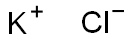
- 7447-40-7
- KCl
- 74.55
- All (273)
- China (27)
- (273)
- 65399-21-5
- C10H10O2S
- 194.25000
- All (0)
- China (0)
- (0)
- 20582-71-2
- Cl4HgK-
- 381.49000
- All (0)
- China (0)
- (0)

- 25443-63-4
- Cl6K3Ru
- 431.08
- All (0)
- China (0)
- (0)
- 15707-74-1
- Cl4KNbO
- 289.81600
- All (0)
- China (0)
- (0)
- 65567-96-6
- Cl2KLi
- 116.95
- All (0)
- China (0)
- (0)
- 1296149-08-0
- C6H15ClKNO9S
- 351.79
- All (1)
- China (1)
- (1)
- 84086-46-4
- CCl4KOPt
- 403.99800
- All (0)
- China (0)
- (0)
- 63889-66-7
- C12H24ClKO6
- 338.86700
- All (0)
- China (0)
- (0)
- 86750-87-0
- C4H5ClKMo2O8
- 447.54900
- All (0)
- China (0)
- (0)
Related Products More >

- 7447-40-9
- CNY Request For Quotation
- 7447-40-8
- CNY Request For Quotation
- 7447-40-7
- CNY Request For Quotation
- 7447-40-7
- CNY 25.0000
- 25kg
- 7784-24-9
- Request For Quotation
- 7447-40-7
- Request For Quotation
- 25
- 7447-40-7
- Request For Quotation
- 25kg/ Drum
- 7447-40-7
- Request For Quotation
- 25kg/drum, customized


KCl is not a gas at ordinary temperatures and pressures. In fact, at room temperature (around 25°C), it exists as a solid, white crystalline substance. This is because of the strong forces holding its constituent ions together. To determine whether it can become a gas, we need to look at its melting and boiling points. The melting point of KCl is approximately 770°C. At this temperature, the solid KCl begins to absorb enough energy to break the regular arrangement of its ions within the crystal lattice. The strong electrostatic forces between the positively charged potassium ions and the negatively charged chloride ions, which hold them in a fixed position in the solid state, start to weaken. As heat is continuously supplied and the temperature reaches the melting point, the ions gain enough kinetic energy to move more freely, and the substance transitions from a solid to a liquid state.
However, for KCl to become a gas, the temperature must be raised even further to its boiling point, which is around 1420°C. Boiling is the process by which a liquid turns into a gas, and it requires an even greater amount of energy compared to melting. At the boiling point, the kinetic energy of the ions in the liquid KCl is sufficient to overcome the remaining attractive forces between them completely. The ions are then able to escape from the liquid phase and enter the gas phase, where they move independently of each other in all directions, filling the available space. So, KCl is only a gas when the temperature exceeds 1420°C; below this temperature, it remains either a solid (up to 770°C) or a liquid (between 770°C and 1420°C).
The ionic bonding in KCl plays a crucial role in its phase changes at high temperatures. Ionic bonds are formed due to the transfer of electrons from one atom to another, resulting in the creation of positively and negatively charged ions. In the case of KCl, potassium, which has one valence electron, donates this electron to chlorine, which needs one electron to complete its outer shell. This transfer leads to the formation of K⁺ and Cl⁻ ions. These ions are then held together by strong electrostatic attractions, creating a highly stable crystal structure.
When heat is applied to KCl, the energy is used to disrupt these ionic bonds. During melting, the heat energy increases the vibrational motion of the ions within the crystal lattice. As the temperature rises, the vibrations become more intense until the ions can break free from their fixed positions and flow as a liquid. For boiling, an even larger amount of energy is required to separate the ions completely and convert the liquid into a gas. The high melting and boiling points of KCl are a direct consequence of the strength of these ionic bonds. The greater the bond strength, the more energy is needed to break the bonds and cause a phase change.
When compared to covalent compounds, KCl has a significantly higher boiling point. Covalent compounds are formed by the sharing of electrons between atoms, resulting in the creation of molecules. The forces between these molecules, such as van der Waals forces and hydrogen bonds (in some cases), are generally much weaker than the ionic bonds in KCl. For example, consider methane (CH₄), a simple covalent compound. The carbon and hydrogen atoms in methane share electrons to form covalent bonds within the molecule, but the forces between individual methane molecules are only weak van der Waals forces. As a result, methane has a very low boiling point of -161.5°C. Even in covalent compounds with stronger intermolecular forces, such as water (H₂O), which has hydrogen bonds between its molecules, the boiling point is 100°C, still much lower than that of KCl.
The reason for the difference in boiling points lies in the nature of the forces holding the particles together. In ionic compounds like KCl, the strong electrostatic attractions between ions require a large amount of energy to overcome. In contrast, the intermolecular forces in covalent compounds are much weaker, and less energy is needed to separate the molecules and convert the substance from a liquid to a gas. This fundamental difference in the strength of the forces between particles is what gives ionic compounds like KCl their high melting and boiling points relative to most covalent compounds.
In industrial and laboratory settings, knowledge of KCl's phase - change behavior is important. For instance, in certain chemical processes that involve high - temperature reactions, understanding whether KCl will be in a solid, liquid, or gas state at a particular temperature helps in designing the reaction vessels and predicting the outcome of the reactions. Also, in the field of materials science, the study of KCl's behavior at high temperatures can provide insights into the properties of other ionic compounds and their potential applications.
The melting point of KCl is around 770°C. This is the temperature at which the solid form of KCl begins to transition into a liquid state. When heat is applied to solid KCl, the thermal energy starts to disrupt the orderly arrangement of potassium cations (K⁺) and chloride anions (Cl⁻) in the crystal lattice. As the temperature rises towards the melting point, the ions gain enough kinetic energy to vibrate more vigorously within their lattice positions. Once the temperature reaches 770°C, the energy is sufficient to break the initial ionic bonds that hold the ions in a fixed, rigid structure, allowing the ions to move more freely, and the substance melts.
The boiling point of KCl is approximately 1420°C. After melting, as the temperature of liquid KCl continues to increase, more energy is supplied to the system. At the boiling point, the energy is enough to completely overcome the remaining intermolecular forces between the ions in the liquid state. In the liquid phase, although the ionic bonds are partially disrupted compared to the solid state, there are still strong electrostatic attractions between the K⁺ and Cl⁻ ions. As the temperature climbs to 1420°C, these forces are finally overpowered, and the liquid KCl transforms into a gaseous state. So, indeed, KCl can exist as a gas when the temperature exceeds its boiling point, but such high temperatures are far beyond what is encountered in everyday circumstances.
The ionic bonding in KCl has a profound impact on its phase changes at high temperatures. Ionic bonds are formed due to the strong electrostatic attraction between oppositely charged ions. In the case of KCl, potassium, a metal from Group 1 of the periodic table, readily donates its single valence electron to chlorine, a non - metal from Group 17. This results in the formation of K⁺ and Cl⁻ ions. These ions are then arranged in a three - dimensional lattice structure in the solid state, with each K⁺ ion surrounded by multiple Cl⁻ ions and vice versa.
To cause a phase change, whether from solid to liquid (melting) or from liquid to gas (boiling), a significant amount of energy is required to break these strong ionic bonds. During melting, the energy is used to loosen the ions from their fixed lattice positions, but the ions still remain in close proximity within the liquid. When it comes to boiling, an even greater amount of energy is needed to separate the ions completely so that they can exist as individual gaseous species. The strength of the ionic bond in KCl means that a large input of heat energy is necessary to achieve these phase transitions, which is why KCl has relatively high melting and boiling points.
When comparing KCl to covalent compounds, the reason for KCl's higher boiling point lies in the nature of the forces holding the particles together. Covalent compounds are formed by the sharing of electrons between atoms. The intermolecular forces in covalent compounds, such as van der Waals forces and, in some cases, hydrogen bonding, are much weaker than ionic bonds. For example, consider methane (CH₄), a simple covalent compound. The forces between methane molecules are primarily weak London dispersion forces. These forces are due to temporary dipoles created by the uneven distribution of electrons in the molecules. To vaporize methane, only these weak forces need to be overcome, which requires relatively little energy, resulting in a low boiling point of -161.5°C.
Even covalent compounds with stronger intermolecular forces, like water (H₂O), which has hydrogen bonding, have boiling points that are much lower than that of KCl. Hydrogen bonding is an intermolecular force that occurs when a hydrogen atom is bonded to a highly electronegative atom (such as oxygen, nitrogen, or fluorine) and is attracted to another electronegative atom in a neighboring molecule. While hydrogen bonding is stronger than other van der Waals forces, it is still significantly weaker than the ionic bond in KCl. The boiling point of water is 100°C, which is far below the 1420°C boiling point of KCl. In essence, the boiling of KCl involves breaking strong chemical bonds between ions, whereas the boiling of covalent compounds generally involves overcoming much weaker intermolecular forces, explaining the large difference in their boiling points.
The boiling point of KCl is even higher, at approximately 1420 degrees Celsius, or 2590 degrees Fahrenheit, which corresponds to 1690 Kelvin. At this temperature, KCl transitions from the liquid phase to the gaseous phase. The high boiling point is a direct result of the strong ionic bonding within the compound. Ionic compounds like KCl are formed through the transfer of electrons from a metal (potassium in this case) to a non-metal (chlorine). This transfer results in the formation of positively charged potassium ions (K⁺) and negatively charged chloride ions (Cl⁻). These ions are held together by strong electrostatic forces, creating a rigid lattice structure in the solid state. This lattice structure is what gives KCl its high melting and boiling points.
The ionic bonding in KCl plays a crucial role in its phase changes at high temperatures. The strength of the ionic bonds means that a considerable amount of energy is required to break these bonds and transition from one phase to another. In the solid state, the ions are arranged in a highly ordered lattice structure, with each ion surrounded by ions of the opposite charge. This arrangement maximizes the electrostatic attraction between the ions, making the solid very stable. When KCl is heated, the thermal energy provided must be sufficient to overcome these strong ionic bonds. The energy required to break these bonds and allow the substance to change phases is substantial, resulting in the high melting and boiling points observed for KCl.
Compared to covalent compounds, KCl has a much higher boiling point. This difference is primarily due to the nature of the bonding in each type of compound. In covalent compounds, atoms are held together by sharing electrons. The intermolecular forces between covalent molecules are generally weaker than the ionic bonds in KCl. These intermolecular forces can include van der Waals forces, hydrogen bonds, or dipole-dipole interactions. While these forces are significant in holding covalent molecules together, they are not as strong as the electrostatic forces between ions in an ionic compound like KCl. As a result, covalent compounds typically require less energy to transition from the liquid to the gaseous phase, leading to lower boiling points.
The high boiling point of KCl can be understood by considering the energy required to disrupt the ionic lattice structure. When KCl is heated, the thermal energy must be sufficient to break the ionic bonds and allow the ions to move freely. This process requires a large amount of energy, which is why KCl has such a high boiling point. In contrast, covalent compounds have weaker intermolecular forces that can be disrupted with less energy, resulting in lower boiling points. The strength of the ionic bonds in KCl is due to the electrostatic attraction between the positively charged potassium ions and the negatively charged chloride ions. This attraction is strong enough to hold the ions together in a rigid lattice structure at room temperature and requires a significant amount of energy to break.
In addition to its high boiling point, KCl also has a high melting point due to the same ionic bonding principles. The melting process involves breaking the ionic bonds to allow the ions to move more freely, transitioning from the solid to the liquid phase. The energy required for this transition is substantial, reflecting the strength of the ionic bonds. This is why KCl remains a solid at room temperature and requires heating to 770 degrees Celsius to melt.
The behavior of KCl at high temperatures is also influenced by its ionic character. In the gaseous phase, the ions are no longer held together in a rigid lattice structure. Instead, they exist as individual ions or as small clusters of ions. The transition to the gaseous phase requires even more energy than the transition to the liquid phase, as the ions must be completely separated from each other. This is why the boiling point of KCl is significantly higher than its melting point.
In summary, KCl is not a gas at high temperatures under normal conditions. It transitions from a solid to a liquid at its melting point of 770 degrees Celsius and from a liquid to a gas at its boiling point of 1420 degrees Celsius. The high melting and boiling points of KCl are due to the strong ionic bonds between the potassium and chloride ions. These bonds create a rigid lattice structure in the solid state and require a significant amount of energy to break, resulting in the high temperatures needed for phase changes. Compared to covalent compounds, KCl has a higher boiling point because the ionic bonds are stronger than the intermolecular forces in covalent compounds. The strength of the ionic bonds is a result of the electrostatic attraction between the oppositely charged ions, which holds the lattice structure together and requires a large amount of energy to disrupt.