


 Home
Home
Hi, I'd like to ask—Is human urine flammable? Do components in urine such as water, urea, sodium chloride, and uric acid have flammability? Under what environmental conditions might urine be ignited? Would changes in component ratios (such as during dehydration or illness) affect urine flammability? Thanks!
Is Human Urine Flammable? Analyzing Combustion Possibilities from Urine Components Like Water, Urea, Sodium Chloride, and Uric Acid
Related Encyclopedia
- 147017-51-4
- CH6N2O2
- 78.07050
- All (0)
- China (0)
- (0)
- 32119-90-7
- DOT
- 22.02930
- All (50)
- China (13)
- (50)
- 20272-95-1
- DOT
- 21.02960
- All (50)
- China (13)
- (50)

- 358616-29-2
- H3O2
- 35.02260
- All (50)
- China (13)
- (50)
- 61468-85-7
- OT2
- 23.03120
- All (50)
- China (13)
- (50)
- 53774-37-1
- OT2
- 24.03130
- All (50)
- China (13)
- (50)
- 32113-92-1
- HOT
- 22.02320
- All (50)
- China (13)
- (50)
- 32119-89-4
- HOT
- 21.02310
- All (50)
- China (13)
- (50)
- 32113-93-2
- DOT
- 23.02930
- All (50)
- China (13)
- (50)
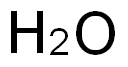
- 7732-18-5
- H2O
- 18.01
- All (50)
- China (13)
- (50)
Related Products More >

- 87-90-1
- CNY Request For Quotation
- 105-55-5
- CNY Request For Quotation
- 102-08-9
- CNY Request For Quotation
- 103-85-5
- CNY Request For Quotation
- 96-45-7 Ethylene thiourea
- CNY Request For Quotation
- 638-16-4 Trithiocyanuric acid
- CNY Request For Quotation
- 638-16-4 Trithiocyanuric acid
- CNY Request For Quotation
- CNY Request For Quotation


Let's take a closer look at the flammability of the individual components of urine. Water, which is the main component, is well - known for its non - flammability. In fact, water is commonly used as a fire suppressant because it can cool down burning materials and reduce the oxygen supply to the fire. Urea, with the chemical formula CH4N2O, is an organic compound produced as a by - product of protein metabolism in the body. Although it is an organic substance, urea is not easily flammable under standard conditions. When heated, urea decomposes before it reaches the temperature at which it could potentially catch fire. Sodium chloride, or common salt, is also non - flammable. In fact, it can be used in some fire - fighting applications as it can smother flames by creating a barrier between the fuel and the oxygen. Uric acid, with the chemical formula C5H4N4O3, is an organic acid that is produced during the breakdown of purines in the body. Uric acid has a relatively high melting point and does not readily ignite in normal environmental conditions. Its chemical structure and physical properties make it resistant to combustion without the presence of extreme heat and other specific conditions.
The question of under what environmental conditions urine might be ignited is an interesting one. As mentioned earlier, for combustion to occur, the three elements of the fire triangle - fuel, oxygen, and an ignition source - must be present in the right proportions. Given that urine is mostly water, even if there are small amounts of potentially combustible organic compounds in it, the large quantity of water dilutes these substances to such an extent that they cannot reach the necessary concentration for combustion. However, in highly artificial and extreme laboratory conditions, where the temperature is raised to extremely high levels (far beyond what is encountered in everyday life) and the water content is significantly reduced through processes like evaporation, it might be possible to vaporize some of the organic components of urine. But even then, achieving sustained combustion would be extremely difficult, as the remaining components and the overall chemical nature of the vaporized mixture would not support a continuous fire.
Changes in the component ratios of urine, such as those that occur during dehydration or certain illnesses, do not significantly affect its flammability. During dehydration, the body conserves water, and as a result, urine becomes more concentrated. This means that the proportion of solutes like urea and uric acid increases relative to the water content. However, even in highly concentrated urine, the water still makes up the majority of the fluid. The high water content continues to act as a deterrent to flammability, preventing the organic compounds from reaching a state where they could be ignited. In medical conditions like diabetes, where there may be changes in the chemical composition of urine, such as the presence of ketones, these additional substances do not add enough combustible material to make the urine flammable. Ketones, although organic compounds, are present in relatively small amounts in diabetic urine, and again, the overwhelming presence of water prevents any potential for combustion.
In real - world applications, understanding the non - flammability of urine has several implications. In healthcare settings, where urine is often handled for diagnostic purposes, there is no need to take special fire - prevention precautions related to urine samples. In industrial processes that may involve the handling of biological waste, including urine, the knowledge that it is non - flammable helps in designing appropriate waste - management systems. It also helps in dispelling common misconceptions about the flammability of bodily fluids. For example, in survival situations, some people might wrongly assume that urine could be used as a fuel source, but knowing its true properties can prevent dangerous and fruitless attempts at using it in such a way. Moreover, this understanding of urine's flammability contributes to the broader knowledge of the chemical and physical properties of biological fluids, which can be useful in various scientific and medical research fields.
When considering the potential for ignition of urine, it's also important to think about the role of external factors. For instance, if urine were to come into contact with highly flammable substances, it could potentially act as a carrier or diluent, but it would not itself become the source of the fire. The chemical bonds within the components of urine are relatively stable under normal environmental conditions, and the energy required to break these bonds and initiate combustion is far beyond what is typically available in daily life. Additionally, the presence of other substances in the body that are excreted in urine, such as electrolytes, further complicates the possibility of combustion. These electrolytes can interact with the organic components in ways that inhibit the formation of a combustible mixture.
In conclusion, despite the presence of some organic compounds in urine, the overwhelming amount of water and the non - flammable nature of its other major components mean that human urine is not flammable under normal and most extreme conditions. Changes in its composition due to physiological states or medical conditions do not alter this fundamental property, and understanding this is crucial for various aspects of safety, waste management, and scientific research.
Urea, which is the second most abundant component at approximately 2% of urine's composition, is a compound with the chemical formula CO(NH₂)₂. Urea is a stable substance that has been widely used in various industrial and agricultural applications. Its molecular structure does not contain the highly reactive and easily oxidizable carbon-hydrogen bonds that are characteristic of flammable substances. Instead, the bonds in urea are relatively strong and do not break easily to release energy in the form of heat and light during combustion.
Sodium chloride, or table salt, is another significant component of urine. It is well - known for its non - flammability. In fact, sodium chloride is often used in some types of fire extinguishers. When present in urine, it further contributes to the non - flammable nature of the substance. Sodium chloride disrupts the chemical reactions necessary for combustion by interfering with the transfer of heat and the availability of oxygen to the fuel source.
Uric acid, although present in urine in trace amounts, is also not a flammable compound. It is a waste product formed during the breakdown of purines in the body. Uric acid has a complex molecular structure that does not readily react with oxygen in the air to produce a flame. Its stability and low concentration in urine mean that it does not pose any risk of making urine flammable.
The reason urine fails to ignite easily can be better understood by looking at the requirements for combustion. The fire triangle concept states that for a fire to occur, three elements must be present: fuel, oxygen, and an ignition source. In the case of urine, while it does contain some organic compounds such as ammonia or small amounts of ketones (especially in certain medical conditions or physiological states), these are present in extremely low concentrations. The vast amount of water dilutes these potential "fuels" to such an extent that they cannot be effectively oxidized to produce a sustained flame. Even if we were to consider the small amounts of organic matter in urine as fuel, the presence of water and non - flammable salts like sodium chloride would quickly quench any attempt at combustion.
Regarding environmental conditions, it is extremely difficult to create a situation where urine could be ignited. Even in cases of severe dehydration, where urine becomes more concentrated, the water content still remains high enough to prevent combustion. When a person is dehydrated, the body tries to conserve water, and as a result, the kidneys produce more concentrated urine. This may lead to an increase in the relative proportion of urea, uric acid, and other solutes, but the water is still the major component.
Medical conditions can also affect the composition of urine. For example, in diabetic ketoacidosis, patients have elevated levels of ketones in their urine. However, despite the increased ketone levels, the overall concentration of these potentially more reactive substances is still not sufficient to make the urine flammable. The body's natural mechanisms for maintaining homeostasis and the dilution effect of the remaining water content in the urine work together to prevent any significant change in the flammability properties.
Changes in the component ratios of urine during dehydration or illness do not transform it into a flammable substance. Although the relative amounts of different components may shift, the fundamental nature of urine as a mostly aqueous solution with non - flammable and heat - resistant substances remains the same. The salts and nitrogenous wastes in urine have high thermal stability. When heated, they do not break down into flammable gases or vapors easily. Instead, they may simply undergo physical changes such as evaporation of water, leaving behind a residue of salts and other non - combustible materials.
However, there are specific conditions under which urine might exhibit flammability. For example, if a person consumes a significant amount of alcohol, the alcohol content in their urine could increase. In rare cases, if the blood alcohol content (BAC) reaches a high enough level, the urine might become flammable. Another condition is severe dehydration, which can lead to highly concentrated urine. This concentrated urine, combined with certain environmental conditions, might increase the likelihood of flammability. Additionally, certain medical conditions or the presence of unusual substances in the urine, such as acetone, could also make it flammable.
In terms of environmental conditions, urine would generally not ignite under normal temperatures and exposure to open air. However, if exposed to extremely high temperatures or concentrated heat sources, such as a gas torch or a propane burner, the components of urine might break down and produce flammable gases like hydrogen sulfide and ammonia, which could then catch fire. This scenario is highly unlikely in everyday situations but could occur in specific industrial or laboratory settings where urine is exposed to extreme conditions.
Regarding changes in component ratios, dehydration can significantly alter the composition of urine. When a person is dehydrated, the water content in urine decreases, and the concentration of other components increases. This could potentially make the urine more flammable, especially if the concentration of flammable substances like urea or uric acid rises. Similarly, during illness, the body might produce different metabolic by-products that could affect the flammability of urine. For instance, in cases of severe metabolic disorders or certain types of infections, the chemical composition of urine can change dramatically.
To mitigate the risk of flammable urine, it is important to stay hydrated and avoid excessive alcohol consumption. In situations where urine might be exposed to heat sources or electrical currents, such as in industrial settings or during camping, precautions should be taken to minimize the risk of fire or electrocution. For example, if someone is using a urine container, it should be emptied promptly to avoid any buildup of pressure or chemical reactions. Additionally, in medical settings, it is crucial to monitor patients who may be at risk of producing flammable urine due to their condition or treatment. Proper ventilation and handling procedures can help prevent any potential hazards.
In everyday life, the risk of urine being flammable is minimal. However, understanding the factors that could potentially make urine flammable, such as high alcohol consumption, severe dehydration, or the presence of specific substances, can help individuals take appropriate precautions. For example, if someone is camping and using a portable toilet, they should ensure that the urine is not exposed to open flames or heat sources. Similarly, in industrial settings where urine might be collected for testing or disposal, proper safety protocols should be followed to prevent any accidental ignition.
It is also important to note that while urine is generally safe, there are rare cases where it might become flammable due to unusual circumstances. For instance, in cases of severe metabolic disorders or certain types of infections, the chemical composition of urine can change dramatically. In such cases, medical professionals should be aware of the potential risks and take appropriate measures to ensure patient safety. This might include monitoring the urine for unusual chemical compositions or taking steps to prevent the urine from coming into contact with potential ignition sources.
In summary, while urine is generally not flammable due to its high water content, certain conditions such as high alcohol consumption, severe dehydration, or the presence of specific substances can increase its flammability. Understanding these factors and taking appropriate precautions can help ensure safety in various situations. Proper hydration, avoiding excessive alcohol consumption, and following safety protocols in industrial and medical settings are all important steps to minimize the risk of flammable urine.