


 Home
Home
Hi, I'd like to ask—Is common table salt (sodium chloride) a flammable substance? Why doesn't salt burn in fire? Will salt undergo decomposition reactions at high temperatures? What types of salts may be flammable?Thanks!
Is Salt Flammable? Will Sodium Chloride Burn at High Temperatures?
Related Encyclopedia
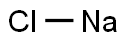
- 7647-14-5
- ClNa
- 58.44
- All (45)
- China (29)
- (45)

- 20510-56-9
- ClNa
- 60.46000
- All (0)
- China (0)
- (0)

- 20510-55-8
- ClNa
- 58.44000
- All (0)
- China (0)
- (0)
- 95860-64-3
- ClCsNa
- 191.34800
- All (0)
- China (0)
- (0)
- 95860-66-5
- ClKNa
- 97.54110
- All (0)
- China (0)
- (0)
- 66650-11-1
- ClH2NaO
- 76.45810
- All (0)
- China (0)
- (0)
- 107472-99-1
- Cl3Na3-
- 175.32800
- All (0)
- China (0)
- (0)
- 61789-31-9
- 0
- All (6)
- China (6)
- (6)
- 124151-79-7
- Cl4NaOTc
- 279.70700
- All (0)
- China (0)
- (0)
- 75393-87-2
- C2H4FN7O4
- 209.09600
- All (0)
- China (0)
- (0)
Related Products More >

- 93348-22-2
- Request For Quotation
- 25KG/50KG/1000KG
- 93348-22-2
- Request For Quotation
- 25kg/Cardboard Drum
- 91031-63-9
- Request For Quotation
- 90387-74-9
- Request For Quotation
- 20 kg per drum
- 90387-74-9
- Request For Quotation
- 25kg/Cardboard Drum
- 90387-74-9
- Request For Quotation
- 25kg/drum
- 90387-74-9
- Request For Quotation
- 100g; 1kg; 25g
- 90387-74-9
- Request For Quotation
- 25kg/drum


Sodium chloride is composed of sodium cations (Na⁺) and chloride anions (Cl⁻) held together by strong ionic bonds. These bonds are formed through the transfer of an electron from sodium to chlorine, resulting in two oppositely charged ions that attract each other. The electrostatic forces between these ions are very strong, requiring a significant amount of energy to break. When salt is exposed to a fire, instead of undergoing combustion, it first reaches its melting point. The melting point of sodium chloride is approximately 801°C (1,474°F), which is much higher than the temperatures typically achieved in common household or outdoor fires. Most ordinary fires have temperatures ranging from about 600°C to 900°C, although this can vary depending on the fuel source and the conditions. Even when the temperature is high enough to melt the salt, the molten sodium chloride does not react with oxygen in the air to burn. The sodium and chloride ions in the molten state remain relatively stable and do not combine with oxygen to form new compounds that would sustain a fire.
At extremely high temperatures, well beyond what is encountered in typical fires, sodium chloride can theoretically undergo decomposition reactions. Decomposition would involve breaking down the NaCl into its constituent elements, sodium and chlorine. However, achieving this through simple heating is extremely difficult. The energy required to break the strong ionic bonds in sodium chloride is substantial, and under normal thermal conditions, the salt remains intact. In industrial processes, such as the Downs process, sodium chloride is decomposed into sodium metal and chlorine gas, but this is accomplished through electrolysis, a method that uses an electric current to drive the chemical reaction rather than relying solely on heat. In most real - world scenarios, including exposure to intense but ordinary fire sources, sodium chloride will either remain solid or melt, and decomposition is a negligible process.
While common table salt is non - flammable, there are many types of salts that can exhibit flammable or fire - related properties. One category of potentially flammable salts is those with combustible anions. For example, salts containing organic anions like acetates. Sodium acetate (NaC2H3O2), when heated, can release flammable vapors. The organic part of the acetate anion, C2H3O2⁻, contains carbon - hydrogen bonds. These bonds can react with oxygen when sufficient heat is applied, leading to combustion. As the sodium acetate is heated, the organic portion breaks down and reacts with oxygen in the air, producing heat, light, and combustion products such as carbon dioxide and water.
Ammonium salts are another group with fire - related characteristics. Ammonium nitrate (NH4NO3), for instance, is not flammable on its own but is a powerful oxidizer. Oxidizers release oxygen when heated or in the presence of a chemical reaction, which can then support the combustion of other materials. Ammonium nitrate is widely used in fertilizers because the nitrogen it contains is beneficial for plant growth. However, it has also been used in explosives. When ammonium nitrate is subjected to high heat, shock, or in the presence of a reducing agent, it can release large amounts of oxygen, accelerating the burning of fuels and potentially causing violent explosions. This property has led to several industrial accidents and safety concerns regarding the storage and handling of ammonium nitrate.
Some salts of reactive metals can also pose fire risks, although their behavior depends on the specific anion present. For example, lithium salts. Lithium is a highly reactive metal, and while lithium chloride (LiCl) itself is not flammable, if lithium metal is somehow released from a lithium - containing salt through a chemical reaction or other means, the lithium metal can burn vigorously in the air. Lithium reacts with oxygen to form lithium oxide, and this reaction is highly exothermic, releasing a significant amount of heat and light.
In addition, some hydrated salts can have interesting thermal behaviors related to fire. Hydrated salts contain water molecules within their crystal structure. When heated, these salts may release the water of hydration. In some cases, this released water can act as a fire suppressant by cooling the surrounding area and diluting any flammable gases. However, once the water has been driven off and the salt becomes anhydrous, its properties may change, although anhydrous salts are generally still not flammable in the same way as organic materials or some oxidizing salts.
Understanding the flammability or fire - related properties of different salts is crucial in various fields. In chemistry laboratories, it helps researchers handle and store chemicals safely. In industrial settings, knowledge of salt properties is essential for preventing accidents and ensuring the proper operation of processes. In fire safety, being aware of which salts can contribute to or suppress fires allows for better fire prevention and response strategies. While common table salt poses no fire risk due to its stability, the wide variety of other salts means that each one must be evaluated based on its specific chemical composition and potential reactions under different conditions.
The non-flammability of sodium chloride can also be understood by examining its melting and boiling points. Sodium chloride has a melting point of approximately 801 degrees Celsius (1474 degrees Fahrenheit) and a boiling point of around 1413 degrees Celsius (2575 degrees Fahrenheit). These temperatures are extremely high and are not easily reached in everyday situations. For comparison, a typical household fire might reach temperatures of around 600 to 800 degrees Celsius, which is still below the melting point of sodium chloride. This means that before salt could even begin to undergo any significant chemical changes that might lead to combustion, it would need to be exposed to temperatures that are simply not achievable in most common scenarios.
When exposed to high temperatures, sodium chloride does not readily decompose. However, at temperatures approaching and exceeding its melting point, it can undergo some chemical changes. At around 801 degrees Celsius, sodium chloride can start to decompose into its constituent elements, sodium and chlorine. This process requires an extremely high input of energy and is not something that happens easily or quickly. In fact, such decomposition is more commonly observed in specialized industrial processes or laboratory settings where precise temperature controls and extreme conditions can be maintained.
It is important to note that while sodium chloride itself is not flammable, other types of salts may exhibit different behaviors when exposed to heat or fire. For example, certain metal salts, particularly those containing alkali metals like lithium or potassium, can be highly reactive. These metals are known for their reactivity with water and air, and their salts can sometimes ignite or react violently under specific conditions. This reactivity is due to the nature of the metals themselves, which are highly electropositive and readily lose electrons to form cations. When these metal salts come into contact with moisture or other reactive substances, they can undergo exothermic reactions that release a significant amount of heat and may even produce flames.
Another example of potentially flammable salts includes some organic salts. These compounds contain carbon and can undergo combustion reactions similar to those of organic fuels. The flammability of organic salts depends on the specific structure and composition of the molecules. For instance, salts derived from fatty acids or other hydrocarbons can burn if exposed to a sufficient source of heat and oxygen. The combustion of these salts involves breaking the carbon-hydrogen bonds and reacting with oxygen to produce carbon dioxide and water, similar to the burning of hydrocarbon fuels.
In contrast to these examples, common table salt remains inert under most conditions. Its stability and non-reactivity make it a safe and widely used substance in cooking, food preservation, and various industrial applications. The high melting and boiling points of sodium chloride, combined with its stable ionic structure, ensure that it does not pose a fire hazard in typical usage scenarios. This is why it is considered a non-flammable substance and is not classified as a fire risk in most safety regulations.
Understanding the properties of sodium chloride and other salts helps to clarify why some materials are flammable while others are not. The key factors influencing flammability include the chemical composition, the strength of the bonds within the compound, and the temperatures required to initiate combustion. Sodium chloride, with its strong ionic bonds and high melting and boiling points, simply does not meet the criteria for flammability under normal conditions. This characteristic is what makes it a reliable and safe substance for a wide range of applications, from everyday use in the kitchen to more specialized industrial processes.
The reason salt doesn't burn in fire is deeply rooted in its chemical structure and properties. When exposed to the heat of a fire, which usually ranges from around 600°C to 1000°C depending on the fuel source, sodium chloride doesn't ignite. Instead, it starts to experience physical changes. It has a relatively high melting point of approximately 801°C. This means that in most common fires, salt will simply melt rather than burn. Even if the temperature rises further, reaching its boiling point of 1465°C, the process is still a physical transition from a liquid to a gaseous state of sodium chloride, not a chemical combustion reaction. The stable ionic lattice structure of NaCl resists the attempts of oxygen to break its bonds and initiate a combustion process. The sodium and chloride ions are already in a highly stable state, and there is no significant energy advantage for them to react with oxygen, unlike in the case of hydrocarbons where combustion releases a large amount of energy due to the formation of more stable carbon - oxygen and hydrogen - oxygen bonds.
At high temperatures, sodium chloride can indeed undergo decomposition reactions, but these are not related to combustion and require extremely harsh conditions. For instance, through a process called electrolysis, when molten sodium chloride is subjected to an electric current, it breaks down into its elemental components: sodium metal and chlorine gas. In a thermal context, under temperatures far beyond what is achievable in ordinary fires, the strong ionic bonds in NaCl can be overcome, leading to the dissociation of the compound. But this is a slow and energy - intensive process that occurs in specialized industrial settings, not in the typical environment of a household or forest fire.
While common table salt is non - flammable, there are certain types of salts that can exhibit flammability or contribute to fire - related hazards. Organic salts, which are salts formed from organic acids and inorganic bases, often have flammable characteristics. For example, sodium acetate, which is the sodium salt of acetic acid, contains an organic acetate group. When heated to a high enough temperature, the organic part of the salt can react with oxygen in the air and burn, although the presence of the sodium ion can somewhat modify its combustion behavior compared to a pure organic compound.
Ammonium salts also play a significant role in fire - related scenarios. Ammonium nitrate (NH₄NO₃), for example, is not flammable on its own but is a powerful oxidizing agent. In the presence of heat or when mixed with combustible materials like fuels, it can release oxygen and accelerate the combustion process, sometimes leading to explosive reactions. This is why ammonium nitrate has been used in the production of fertilizers as well as in certain types of explosives.
Metal salts with reactive anions can also pose fire risks. Salts containing chlorate (ClO₃⁻) or perchlorate (ClO₄⁻) ions, such as potassium chlorate, are strong oxidizers. Although they don't burn in the traditional sense, when in contact with flammable substances, they can supply the necessary oxygen for the combustion to occur more vigorously, making them extremely dangerous in fire - prone environments.
Understanding the flammability or non - flammability of different salts is crucial in various fields, from chemical laboratories to industrial manufacturing and even in household safety. It helps in choosing the right materials, storing chemicals safely, and developing effective fire prevention and suppression strategies.