


 Home
Home
Hi, I'd like to ask—Is sodium hydroxide (NaOH) an effective buffer solution? Why do some substances act as buffers, and what structural or chemical properties enable this function? How does NaOH's strong basicity affect its ability to maintain pH stability in solutions? Under what conditions might NaOH be used in pH-related applications, and what are its limitations as a buffer? Thanks!
Is NaOH a Good Buffer? Understanding Its Role in pH Regulation
Related Encyclopedia
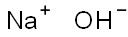
- 1310-73-2
- NaOH
- 39.99711
- All (130)
- China (116)
- (131)

- 12200-64-5
- H3NaO2
- 58.01240
- All (0)
- China (0)
- (0)
- 87331-12-2
- HNa3O
- 85.97670
- All (0)
- China (0)
- (0)
- 389873-17-0
- HNaO
- 40.99680
- All (0)
- China (0)
- (0)
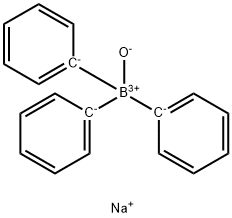
- 12113-07-4
- C18H15BNaO
- 281.12
- All (0)
- China (0)
- (0)
- 12179-02-1
- H3NaO2
- 58.01240
- All (0)
- China (0)
- (0)
![1,1-dioxo-1λ6-benz[d]isothiazole-3-thione, compound of sodium-salt with sodium hydroxide](https://chemcloud-1304660855.cos.ap-shanghai.myqcloud.com/compound/0baa2f2e2d4e447ba1d868ee6e368753.png?imageMogr2/format/webp)
- 132625-48-0
- C7H5NNaO3S2
- 238.23900
- All (0)
- China (0)
- (0)
![2-[1-(2-hydroxyethyl)-2-undecyl-4,5-dihydroimidazol-1-ium-1-yl]acetic acid,sodium,hydroxide](https://chemcloud-1304660855.cos.ap-shanghai.myqcloud.com/compound/6693a34bb157411c9d4382ddc941778e.png?imageMogr2/format/webp)
- 26837-33-2
- C18H36N2NaO4
- 367.47900
- All (0)
- China (0)
- (0)
![Sodium hydroxide - [2-heptyl-1-(2-hydroxyethyl)-4,5-dihydro-1H-im idazol-1-ium-1-yl]acetate (1:1:1)](https://chemcloud-1304660855.cos.ap-shanghai.myqcloud.com/compound/23c6ba61894848ea9c3c4025e1e71755.png?imageMogr2/format/webp)
- 13039-35-5
- C14H27N2NaO4
- 310.36500
- All (0)
- China (0)
- (0)
![Sodium hydroxide 3-{3-[2-(2-carboxylatoethoxy)ethyl]-2-undecyl-4, 5-dihydro-1H-imidazol-3-ium-1-yl}propanoate (2:1:1)](https://chemcloud-1304660855.cos.ap-shanghai.myqcloud.com/compound/07ddc7ccc09a46bf834d1de80735783c.png?imageMogr2/format/webp)
- 68610-43-5
- C22H40N2Na2O6
- 474.54234
- All (0)
- China (0)
- (0)
Related Products More >

- 1310-73-2
- Request For Quotation
- 1310-73-2
- Request For Quotation
- 1310-73-2
- Request For Quotation
- 1310-73-2
- USD 1.0000
- 25kg
- 1310-73-2
- CNY 750.0000
- 1ton
- 1310-73-2
- CNY 2.6000
- 25kg
- 1310-73-2
- USD 450.0000
- 50kg
- 1310-73-2
- Request For Quotation
- 30ton


Let's take a closer look at how buffer solutions work. Consider a buffer made up of acetic acid (CH₃COOH) and sodium acetate (CH₃COONa). Acetic acid is a weak acid that only partially dissociates in water, following the reaction CH₃COOH ⇌ CH₃COO⁻ + H⁺. Sodium acetate, on the other hand, dissociates completely in water to release acetate ions (CH₃COO⁻) and sodium ions (Na⁺). When a strong acid, such as hydrochloric acid (HCl), is added to this buffer solution, the additional hydrogen ions (H⁺) from the HCl react with the acetate ions (CH₃COO⁻) present in the buffer. The acetate ions, acting as the conjugate base, combine with the hydrogen ions to form more acetic acid molecules. This reaction effectively consumes the added hydrogen ions, preventing a drastic increase in the concentration of hydrogen ions and thus maintaining the pH of the solution relatively stable.
Conversely, when a strong base, like sodium hydroxide (NaOH), is added to the buffer, the hydroxide ions (OH⁻) react with the acetic acid molecules. The acetic acid donates a hydrogen ion to the hydroxide ion, forming water and acetate ions. In this way, the added hydroxide ions are neutralized, and the pH of the solution remains relatively unchanged. This interplay between the weak acid and its conjugate base is what gives buffer solutions their pH-stabilizing ability.
Now, let's turn our attention to the properties that enable substances to act as buffers. The key factor is the presence of a conjugate acid-base pair with appropriate dissociation constants. The dissociation constant (Ka) of a weak acid measures the extent to which the acid dissociates in water. The pKa, which is the negative logarithm of Ka, is often used to describe the acid's strength. For a buffer solution to be effective, the pKa of the weak acid in the conjugate acid-base pair should be close to the desired pH of the buffer. Typically, a buffer is most effective when the pH of the solution is within one unit of the pKa value of the weak acid.
Structurally, weak acids usually contain functional groups that can readily donate a proton. For example, carboxylic acids like acetic acid have a carboxyl group (-COOH). This group can release a hydrogen ion, leaving behind the carboxylate ion, which is the conjugate base. Weak bases, on the other hand, have the ability to accept a proton. Ammonia (NH₃), for instance, can accept a proton to form the ammonium ion (NH₄⁺), which is its conjugate acid. The balance between the proton-donating and proton-accepting abilities of the conjugate acid-base pair is crucial for the buffer's functionality.
In contrast, sodium hydroxide is a strong base. When NaOH is dissolved in water, it dissociates completely according to the reaction NaOH → Na⁺ + OH⁻. This complete dissociation results in a high concentration of hydroxide ions in the solution. Unlike a buffer solution, which has a dual-component system that can respond to both acid and base additions, NaOH lacks the necessary conjugate acid-base pair to act as a buffer. When a strong acid is added to a solution of NaOH, the hydroxide ions from the NaOH react with the hydrogen ions from the acid to form water. Once all the hydroxide ions from the NaOH have reacted, there are no more components in the solution to neutralize any additional acid. As a result, the pH of the solution will drop rapidly.
Similarly, when more strong base is added to a NaOH solution, since the solution already has a high concentration of hydroxide ions, the pH will increase significantly. There is no mechanism within the NaOH solution to counteract these changes in the way a buffer solution can. The strong basicity of NaOH means that it is highly effective at rapidly increasing the pH of a solution, but it offers no resistance to pH changes caused by external factors such as the addition of acids or bases.
Despite not being a buffer, NaOH does have important applications in pH-related processes. In industrial wastewater treatment, for example, NaOH is often used to neutralize acidic wastewater. By adding NaOH to acidic effluents, the hydroxide ions react with the hydrogen ions present in the wastewater, raising the pH to a more environmentally acceptable level. In laboratory settings, NaOH is commonly used as a standard reagent in acid-base titrations. Its known concentration and strong basicity make it ideal for determining the concentration of unknown acids.
However, NaOH has several limitations when it comes to maintaining pH stability. Its lack of buffering capacity means that it cannot keep the pH of a solution stable in the face of small changes in acidity or basicity. It is only useful in situations where a solution needs to be made highly basic and there is no expectation of significant changes in the pH due to external factors. Additionally, NaOH is highly corrosive. Handling NaOH requires extreme caution, as it can cause severe burns to skin and eyes. In applications where precise and stable pH control is necessary, such as in biological experiments where enzymes are sensitive to pH changes, buffer solutions are the preferred choice over NaOH.
In conclusion, the ability of a substance to act as a buffer is determined by the presence of a conjugate acid-base pair with suitable chemical properties. Sodium hydroxide, due to its nature as a strong base with complete dissociation, does not possess these characteristics and therefore cannot function as a buffer. While it has its own uses in adjusting pH, it is not suitable for maintaining pH stability in the same way that buffer solutions can. Understanding these differences is essential for making the right choices in various chemical applications.
Buffer solutions work because they contain components that can react with added acids or bases. For example, a common buffer system is the acetic acid (CH3COOH) and sodium acetate (CH3COONa) pair. Acetic acid is a weak acid that can donate H+ ions, while sodium acetate provides acetate ions (CH3COO−), which can react with H+ ions to form acetic acid again. This equilibrium helps to stabilize the pH of the solution. The ability of a substance to act as a buffer depends on its chemical properties, particularly the presence of a weak acid or base and its conjugate partner. In the case of acetic acid and sodium acetate, the weak acid (acetic acid) can donate protons (H+), while the conjugate base (acetate ion) can accept protons. This dual ability allows the buffer to neutralize both acids and bases added to the solution, thereby maintaining a relatively constant pH.
Sodium hydroxide, on the other hand, is a strong base. When dissolved in water, it dissociates completely into Na+ and OH− ions. The presence of a high concentration of OH− ions makes the solution strongly basic, with a pH typically above 12, depending on the concentration. Because NaOH is a strong base, it does not have a conjugate acid that can effectively neutralize added acids. Instead, it will simply neutralize any acid added to the solution, resulting in a significant change in pH. The strong basicity of sodium hydroxide means that it is highly effective at raising the pH of acidic solutions. However, this same property makes it unsuitable for maintaining pH stability in buffer solutions. When NaOH is added to a solution, it will neutralize any acids present, but it will not have the capacity to neutralize added bases. This results in a solution that is highly sensitive to changes in pH, especially when bases are added.
There are specific conditions under which sodium hydroxide might be used in pH-related applications, but these are generally not for buffering purposes. For example, NaOH is commonly used in titrations to determine the concentration of an unknown acid. In this context, its strong basicity is an advantage because it can neutralize the acid completely, allowing for accurate measurement of the acid's concentration. Additionally, NaOH is used in industrial processes to neutralize acidic waste streams or to adjust the pH of solutions to a desired level for further processing. In these applications, the strong basicity of sodium hydroxide allows it to effectively neutralize acids and raise the pH of the solution to a desired level. However, the limitations of sodium hydroxide as a buffer are significant. Because it cannot maintain pH stability in the presence of added acids or bases, it is not suitable for applications where a stable pH is required over a range of conditions. Buffer solutions, which are designed to resist changes in pH, are much more appropriate for such applications. For example, in biological systems, where enzymes and other proteins require a stable pH to function properly, buffer solutions are essential. Similarly, in laboratory experiments where precise pH control is necessary, buffer solutions are preferred over strong bases like NaOH.
In addition to its use in titrations and industrial pH adjustments, sodium hydroxide is also used in various other applications due to its strong basicity. For example, it is used in the production of soap and detergents, where its ability to neutralize fats and oils is crucial for the saponification process. In this process, sodium hydroxide reacts with fats and oils to produce glycerol and soap, which is a salt of the fatty acids. The strong basicity of sodium hydroxide allows it to break down the fats and oils, facilitating the formation of soap. Sodium hydroxide is also used in the pulp and paper industry, where it helps to break down lignin, a complex organic polymer that binds cellulose fibers together in wood. By treating wood chips with a sodium hydroxide solution, the lignin can be removed, leaving behind cellulose fibers that can be processed into paper. The strong basicity of the sodium hydroxide solution helps to break the chemical bonds in lignin, facilitating its removal.
Despite its many uses, the limitations of sodium hydroxide as a buffer are clear. Its strong basicity and lack of a conjugate acid make it unsuitable for maintaining pH stability in solutions. While it can neutralize acids effectively, it cannot neutralize bases, resulting in a solution that is highly sensitive to changes in pH. This makes it unsuitable for applications where a stable pH is required, such as in biological systems or laboratory experiments where precise pH control is necessary. In these cases, buffer solutions that contain a weak acid and its conjugate base, or a weak base and its conjugate acid, are preferred because they can neutralize both acids and bases added to the solution, thereby maintaining a relatively constant pH.
In summary, sodium hydroxide is not an effective buffer solution due to its strong basicity and lack of a conjugate acid to neutralize added bases. While it is highly effective at neutralizing acids and raising the pH of solutions, it cannot maintain pH stability in the presence of added acids or bases. Therefore, its use is generally limited to applications where strong basicity is required, such as titrations or industrial pH adjustments, rather than in buffering systems where pH stability is crucial.
In contrast, NaOH is a strong base. When NaOH is dissolved in water, it dissociates completely into sodium ions (Na⁺) and hydroxide ions (OH⁻). This complete dissociation is a key characteristic that differentiates it from substances capable of acting as buffers. When an acid is added to a solution of NaOH, the large number of hydroxide ions present react vigorously with the hydrogen ions from the acid to form water. Once all the NaOH in the solution has reacted with the added acid, there is no further capacity to resist additional changes in pH. If more acid is added beyond the amount that can be neutralized by the available NaOH, the pH of the solution will drop sharply. Similarly, if more base is added to a NaOH solution, the concentration of hydroxide ions will increase, causing the pH to rise without any mechanism to counterbalance these changes. In essence, a NaOH solution lacks the equilibrium system that is fundamental to a buffer's function. There is no conjugate acid component in the solution that can regenerate hydroxide ions or respond to further fluctuations in pH.
The substances that can act as buffers owe their functionality to specific structural and chemical properties. The presence of a weak acid-base conjugate pair is crucial. Weak acids or bases do not dissociate completely in water; instead, they establish a dynamic equilibrium between the undissociated molecules and their corresponding ions. This equilibrium allows them to respond to changes in the concentration of hydrogen or hydroxide ions in the solution. Consider ammonia (NH₃), a weak base, and ammonium chloride (NH₄Cl), its conjugate acid. In a solution containing both, NH₃ can accept hydrogen ions to form NH₄⁺ when an acid is added, and NH₄⁺ can donate hydrogen ions to form NH₃ when a base is added. This reversible reaction mechanism is what gives buffers their ability to absorb or release hydrogen ions as required, maintaining the pH within a narrow range. Strong acids and bases like NaOH, however, lack this reversible dissociation characteristic because they dissociate fully, leaving no undissociated molecules to participate in the equilibrium reactions necessary for buffering.
The strong basicity of NaOH has a profound impact on its inability to maintain pH stability in the way buffers do. As a strong base, NaOH has an extremely high affinity for hydrogen ions. When an acid is added to a NaOH solution, the reaction between the hydroxide ions from NaOH and the hydrogen ions from the acid occurs rapidly and almost instantaneously forms water. This reaction is essentially one - directional under normal conditions and does not allow for the reverse process to occur easily. Once the hydroxide ions have reacted with the hydrogen ions, they are consumed as water molecules, and there is no built - in mechanism in the NaOH solution to replenish the hydroxide ions or adjust to any further changes in the concentration of acids or bases. For instance, if a small quantity of hydrochloric acid (HCl) is added to a NaOH solution, the OH⁻ ions from NaOH and the H⁺ ions from HCl combine to form water, and the pH of the solution may decrease slightly but still remain on the basic side. But if a large excess of HCl is added, there are no remaining OH⁻ ions from NaOH to neutralize the additional hydrogen ions, and the pH will plummet dramatically, highlighting the lack of buffering capacity.
Despite not being a buffer, NaOH is still widely used in numerous pH - related applications. In industrial settings, it is commonly employed to increase the pH of acidic solutions. For example, in wastewater treatment plants, NaOH is added to acidic effluents to neutralize the acids present, making the wastewater less harmful before it is discharged into the environment. In the manufacturing of soaps and detergents, NaOH plays a crucial role in the saponification process, where it reacts with fats and oils to produce soap. In laboratory environments, NaOH solutions are frequently used as standard reagents in acid - base titrations. The strong basicity of NaOH allows for a complete and predictable reaction with acids, enabling accurate determination of the concentration of unknown acid samples. NaOH can also be used in situations where a stable high - pH environment is required without the need to buffer against external acid or base additions, such as in certain chemical reactions that are favored under alkaline conditions or in alkaline extraction processes.
However, NaOH has significant limitations when it comes to acting as a buffer. Its most prominent shortcoming is the lack of a conjugate acid - base pair, which renders it ineffective in maintaining a stable pH when exposed to both acids and bases. It can only neutralize acids until it is completely consumed, after which the solution loses all ability to resist pH changes. Additionally, handling NaOH requires extreme caution due to its highly corrosive nature. It can cause severe burns to the skin and eyes, and proper safety equipment and procedures must be followed when working with it. In buffer - required applications, using NaOH alone would be inappropriate as it cannot provide the necessary pH stability. Instead, mixtures of weak acids and their conjugate bases or weak bases and their conjugate acids must be used to achieve the buffering effect.