


 Home
Home
Hi, I'd like to ask—is sodium chloride (NaCl) a compound? How to determine its category from a chemical structure perspective? What elements does NaCl consist of, and what type of chemical bond holds them together? Is it considered an ionic compound or a covalent compound? Thanks!
Is Sodium Chloride (NaCl) a Compound? How to Judge Its Category by Structure?
Related Encyclopedia
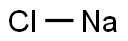
- 7647-14-5
- ClNa
- 58.44
- All (45)
- China (29)
- (45)

- 20510-56-9
- ClNa
- 60.46000
- All (0)
- China (0)
- (0)

- 20510-55-8
- ClNa
- 58.44000
- All (0)
- China (0)
- (0)
- 95860-64-3
- ClCsNa
- 191.34800
- All (0)
- China (0)
- (0)
- 95860-66-5
- ClKNa
- 97.54110
- All (0)
- China (0)
- (0)
- 66650-11-1
- ClH2NaO
- 76.45810
- All (0)
- China (0)
- (0)
- 107472-99-1
- Cl3Na3-
- 175.32800
- All (0)
- China (0)
- (0)
- 124151-79-7
- Cl4NaOTc
- 279.70700
- All (0)
- China (0)
- (0)
- 68002-60-8
- 0
- All (0)
- China (0)
- (0)
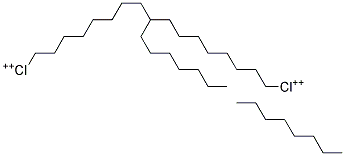
- 68424-95-3
- C32H66Cl2+4
- 521.77244
- All (0)
- China (0)
- (0)
Related Products More >

- 9002-86-2
- Request For Quotation
- 86508-42-1
- Request For Quotation
- Bulk
- 86508-42-1
- Request For Quotation
- 200KG/Drum
- 86508-42-1
- Request For Quotation
- bottle or customized
- 86508-42-1
- Request For Quotation
- Drum/Customized packaging
- 86508-42-1
- Request For Quotation
- 25KG/DRUM
- 86508-42-1
- Request For Quotation
- kg
- 86508-42-1
- Request For Quotation
- 25kg/Drum


When it comes to determining the category of NaCl from a chemical structure perspective, a detailed examination of the atoms involved and the type of bond between them is necessary. Sodium is an element located in Group 1 of the periodic table, commonly referred to as an alkali metal. These metals are characterized by having a single electron in their outermost energy level. On the other hand, chlorine is a member of Group 17, known as the halogens, and it has seven electrons in its outermost shell.
The key to understanding the chemical structure of NaCl lies in the concept of electron transfer. Sodium, with its single valence electron, has a strong tendency to lose this electron in order to achieve a stable electron configuration similar to that of the noble gas neon. Chlorine, on the contrary, needs to gain one electron to complete its outermost shell and attain the electron configuration of the noble gas argon. When sodium and chlorine come into contact under the right conditions, sodium readily donates its valence electron to chlorine. This results in the formation of two charged particles: a sodium cation (Na⁺), which has lost an electron and thus has a positive charge, and a chloride anion (Cl⁻), which has gained an electron and acquired a negative charge.
The bond that holds these two ions together in sodium chloride is an ionic bond. Ionic bonds are formed due to the strong electrostatic forces of attraction between oppositely charged ions. In the case of NaCl, the positively charged sodium ions are attracted to the negatively charged chloride ions, creating a stable and ordered structure. This type of bonding is typical between metals and nonmetals, as is the situation with sodium and chlorine.
Sodium chloride is clearly classified as an ionic compound because of the presence of this ionic bond. Ionic compounds have several characteristic properties that distinguish them from other types of compounds. One of the most notable properties is their high melting and boiling points. The strong electrostatic forces between the ions in an ionic lattice require a significant amount of energy to break, which is why NaCl has a melting point of around 801°C and a boiling point of approximately 1465°C. These high temperatures are a result of the need to overcome the forces that hold the ions in place within the crystal structure.
In the solid state, ionic compounds like NaCl form a highly ordered crystalline structure. In the case of sodium chloride, it has a face-centered cubic lattice structure. Each sodium ion is surrounded by six chloride ions, and each chloride ion is surrounded by six sodium ions. This arrangement maximizes the attractive forces between the oppositely charged ions and minimizes the repulsive forces between ions of the same charge. This regular and repeating pattern gives the crystal its characteristic shape and physical properties, such as hardness and brittleness. When a force is applied to a crystal of NaCl, the layers of ions may shift slightly. If this shift causes ions of the same charge to come into close proximity, the repulsive forces can cause the crystal to break along specific cleavage planes.
Another important property of ionic compounds, including NaCl, is their ability to conduct electricity when molten or dissolved in water. In the solid state, the ions in NaCl are fixed in place within the crystal lattice and cannot move freely. However, when sodium chloride is melted, the heat provides enough energy to break the ionic bonds to some extent, allowing the ions to move around. Similarly, when NaCl is dissolved in water, the polar water molecules surround the ions, separating them from the crystal lattice and enabling them to move freely in the solution. These mobile ions can carry an electric current, making molten sodium chloride and saltwater solutions good conductors of electricity.
The ionic nature of sodium chloride also has significant implications in biological systems. In the human body, sodium and chloride ions play crucial roles. Sodium ions are involved in maintaining the balance of fluids inside and outside of cells, and they are essential for nerve impulse transmission and muscle contraction. Chloride ions also contribute to fluid balance and are involved in the production of stomach acid. In addition, sodium chloride is commonly used in food preservation, as its presence can inhibit the growth of bacteria and other microorganisms. This is due to the fact that the high concentration of salt can draw water out of the cells of these organisms through a process called osmosis, causing them to dehydrate and die.
In industry, sodium chloride is a vital raw material. It is used in the production of a wide range of chemicals, such as chlorine, sodium hydroxide, and hydrogen through processes like electrolysis of brine (a concentrated solution of sodium chloride in water). Chlorine produced in this way is used in the manufacture of plastics, solvents, and many other chemical products. Sodium hydroxide, also known as caustic soda, is used in the paper industry, in the production of soaps and detergents, and in various other industrial processes.
Overall, sodium chloride's status as an ionic compound is firmly established by its chemical structure and the resulting properties. The ionic bond between sodium and chlorine gives rise to its unique physical and chemical characteristics, which make it important in a variety of fields, from basic chemistry to everyday life and industrial applications. Understanding the nature of this compound helps explain its behavior in different environments and its wide - reaching significance.
Sodium chloride consists of two elements: sodium (Na) and chlorine (Cl). Sodium is an alkali metal found in Group 1 of the periodic table, while chlorine is a halogen located in Group 17. The formation of sodium chloride involves a fundamental concept in chemistry: the transfer of electrons between atoms to achieve stable electron configurations. Sodium has one valence electron in its outermost shell, which it readily loses to achieve a stable noble gas configuration. Chlorine, on the other hand, has seven valence electrons and needs to gain one electron to achieve a stable configuration similar to that of a noble gas. When sodium loses its one valence electron, it forms a positively charged ion, Na⁺. Simultaneously, chlorine gains this electron to form a negatively charged ion, Cl⁻.
The bond that holds these ions together is an ionic bond. Ionic bonds are formed through the electrostatic attraction between oppositely charged ions. In the case of sodium chloride, the positively charged sodium ion (Na⁺) is attracted to the negatively charged chloride ion (Cl⁻). This electrostatic force is strong and results in a stable compound. The formation of sodium chloride can be represented by the chemical equation: Na + Cl → NaCl. This equation illustrates the transfer of an electron from sodium to chlorine, leading to the formation of the ionic compound.
The properties of sodium chloride are characteristic of ionic compounds. It has a high melting point and boiling point due to the strong ionic bonds between the sodium and chloride ions. These bonds require a significant amount of energy to break, which is why sodium chloride remains solid at room temperature and only melts at around 801 degrees Celsius. Additionally, sodium chloride is highly soluble in water. When dissolved in water, the ionic bonds are disrupted by the polar water molecules, allowing the sodium and chloride ions to separate and move freely. This results in a solution that conducts electricity, as the ions are free to move and carry an electric charge.
In its solid state, sodium chloride forms a crystalline lattice structure. The sodium and chloride ions are arranged in a repeating pattern, with each sodium ion surrounded by six chloride ions and vice versa. This arrangement maximizes the electrostatic attractions between the oppositely charged ions, contributing to the stability of the compound. The lattice structure also explains why solid sodium chloride does not conduct electricity. In the solid state, the ions are locked in place and cannot move freely, unlike in the dissolved or molten state.
Sodium chloride is not only a common household item but also a crucial substance in various industrial and scientific applications. In industry, it is used as a raw material for the production of chlorine and sodium hydroxide through the electrolysis of brine (a concentrated solution of sodium chloride). Chlorine is an important industrial chemical used in the production of plastics, disinfectants, and other chemicals, while sodium hydroxide is used in the manufacture of paper, textiles, and detergents. In addition to its industrial uses, sodium chloride plays a vital role in biological systems. It is essential for maintaining fluid balance in the human body and is a key component of bodily fluids such as blood and sweat.
The study of sodium chloride also provides valuable insights into the principles of chemical bonding and the properties of ionic compounds. Its simple yet fundamental structure serves as an excellent model for understanding how ionic bonds form and how they influence the physical and chemical properties of a compound. The behavior of sodium chloride in different states—solid, liquid, and dissolved—demonstrates the impact of ionic bonding on solubility, melting and boiling points, and electrical conductivity.
In everyday life, sodium chloride is a familiar substance with a wide range of uses. Beyond its role as a seasoning agent in food, it is also used in the preservation of food, as a de-icing agent on roads during winter, and in various household cleaning products. Its ability to lower the freezing point of water makes it effective for melting ice and snow, while its preservative properties help extend the shelf life of food products.
The formation and properties of sodium chloride highlight the fundamental principles of ionic bonding and the behavior of ionic compounds. The transfer of electrons from sodium to chlorine results in the formation of ions that are held together by strong electrostatic forces. This ionic bond gives sodium chloride its characteristic properties, such as high melting and boiling points, solubility in water, and electrical conductivity in solution or molten state. Sodium chloride's widespread use in industry, science, and daily life underscores its importance as a versatile and essential compound.
NaCl consists of sodium, a highly reactive alkali metal, and chlorine, a reactive halogen. The bond holding them together is an ionic bond, formed through the complete transfer of an electron from the sodium atom to the chlorine atom. Sodium, with a low electronegativity (0.93), readily donates its single valence electron to achieve a stable electron configuration similar to that of neon. Chlorine, with a high electronegativity (3.16), accepts this electron to complete its valence shell, mirroring the electron configuration of argon. This electron transfer results in the formation of sodium cations (Na⁺) and chloride anions (Cl⁻), which are held together by strong electrostatic attractions—the hallmark of ionic bonding.
Due to this ionic bonding, NaCl is classified as an ionic compound. Ionic compounds are characterized by the presence of ions arranged in a regular, repeating three-dimensional lattice structure, which gives them distinct physical properties. For example, NaCl has a high melting point (801°C) and boiling point (1465°C), as significant energy is required to overcome the strong electrostatic forces between the ions. Additionally, in its solid state, NaCl does not conduct electricity because the ions are fixed in position and cannot move freely. However, when melted or dissolved in water, the ions dissociate and become mobile, allowing the compound to conduct electricity—a key diagnostic property of ionic compounds.
In contrast, covalent compounds form when atoms share electrons, typically occurring between nonmetals with smaller electronegativity differences. For instance, in chlorine gas (Cl₂), two chlorine atoms share a pair of electrons to form a covalent bond. In NaCl, the large electronegativity difference (approximately 2.23) ensures that electron sharing does not occur; instead, the bond is purely ionic. This distinction is critical in predicting chemical and physical behaviors. Ionic compounds like NaCl are often soluble in polar solvents (such as water), as the polar water molecules can surround and stabilize the separated ions, whereas covalent compounds may exhibit different solubility patterns depending on their polarity.
The crystalline structure of NaCl further reinforces its classification as an ionic compound. In its lattice, each Na⁺ ion is surrounded by six Cl⁻ ions, and each Cl⁻ ion is surrounded by six Na⁺ ions, creating a tightly packed, stable structure known as a face-centered cubic lattice. This arrangement maximizes the electrostatic attractions between oppositely charged ions while minimizing repulsions between like charges, a characteristic feature of ionic solids.
In summary, NaCl’s status as an ionic compound is determined by the electron transfer between sodium and chlorine, the resulting formation of ions, and the ionic bonding that dictates its structure and properties. Its composition from two distinct elements in a fixed ratio confirms its identity as a compound, while the electronegativity difference and resulting ionic interactions classify it within the ionic compound category. This understanding is fundamental in chemistry for predicting how NaCl will behave in various chemical and physical contexts, from its solubility in solutions to its conductivities under different conditions.