


 Home
Home
Hi, I'd like to ask—what is the chemical composition of washing soda, and how is it different from baking soda? What are the main uses of washing soda in detergent formulations, water treatment, or other industries? How is washing soda produced, and does it have any practical applications in daily life? Thanks!
What Is in Washing Soda? Composition and Functions of This Compound
Related Encyclopedia
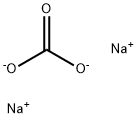
- 497-19-8
- CH2O3.2Na
- 105.99
- All (113)
- China (64)
- (113)
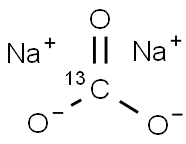
- 93673-48-4
- CNa2O3
- 107
- All (0)
- China (0)
- (0)
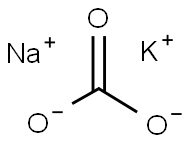
- 10424-09-6
- CKNaO3
- 122.1
- All (0)
- China (0)
- (0)
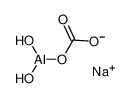
- 16482-55-6
- CH2AlNaO5
- 143.99500
- All (0)
- China (0)
- (0)
- 6132-02-1
- CH20Na2O13
- 286.14
- All (3)
- China (1)
- (3)
- 5968-11-6
- CH5NaO4
- 104.04
- All (7)
- China (4)
- (7)
- 24551-51-7
- CH20Na2O13
- 286.14
- All (3)
- China (1)
- (3)
- 57127-86-3
- CNaNpO5
- 351.99700
- All (0)
- China (0)
- (0)
- 85135-19-9
- CH2NaNpO6
- 370.01300
- All (0)
- China (0)
- (0)
- 85135-20-2
- CH2NaO6Pu
- 377.01300
- All (0)
- China (0)
- (0)
Related Products More >

- 497-19-8
- USD 240.0000
- 25kg
- 497-19-8
- USD 200.0000
- 25kg
- 497-19-8
- USD 238.0000
- 40kg
- 96036-03-2
- Request For Quotation
- 9004-82-4
- Request For Quotation
- 9000-11-7
- Request For Quotation
- 68603-42-9
- Request For Quotation


The differences between washing soda and baking soda (sodium bicarbonate, NaHCO₃) are both chemical and functional. Structurally, baking soda has an additional hydrogen atom and an extra oxygen atom in its bicarbonate ion (HCO₃⁻) compared to the carbonate ion in washing soda. These structural disparities result in significant differences in their chemical reactivity and practical applications. Baking soda is a mild base. When it comes into contact with acids, it rapidly reacts to produce carbon dioxide gas. This property makes it an essential ingredient in baking, where the release of carbon dioxide causes dough and batters to rise, creating a light and airy texture. In contrast, washing soda is a stronger base with a higher pH value. It doesn't react with acids to produce gas in the same quick and visible manner as baking soda. Instead, when heated to very high temperatures, above 850°C, it decomposes into sodium oxide and carbon dioxide. In terms of solubility, washing soda is more soluble in water than baking soda. This higher solubility allows it to dissolve grease and break down minerals more effectively, making it a superior choice for heavy - duty cleaning tasks.
Washing soda plays a crucial role in detergent formulations. As a water - softening agent, it interacts with calcium and magnesium ions present in hard water. These ions can form insoluble compounds with soap and detergent surfactants, reducing their cleaning efficiency. Washing soda reacts with calcium and magnesium ions to form insoluble carbonates, such as calcium carbonate (CaCO₃) and magnesium carbonate (MgCO₃). By removing these interfering ions from the water, it enables surfactants in detergents to lather better and penetrate fabrics more effectively, resulting in improved dirt and stain removal. Additionally, as a strong base, washing soda participates in the saponification process. It breaks down fatty acids and oils, converting them into water - soluble soaps. This makes it highly effective for degreasing laundry stained with oil, as well as for cleaning kitchen surfaces and oven racks caked with grease. It also acts as a pH buffer, maintaining a high pH level in cleaning solutions. This alkaline environment helps dissolve organic matter and prevents the redeposition of dirt onto cleaned surfaces or fabrics.
In the field of water treatment, washing soda has several important applications. In industrial settings, it is used to prevent scale buildup in boilers and cooling systems. The calcium and magnesium ions in water can form hard deposits over time, which not only reduce the efficiency of these systems but can also cause damage. Washing soda precipitates these ions out of the water, protecting the equipment. In wastewater treatment, it is employed to neutralize acidic wastewater. By adjusting the pH level, it makes the wastewater more suitable for further treatment processes. It also aids in the coagulation of suspended particles, making it easier to filter and purify the water.
The production of washing soda has evolved over time. Historically, it was obtained from sources like plant ashes or certain mineral deposits. However, today, the Solvay process, also known as the ammonia - soda process, is the predominant method for large - scale production. This process involves a series of chemical reactions starting with sodium chloride (common salt), ammonia, carbon dioxide, and water. First, sodium bicarbonate is formed through a reaction between these substances. Then, by heating the sodium bicarbonate, it decomposes into sodium carbonate, carbon dioxide, and water. The carbon dioxide and ammonia used in the process can be recycled, making it an efficient and cost - effective production method. Another way to obtain washing soda is by mining natural deposits of minerals such as trona (Na₂CO₃·NaHCO₃·2H₂O) or nahcolite. These minerals are processed to remove water and bicarbonate components, leaving behind sodium carbonate.
In daily life, washing soda has numerous practical applications. Adding a small amount of washing soda to laundry detergent can significantly boost its cleaning power, especially when dealing with heavily soiled clothes or when washing in hard water conditions. It can be mixed with water to create a powerful cleaning solution for various household surfaces. This solution is effective for scrubbing floors, cleaning tile grout, and removing stubborn stains from countertops and stovetops. Some people also use it as a substitute for commercial dishwasher detergents, although it's important to handle it with care due to its caustic nature. In pool maintenance, washing soda can be used to adjust the pH levels of swimming pools, ensuring that the water remains balanced and that pool equipment is protected from corrosion.
In the paper and pulp industry, washing soda is used in the chemical pulping process. The goal of this process is to separate cellulose fibers from wood, which is the main raw material for paper production. Wood contains lignin, a complex polymer that binds the cellulose fibers together. Sodium carbonate helps to break down lignin, making it possible to separate the cellulose fibers. Once separated, these fibers can be further processed and refined to create paper products.
In daily life, washing soda still has several practical applications. For household cleaning, a diluted solution of washing soda can be used to scrub floors, walls, and kitchen surfaces. It is particularly effective in removing stubborn grease stains from stovetops and ovens. In laundry, it can be added to the wash water as a laundry booster. In hard water areas, it helps to improve the cleaning performance of regular laundry detergents, ensuring that clothes come out cleaner and brighter. It can also be used to make homemade cleaning products, such as all - purpose cleaners and stain removers. For example, making a paste by mixing washing soda with a small amount of water can be applied to stains on fabrics or carpets and left to sit before being washed or vacuumed away.
The production of washing soda has evolved over time. Historically, it was obtained from natural sources. One source was mineral deposits, such as trona ore, which contains sodium carbonate sesquicarbonate, Na₂CO₃·NaHCO₃·2H₂O. Another source was the ashes of certain plants, especially seaweed, which were rich in sodium compounds. Today, the majority of sodium carbonate is produced through the Solvay process. This process begins with the carbonation step, where carbon dioxide (CO₂) is passed through a solution of sodium chloride (NaCl) and ammonia (NH₃). This reaction results in the formation of sodium bicarbonate (NaHCO₃) and ammonium chloride (NH₄Cl). The sodium bicarbonate precipitate is then filtered out and subjected to calcination, which involves heating it to a high temperature. This causes the sodium bicarbonate to decompose into sodium carbonate, releasing carbon dioxide and water in the process. The carbon dioxide and ammonia can be recycled back into the process, making it relatively efficient and cost - effective.
When handling washing soda, certain safety precautions should be taken. Although it is less caustic than some other alkaline substances like sodium hydroxide, it can still cause skin and eye irritation. When working with concentrated solutions, it is advisable to wear gloves and protective eyewear to prevent any accidental contact. Inhalation of the dust can also irritate the respiratory tract, so working in a well - ventilated area is important. It should be stored in a dry place, as it is hygroscopic and can absorb moisture from the air, which may affect its quality and performance over time.
When comparing washing soda to baking soda, which is sodium bicarbonate (NaHCO₃), several differences become apparent. At the most basic level, the difference lies in their chemical structure. Washing soda contains the carbonate ion (CO₃²⁻), while baking soda has the bicarbonate ion (HCO₃⁻). This structural disparity leads to significant variations in their properties. In terms of alkalinity, washing soda is much more alkaline. When dissolved in water, a solution of sodium carbonate typically has a pH in the range of 11 - 12, creating a highly basic environment. On the other hand, sodium bicarbonate solutions are only mildly alkaline, with a pH around 8 - 9. This difference in alkalinity makes washing soda more effective for heavy - duty cleaning tasks that require the breakdown of tough grease and grime, while baking soda is better suited for milder cleaning and deodorizing applications.
Solubility is another area where the two compounds diverge. Washing soda exhibits higher solubility in water, especially at elevated temperatures. This characteristic allows it to dissolve more readily in hot water, which is often used in laundry and cleaning processes. The enhanced solubility enables washing soda to quickly disperse in the cleaning medium and interact with dirt and stains. Baking soda, on the contrary, has lower solubility, and its effectiveness is not as closely tied to temperature.
Reactivity also sets them apart. Baking soda is well - known for its decomposition when heated, releasing carbon dioxide gas. This property is what makes it a key ingredient in baking, as the released CO₂ causes dough and batters to rise, creating a light and fluffy ure. Washing soda, however, is thermally stable and does not undergo such decomposition under normal conditions. This stability makes it suitable for high - temperature industrial processes where its chemical composition needs to remain unchanged.
In detergent formulations, washing soda plays multiple vital roles. As a water softener, it is highly effective in dealing with hard water. Hard water contains calcium (Ca²⁺) and magnesium (Mg²⁺) ions, which can react with soap to form insoluble "scum" that reduces the cleaning power of the soap. Washing soda reacts with these metal ions, forming insoluble carbonates such as CaCO₃ and MgCO₃. These precipitates can then be easily removed, allowing the surfactants in the detergent to work more efficiently. Additionally, its high alkalinity helps in the process of saponification, where it reacts with fats and oils to convert them into soap - like molecules. This aids in the removal of greasy stains from fabrics. Washing soda also acts as a pH buffer, maintaining the optimal pH level for the cleaning process. It helps to keep the solution alkaline, which is beneficial for the action of many cleaning agents.
In the water treatment industry, washing soda has several important applications. It is used to adjust the pH of water. In cases where water is too acidic, adding sodium carbonate can raise the pH to a more neutral or slightly alkaline range. This is crucial in many industrial processes, as well as in municipal water supplies, as a proper pH level helps to prevent corrosion of pipes and ensures the effectiveness of other water treatment chemicals. It also plays a role in the removal of heavy metals from water. By reacting with heavy metal ions such as lead, zinc, and cadmium, it forms insoluble carbonates that can be filtered out, thereby purifying the water.