


 Home
Home
Hi, I'd like to ask—what happens when francium reacts with water? Is the reaction violent? How does francium's position in the periodic table affect its reactivity with water compared to other alkali metals? What are the products of the reaction, and are there any safety considerations due to its high reactivity? Thanks!
What Happens When Francium Reacts with Water and Why Is It So Reactive?
Related Encyclopedia

- 36840-25-2
- Fr
- 223.00000
- All (0)
- China (0)
- (0)
- 32119-90-7
- DOT
- 22.02930
- All (50)
- China (13)
- (50)
- 20272-95-1
- DOT
- 21.02960
- All (50)
- China (13)
- (50)

- 358616-29-2
- H3O2
- 35.02260
- All (50)
- China (13)
- (50)
- 61468-85-7
- OT2
- 23.03120
- All (50)
- China (13)
- (50)
- 53774-37-1
- OT2
- 24.03130
- All (50)
- China (13)
- (50)
- 32113-92-1
- HOT
- 22.02320
- All (50)
- China (13)
- (50)
- 32119-89-4
- HOT
- 21.02310
- All (50)
- China (13)
- (50)
- 32113-93-2
- DOT
- 23.02930
- All (50)
- China (13)
- (50)
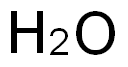
- 7732-18-5
- H2O
- 18.01
- All (50)
- China (13)
- (50)
Related Products More >

- 9003-05-8
- USD 30.0000
- 25kg
- 9003-05-8
- USD 30.0000
- 25kg
- 1336-21-6
- CNY 500.0000
- 1ton


The reaction of francium with water is based on a simple yet powerful chemical principle. Water is composed of H₂O molecules, and francium, being highly reactive, will displace the hydrogen in water. The process starts with francium atoms losing their single valence electron. These electrons are transferred to the hydrogen in water molecules. As a result, hydrogen gas (H₂) is liberated. The remaining part of the water molecule combines with the francium ion to form francium hydroxide (FrOH). The balanced chemical equation for this reaction, 2Fr + 2H₂O → 2FrOH + H₂↑, clearly shows the reactants and products involved.
This reaction is exothermic, meaning it releases a large amount of heat. In the case of other, lighter alkali metals such as lithium, sodium, and potassium, when they react with water, the heat generated can be enough to ignite the hydrogen gas produced. This often leads to flames and sometimes small explosions. For francium, its position in the periodic table makes it even more reactive than these lighter alkali metals. Francium is located at the bottom of Group 1 and in period 7. As we move down a group in the periodic table, the atomic radius of elements increases. With an increase in atomic radius, the outermost electron is farther from the nucleus and is less strongly attracted to it. This makes it easier for the electron to be lost, increasing the element's reactivity. Francium, having the largest atomic radius among the naturally occurring alkali metals, has the lowest ionization energy in the group. Ionization energy is the energy required to remove an electron from an atom. A low ionization energy means that francium can lose its valence electron with relative ease, resulting in a reaction with water that is expected to be much more violent.
The potential violence of francium's reaction with water is not just a theoretical concept. Given its extreme reactivity, the heat generated during the reaction could be so intense that it would rapidly heat up the surrounding hydrogen gas and cause a violent explosion. However, studying this reaction in a practical sense is extremely difficult. Francium is one of the rarest elements on Earth. It is highly radioactive, with the longest lived isotope, ²²³Fr, having a half life of only about 22 minutes. This short half life means that any sample of francium decays quickly into other elements, making it hard to obtain and work with in a laboratory setting. Most of what we know about how francium would react with water is based on extrapolating from the well studied reactions of other alkali metals and on theoretical chemical models.
When considering the products of the reaction, francium hydroxide is a strong base. In solution, it would dissociate into francium ions (Fr⁺) and hydroxide ions (OH⁻). The presence of these ions can have a significant impact on the pH of the solution, making it highly basic. The hydrogen gas produced is highly flammable, adding to the potential danger of the reaction.
Safety considerations when dealing with francium are of utmost importance. Due to its radioactivity, special precautions must be taken to prevent radiation exposure. Any experiment involving francium would need to be carried out in a highly controlled environment, such as a radiation shielded laboratory. Researchers handling francium would have to wear appropriate protective gear, including lead lined suits and gloves, to shield themselves from the alpha particles emitted during francium's radioactive decay. Additionally, because of the expected violent reaction with water, even trace amounts of moisture in the air could pose a risk. So, all handling of francium would need to be done in a sealed, inert atmosphere to prevent any accidental contact with water or moisture.
Understanding the reaction of francium with water not only helps us in the field of chemistry but also has implications in other areas. In nuclear chemistry, knowledge of francium's properties and reactions can contribute to a better understanding of radioactive decay processes and nuclear reactions. In materials science, the study of highly reactive elements like francium can inspire the development of new materials that can withstand extreme chemical reactions or radiation. In environmental science, although francium is extremely rare in the environment, understanding its reactivity helps in predicting how other highly reactive and radioactive substances might behave if they were to enter the environment.
In the periodic table, as we move down Group 1, the atomic size increases. This increase in atomic size leads to a decrease in the effective nuclear charge experienced by the outermost electron. The outermost electron in francium is much farther from the nucleus compared to that in lighter alkali metals like lithium, sodium, or potassium. As a result, the attraction between the nucleus and the outermost electron is weaker, and it becomes extremely easy for francium to lose that electron during a chemical reaction. This ease of losing an electron translates into a high reactivity.
For instance, when sodium reacts with water, it already produces a vigorous reaction. Sodium skates across the surface of the water, fizzes, and may even catch fire due to the heat generated by the reaction. The reaction between sodium and water is as follows: 2Na(s) + 2H₂O(l) → 2NaOH(aq) + H₂(g). The heat released can ignite the hydrogen gas produced, creating a small explosion. Potassium reacts even more violently than sodium. When potassium comes in contact with water, it bursts into a large, colorful flame almost immediately, and the reaction is so exothermic that the hydrogen gas ignites instantly.
Given francium's position below potassium in the periodic table, its reaction with water would be far more intense. The reaction would follow the same general pattern as other alkali metals. The chemical equation for the reaction between francium and water is 2Fr(s) + 2H₂O(l) → 2FrOH(aq) + H₂(g). A vast amount of heat would be released during this reaction, enough to cause the immediate ignition of the hydrogen gas produced. In fact, the reaction might be so explosive that it could shatter any container used to hold the reaction, spreading radioactive francium hydroxide and other radioactive materials.
Francium hydroxide, the product of the reaction, is a strong base. Just like other alkali metal hydroxides, it would dissociate completely in water, releasing hydroxide ions (OH⁻). This would make the resulting solution highly basic, with a high pH level. If the reaction occurred in an open environment, the francium hydroxide could contaminate surrounding areas, reacting with other substances and potentially causing damage to materials and harm to living organisms.
Safety considerations when dealing with francium are of utmost importance. Due to its radioactivity, even the smallest amount of francium requires special handling. Francium emits alpha particles, which can cause significant damage to living tissue if the element is ingested, inhaled, or comes into contact with the skin. Specialized laboratories with advanced shielding, such as lead or concrete barriers, are needed to protect researchers from radiation exposure.
When considering a reaction with water, the setup would need to be extremely well contained. Any attempt to conduct this reaction would likely involve remote handling techniques, where the francium and water are introduced to each other using robotic arms or other remote controlled devices. In case of an accidental release of francium or the products of its reaction, strict decontamination procedures would be necessary. These procedures would involve using substances that can bind to radioactive materials and safely remove them from the area.
Moreover, because of the explosive nature of the reaction, the containment vessel would need to be able to withstand a large amount of pressure. Even a small miscalculation in handling francium during the reaction with water could lead to a catastrophic event, releasing radioactive materials into the environment and endangering the health and safety of everyone in the vicinity. The rarity of francium means that there is very little room for error, as each atom is precious and difficult to produce. Scientists studying francium must take every precaution to ensure that the element is used effectively and safely in research, while also minimizing the risks associated with its highly reactive and radioactive nature.
The fundamental reason behind the reactivity of alkali metals with water lies in their strong tendency to lose the single electron in their outermost shell, thereby forming a cation with a charge of +1. This electron losing process is closely related to their low ionization energies. Ionization energy refers to the energy required to remove an electron from an atom in the gaseous state. As we move down group 1 of the periodic table, the atomic size of alkali metals increases. With the increase in atomic size, the outermost electron is located farther from the positively charged nucleus, and the shielding effect of inner shell electrons also becomes stronger. As a result, the attractive force between the nucleus and the outermost electron weakens, leading to a decrease in ionization energy.
Francium has the lowest ionization energy among all alkali metals. When francium is placed in water, the single valence electron of francium is very easily donated to a water molecule. Water can be considered as (H O H). In this reaction, the water molecule accepts the electron from francium. The chemical equation for the reaction of alkali metals with water is (2M+2H_2Orightarrow 2MOH + H_2uparrow), where (M) represents an alkali metal. For francium ((M = Fr)), the products of the reaction are francium hydroxide ((FrOH)) and hydrogen gas ((H_2)).
This reaction is highly exothermic, which means a large amount of heat is released during the process. When lighter alkali metals such as sodium or potassium react with water, the heat generated can ignite the hydrogen gas produced, resulting in flames or even small explosions. Given that francium is more reactive than these lighter alkali metals, the heat released during its reaction with water is likely to be much greater, and the reaction rate is also expected to be extremely fast. The rapid generation of a large volume of hydrogen gas and the intense heat release could very well lead to a violent explosion, which is far more powerful than the reactions of other alkali metals.
Francium's position in the periodic table is crucial in determining its reactivity compared to other alkali metals. As mentioned before, as we move down group 1, from lithium at the top to francium at the bottom, the atomic radius gradually increases. Lithium has a relatively small atomic radius, and its outermost electron is tightly held by the nucleus, so it requires more energy to remove this electron, resulting in a relatively higher ionization energy compared to the lower positioned alkali metals. In contrast, francium's large atomic size means that its outermost electron is much more loosely bound. This makes it extremely easy for francium to lose its valence electron and participate in chemical reactions, thus making it the most reactive among the alkali metals when reacting with water.
In terms of safety, dealing with francium poses numerous challenges. Firstly, francium has no stable isotopes. Its longest lived isotope, (^{223}text{Fr}), has a half life of only about 22 minutes. This short half life means that francium decays quickly, emitting alpha particles during the decay process. Alpha particles can cause significant damage to living tissues if they come into contact with the human body, leading to radiation induced health problems such as cell damage and an increased risk of cancer.
Secondly, considering its reaction with water, if francium were to react with water, the explosive release of hydrogen gas could scatter radioactive francium hydroxide particles into the surrounding environment. These radioactive particles could contaminate the air, water, and soil, posing a serious threat to the ecological environment and human health. Moreover, the intense heat generated during the reaction could vaporize francium or its compounds, releasing radioactive vapors. These vapors could be inhaled by people in the vicinity, further exacerbating the radiation risk.
In real world scenarios, due to the extreme rarity of francium, with an estimated total amount in the Earth's crust at any given time being less than 30 grams, and the associated difficulties in isolating and handling it, direct experiments on its reaction with water are almost non existent. However, based on the well established periodic trends and the known chemical properties of alkali metals, scientists can make reasonable predictions about the violent nature of francium's reaction with water and the associated safety hazards.