


 Home
Home
Hi, I'd like to ask—What is the solubility of sodium carbonate in water? Does temperature affect its solubility, and if so, how? How does its solubility compare to other carbonates, like calcium carbonate? Thanks!
How Soluble Is Sodium Carbonate in Water?
Related Encyclopedia
- 32119-90-7
- DOT
- 22.02930
- All (50)
- China (13)
- (50)
- 20272-95-1
- DOT
- 21.02960
- All (50)
- China (13)
- (50)

- 358616-29-2
- H3O2
- 35.02260
- All (50)
- China (13)
- (50)
- 61468-85-7
- OT2
- 23.03120
- All (50)
- China (13)
- (50)
- 53774-37-1
- OT2
- 24.03130
- All (50)
- China (13)
- (50)
- 32113-92-1
- HOT
- 22.02320
- All (50)
- China (13)
- (50)
- 32119-89-4
- HOT
- 21.02310
- All (50)
- China (13)
- (50)
- 32113-93-2
- DOT
- 23.02930
- All (50)
- China (13)
- (50)
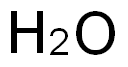
- 7732-18-5
- H2O
- 18.01
- All (50)
- China (13)
- (50)
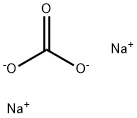
- 497-19-8
- CH2O3.2Na
- 105.99
- All (113)
- China (64)
- (113)
Related Products More >

- CNY Request For Quotation
- CNY Request For Quotation
- Request For Quotation
- 9003-05-8
- USD 30.0000
- 25kg
- 9003-05-8
- USD 30.0000
- 25kg
- 1336-21-6
- CNY 500.0000
- 1ton
- 497-19-8
- USD 240.0000
- 25kg
- 497-19-8
- USD 200.0000
- 25kg


1. Solubility of Sodium Carbonate in Water
Sodium carbonate is an ionic compound composed of sodium cations (Na⁺) and carbonate anions (CO₃²⁻). In water, it dissociates into these ions, a process facilitated by the polar nature of water molecules. At 20°C, approximately 21.5 grams of sodium carbonate can dissolve in 100 milliliters of water. As temperature increases, this solubility rises dramatically: at 100°C, the solubility jumps to around 45.5 grams per 100 mL of water. This trend is characteristic of most ionic compounds, where higher temperatures provide more energy to overcome the lattice energy holding the solid together, enabling greater dissociation.
2. How Temperature Affects Solubility
The relationship between temperature and sodium carbonate’s solubility is endothermic, meaning the dissolution process absorbs heat. According to Le Chatelier’s principle, increasing temperature shifts the equilibrium toward the dissolved products to absorb the added heat, thereby enhancing solubility. This can be visualized in a solubility curve, where sodium carbonate’s curve slopes steeply upward with temperature.
Case Study: Solubility Data for Sodium Carbonate
| Temperature (°C) | Solubility (g100 mL H₂O) |
|------------------|---------------------------|
| 0| 7.0 |
| 20 | 21.5|
| 40 | 49.0|
| 60 | 46.0 |
| 80 | 43.9|
| 100| 45.5|
Note: The slight decrease at 60°C is due to the formation of a hydrate (Na₂CO₃·10H₂O) at lower temperatures, which affects the anhydrous form’s solubility curve.This data illustrates that solubility increases steadily with temperature, except for minor fluctuations due to hydration effects. In practical terms, this means hot water can dissolve more sodium carbonate, making it useful in applications requiring high concentrations, such as in soap-making or textile processing.
3. Comparison with Other Carbonates: Calcium Carbonate
Calcium carbonate (CaCO₃), a common carbonate found in minerals like limestone, exhibits extremely low solubility in water. At 25°C, only about 0.0013 grams of CaCO₃ dissolves in 100 mL of water—over 16,000 times less than sodium carbonate. This stark difference arises from two key factors:
1. Ionic Charge and Lattice Energy: Calcium ions (Ca²⁺) and carbonate ions (CO₃²⁻) carry higher charges than sodium ions (Na⁺). The stronger electrostatic attractions in CaCO₃’s lattice structure require more energy to break, reducing solubility.
In acidic conditions, this equilibrium shifts right, increasing solubility, but in neutral or basic water, solubility remains minimal. For sodium carbonate, the Na⁺ ion does not significantly affect pH, allowing straightforward dissolution.
Case Study: Natural Occurrences and Industrial Applications
Sodium Carbonate: Abundant in mineral deposits (e.g., trona) and extracted via dissolution in hot water due to its temperature-dependent solubility.Calcium Carbonate: Insoluble nature makes it ideal for structural uses (e.g., building materials) but problematic in water systems, where it forms scale (e.g., in pipes or boilers).
For example, in water treatment, sodium carbonate Here, the soluble sodium carbonate provides carbonate ions to react with calcium, leveraging the vast solubility difference to drive the reaction to completion.
4. Solutions and Applications
A. Industrial Uses of Sodium Carbonate’s Solubility
Glass Production: High solubility allows efficient mixing of sodium carbonate with silica and calcium oxide at high temperatures.Detergents: In warm water, sodium carbonate dissolves to release carbonate ions, which soften water by precipitating calcium and magnesium ions (similar to the water treatment example above).
B. Managing Calcium Carbonate’s Low Solubility
Acid Treatment: In plumbing, acidic solutions (e.g., vinegar) dissolve calcium carbonate scale Water Softening: Ion exchange systems replace calcium ions with sodium ions, preventing insoluble carbonate formation.
C. Laboratory Considerations
When working with carbonates:Use warm water to dissolve sodium carbonate for higher concentrations. For calcium carbonate, avoid aqueous solutions unless reacting with acids or carbon dioxide (e.g., in the formation of temporary hard water).
Sodium carbonate’s high and temperature-sensitive solubility in water stems from its ionic structure and endothermic dissolution process, making it a versatile compound in industrial and domestic applications. In contrast, calcium carbonate’s low solubility is a result of stronger ionic bonds and pH-dependent behavior, limiting its use to insoluble roles but enabling applications like scale formation or acid neutralization. Understanding these differences is critical in fields ranging from chemistry to engineering, where solubility directly impacts process efficiency and material performance.
The solubility of sodium carbonate in water generally increases as the temperature rises. This means that more sodium carbonate can dissolve in water at higher temperatures compared to lower temperatures. However, it’s worth noting that the solubility curve of sodium carbonate has a maximum at around 35.4°C, after which the solubility starts to decrease slightly.
Calcium carbonate (CaCO₃), on the other hand, is much less soluble in water compared to sodium carbonate. Calcium carbonate is considered almost insoluble in pure water, with a solubility of about 0.2 grams per liter at 25°C. This low solubility is due to the strong electrostatic bonds between the carbonate anion (CO₃²⁻) and the calcium cation (Ca²⁺), which resist solvation by water molecules.
However, calcium carbonate can dissolve in water that contains dissolved carbon dioxide, which forms carbonic acid (H₂CO₃). This weak acid can react with calcium carbonate to form soluble bicarbonate ions (HCO₃⁻), a process that contributes to the erosion of limestone and marble.
Temperature: As mentioned, the solubility of sodium carbonate increases with temperature up to a certain point, while calcium carbonate’s solubility remains very low and is not significantly affected by temperature changes.
Presence of Acids: Both sodium carbonate and calcium carbonate can dissolve in acidic solutions. Sodium carbonate forms sodium bicarbonate (NaHCO₃) in the presence of acids, while calcium carbonate forms calcium bicarbonate (Ca(HCO₃)₂), which is more soluble.
Water Hardness: Sodium carbonate is often used to soften hard water, which typically contains calcium and magnesium ions. It reacts with these ions to form insoluble precipitates, thereby reducing water hardness.
Sodium Carbonate: Widely used in industries such as glass making, soap and detergent production, and water treatment. Its solubility and alkaline nature make it effective for various chemical processes.
Calcium Carbonate: Commonly used in construction materials like limestone and marble, as well as in the production of antacids and as a dietary calcium supplement. Its low solubility makes it useful for applications where a solid form is required.
In summary, sodium carbonate is soluble in water and its solubility increases with temperature, while calcium carbonate is poorly soluble in water but can dissolve in acidic conditions. Understanding these differences is crucial for their respective industrial and practical applications. If you have any more questions or need further clarification, feel free to ask!
Temperature significantly affects the solubility of sodium carbonate. Generally, the solubility of sodium carbonate increases with increasing temperature up to a certain point. For example, from 0°C to 35°C, the solubility increases dramatically. However, beyond 35°C, the solubility starts to decrease slightly. This behavior is somewhat unusual compared to many other salts, which typically show either increasing solubility with temperature or a more consistent trend. The reason for this peculiar behavior is related to the hydration and dehydration processes of sodium carbonate at different temperatures.
Sodium carbonate is much more soluble in water compared to calcium carbonate (CaCO₃). Calcium carbonate is considered almost insoluble in pure water, with a solubility of only about 0.2 gL at 25°C. In contrast, sodium carbonate is highly soluble, as previously mentioned. The difference in solubility is due to the nature of the metal cations involved. Sodium ions (Na⁺) form weaker electrostatic bonds with the carbonate anion (CO₃²⁻) compared to calcium ions (Ca²⁺), allowing sodium carbonate to dissolve more readily in water. Additionally, calcium carbonate can dissolve in water that contains dissolved carbon dioxide, which forms carbonic acid and helps to dissolve the carbonate.
The solubility differences between sodium carbonate and calcium carbonate are primarily due to the strength of the ionic bonds and the hydration energy of the ions. Sodium ions are smaller and have a lower charge density compared to calcium ions, making them easier to solvate by water molecules. In contrast, calcium carbonate forms strong electrostatic bonds that are difficult to break with water alone.
Sodium carbonate is widely used in various industrial processes, such as glass making, pulp and paper production, soap and detergent manufacturing, and as a water softener. Its high solubility makes it effective in these applications. Calcium carbonate, on the other hand, is used in construction materials like cement and limestone, and as a dietary calcium supplement. Its low solubility is beneficial in these contexts, as it provides a stable and durable material.
In industrial applications where sodium carbonate is used, temperature control is crucial to ensure optimal solubility. For example, in glass making, the temperature must be carefully managed to dissolve the right amount of sodium carbonate to achieve the desired properties of the glass. Similarly, in water treatment processes, the temperature should be adjusted to maximize the solubility of sodium carbonate for effective water softening.
When selecting between sodium carbonate and calcium carbonate for a particular application, the solubility properties must be considered. For processes requiring a highly soluble compound, sodium carbonate is preferred. For applications where a stable, insoluble material is needed, calcium carbonate is more suitable. Understanding these properties helps in optimizing industrial processes and achieving the desired outcomes.
In summary, sodium carbonate is highly soluble in water, with its solubility peaking around 35°C before decreasing slightly at higher temperatures. This contrasts with calcium carbonate, which is almost insoluble in water. The differences in solubility are due to the nature of the metal cations and their interactions with water molecules. Temperature control and material selection based on solubility properties are essential considerations in various industrial and household applications.