


 Home
Home
Hi, I'd like to ask—Are sodium carbonate and alcohol polar or nonpolar compounds? How to determine the molecular polarity of each? How do their polarity differences affect solubility and chemical properties? Does sodium carbonate react with alcohol? Thanks!
Are Sodium Carbonate and Alcohol Polar or Nonpolar Compounds?
Related Encyclopedia
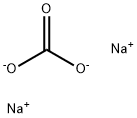
- 497-19-8
- CH2O3.2Na
- 105.99
- All (113)
- China (64)
- (113)
- 93673-48-4
- CNa2O3
- 107
- All (0)
- China (0)
- (0)
- 10424-09-6
- CKNaO3
- 122.1
- All (0)
- China (0)
- (0)
- 16482-55-6
- CH2AlNaO5
- 143.99500
- All (0)
- China (0)
- (0)
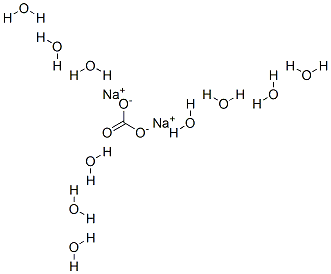
- 6132-02-1
- CH20Na2O13
- 286.14
- All (3)
- China (1)
- (3)
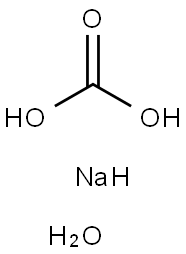
- 5968-11-6
- CH5NaO4
- 104.04
- All (7)
- China (4)
- (7)
- 24551-51-7
- CH20Na2O13
- 286.14
- All (3)
- China (1)
- (3)
![2-[2-hydroxyethyl(tetradecyl)amino]ethanol](https://chemcloud-1304660855.cos.ap-shanghai.myqcloud.com/compound/646107526b314f96afdf50fea56f6788.png?imageMogr2/format/webp)
- 18924-66-8
- C18H39NO2
- 301.51000
- All (0)
- China (0)
- (0)
![Ethanol, 2-[(3-bromophenyl)methoxy]-](https://chemcloud-1304660855.cos.ap-shanghai.myqcloud.com/compound/e7ded56e48464d20b92f2bb0fab6b69d.png?imageMogr2/format/webp)
- 1149358-73-5
- C9H11BrO2
- 231.08600
- All (0)
- China (0)
- (0)
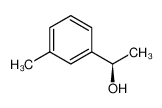
- 42070-91-7
- C9H12O
- 136.19100
- All (0)
- China (0)
- (0)
Related Products More >

- 68890-66-4
- CNY Request For Quotation
- 68890-66-4
- CNY Request For Quotation
- 64-17-5
- Request For Quotation
- 111-76-2
- Request For Quotation
- 110-80-5
- Request For Quotation
- 67-56-1
- Request For Quotation
- 67-56-1
- CNY 2400.0000
- 1ton
- 122-99-6
- CNY 3.0000
- 25kg


First off, sodium carbonate is a polar compound. It’s an ionic compound made up of sodium ions (Na⁺) and carbonate ions (CO₃²⁻). Because of the way these ions interact, there’s a significant separation of electrical charge within the compound. This separation creates a polar nature. In simple terms, the sodium and carbonate parts of the compound have different electronegativities, meaning they attract electrons differently, which leads to a polar molecule overall.
On the other hand, alcohol can be a bit more complex. When we talk about alcohol in a general sense, we’re usually referring to ethanol, which is the kind you might find in beverages. Ethanol has both polar and nonpolar characteristics. The hydroxyl group (OH) in ethanol is polar because oxygen is more electronegative than hydrogen, creating a dipole moment. However, the rest of the ethanol molecule, specifically the ethyl group (C₂H₅), is nonpolar. This combination makes ethanol a polar molecule overall, but it’s what we call a “polar molecule with some nonpolar character.”
Now, let’s talk about how we determine the molecular polarity of each. For sodium carbonate, it’s pretty straightforward because of its ionic nature. Ionic compounds are inherently polar due to the transfer of electrons between atoms, creating charged particles. In the case of sodium carbonate, the sodium atoms give up electrons to the oxygen atoms in the carbonate group, resulting in ions that have distinct positive and negative charges.
For alcohol, like ethanol, you have to look at the molecular structure. The key is to identify the electronegativity differences between the atoms in the molecule. In ethanol, the oxygen in the hydroxyl group is more electronegative than the hydrogen it’s bonded to, which creates a polar bond. When you look at the whole molecule, the polar hydroxyl group dominates, making ethanol a polar molecule. But because of the nonpolar ethyl group, ethanol can interact with both polar and nonpolar substances to some extent.
The polarity differences between sodium carbonate and alcohol have a big impact on their solubility and chemical properties. Sodium carbonate, being highly polar, dissolves really well in water, which is also a polar solvent. Water molecules can surround the sodium and carbonate ions, separating them and allowing the compound to dissolve easily. This is why you can mix sodium carbonate in water to make solutions for various uses, like cleaning or in the lab.
Alcohol, with its polar nature, also dissolves well in water. The polar hydroxyl group can form hydrogen bonds with water molecules, which helps it mix easily. This is why you can mix alcohol and water in any proportion, and they’ll stay mixed. However, because alcohol has some nonpolar character too, it can also dissolve some nonpolar substances better than water can. This makes alcohol a versatile solvent for things like oils or certain organic compounds.
When it comes to chemical properties, the polarity affects how these compounds react with other substances. Sodium carbonate, being ionic and polar, can react with acids to produce carbon dioxide gas. This is a classic reaction you might see in a baking soda and vinegar experiment. The carbonate ions react with the hydrogen ions from the acid to form CO₂, which is why you get fizzing and bubbling.
Alcohol, being a polar organic compound, can participate in a variety of chemical reactions. For example, it can react with acids to form esters, which are compounds with a fruity smell. This reaction is used in making perfumes and flavorings. The hydroxyl group in alcohol can also be oxidized to form other compounds like aldehydes or ketones, which is important in organic chemistry and biochemistry.
Now, about the reaction between sodium carbonate and alcohol. Generally, sodium carbonate doesn’t react directly with alcohol under normal conditions. They’re just not reactive enough with each other. However, if you were to mix them, you’d mostly just get a physical mixture. The alcohol might dissolve a bit of the sodium carbonate, but there wouldn’t be a chemical reaction like you’d see with an acid.
If you’re thinking of using these compounds together, it’s important to consider their properties and how they might interact in your specific situation. For example, if you’re mixing them for a cleaning solution, the alcohol might help dissolve some nonpolar dirt or grease, while the sodium carbonate could help with more polar stains or provide a basic environment to break down certain substances.
In summary, sodium carbonate is a polar ionic compound that dissolves well in water and reacts with acids, while alcohol is a polar organic compound that can dissolve both polar and nonpolar substances and participate in various organic reactions. Their polarity differences affect their solubility and chemical behavior, but they don’t typically react directly with each other. Understanding these properties can help you use them effectively in different applications.
Classification and Molecular Polarity Determination1. Sodium Carbonate (Ionic Compound)Polarity Classification: Ionic compounds are inherently polar due to the separation of positive and negative charges.Determination of Polarity:Formed by the transfer of electrons from sodium (metal) to carbonate (polyatomic ion).Contains discrete ions (Na⁺ and CO₃²⁻) with strong ionic bonds, leading to high meltingboiling points and solubility in polar solvents.Unlike covalent molecules, ionic compounds do not have "molecular polarity" in the traditional sense but exhibit extreme charge separation.2. Alcohols (Polar Covalent Compounds)Polarity Classification: Polar, with the degree of polarity depending on the hydrocarbon chain length:Low-molecular-weight alcohols (e.g., methanol, ethanol): Highly polar due to the dominant -OH group.
High-molecular-weight alcohols (e.g., octanol, C₈H₁₇OH): Less polar as the nonpolar hydrocarbon chain outweighs the -OH group’s polarity.Determination of Polarity:Electronegativity Difference: The O-H bond (ΔEN ≈ 1.4) and C-O bond (ΔEN ≈ 0.8) create permanent dipoles.Molecular Geometry: The bent shape of the -OH group (due to oxygen’s lone pairs) enhances the net dipole moment.Hydrogen Bonding: Polar alcohols form hydrogen bonds with water, a key indicator of polarity.Case StudiesCase 1: Sodium Carbonate’s Polarity and SolubilityObservation: Na₂CO₃ is highly soluble in water (a polar solvent) but insoluble in nonpolar solvents like hexane.Explanation:Water molecules (polar) surround and solvate the Na⁺ and CO₃²⁻ ions through ion-dipole interactions, breaking the ionic lattice.Nonpolar solvents lack the dipole moment needed to overcome ionic bonds, hence no solubility.Case 2: Alcohol Polarity and Solubility TrendsEthanol (C₂H₅OH):Soluble in water (miscible) due to strong hydrogen bonding between -OH groups and water molecules.Octanol (C₈H₁₇OH):Partially soluble in water. The long hydrocarbon chain reduces the effectiveness of hydrogen bonding, making it more lipophilic (soluble in nonpolar solvents like chloroform).Impact of Polarity Differences on Solubility and Chemical Properties1. SolubilitySodium Carbonate:Soluble in polar solvents (water) → ion-dipole interactions dominate.Insoluble in nonpolar solvents → no charge-dipole attraction.Alcohols:Solubility in water decreases with increasing carbon chain length (e.g., methanol > ethanol > octanol) due to reduced hydrogen bonding capability.Solubility in nonpolar solvents increases with chain length (e.g., octanol > ethanol in hexane) as the nonpolar "tail" dominates.2. Chemical PropertiesSodium Carbonate:Basicity: In water, CO₃²⁻ hydrolyzes to form OH⁻ ions, making solutions alkaline (e.g., Na₂CO₃ + H₂O ⇌ NaHCO₃ + NaOH).
Reactivity with Acids: Reacts vigorously with acids to produce CO₂ (e.g., Na₂CO₃ + 2HCl → 2NaCl + CO₂↑ + H₂O), a classic acid-base reaction.Alcohols:Hydrogen Bonding: Influences boiling points (e.g., ethanol boils at 78°C, higher than nonpolar hydrocarbons of similar molecular weight).AcidityReactivity: Mildly acidic at the -OH group (e.g., reacts with strong bases like Na to form alkoxides: 2C₂H₅OH + 2Na → 2C₂H₅ONa + H₂↑).Esterification: Reacts with carboxylic acids in acidic conditions to form esters (e.g., ethanol + acetic acid ⇌ ethyl acetate + water).Does Sodium Carbonate React with Alcohol?Under normal conditions, sodium carbonate (Na₂CO₃) and alcohols do not undergo a significant chemical reaction. Here’s the breakdown:1. Acid-Base Consideration:Alcohols are very weak acids (pKa ≈ 15–18), weaker than carbonic acid (pKa₁ ≈ 6.35).Na₂CO₃ acts as a base, but it is not strong enough to deprotonate alcohols (stronger bases like NaH or Na metal are required for alcohol deprotonation).2. Solubility and Ionic Interactions:Na₂CO₃ dissolves in polar solvents like water but is poorly soluble in alcohols (except low-molecular-weight alcohols, where some ion-dipole interactions may occur).In a mixture, Na₂CO₃ may remain as a solid or form a suspension in alcohols, with no chemical reaction.
Exception: Under high-temperature or specialized conditions (e.g., in the presence of a catalyst), sodium carbonate might act as a base in certain organic reactions involving alcohols (e.g., transesterification), but such cases are rare and require specific reagentsconditions.
Sodium Carbonate: Ionic, highly polar, soluble in water, reactive with acids, but inert toward alcohols under normal conditions.Alcohols: Polar covalent, solubility and polarity depend on chain length, capable of hydrogen bonding and reactions like esterification or metal deprotonation (with strong bases).Polarity’s Role: Dictates solubility ("like dissolves like") and chemical reactivity, with ionicpolar compounds favoring polar environments and nonpolar compounds favoring nonpolar environments.This analysis underscores the critical role of molecular structure and polarity in determining physical and chemical behaviors in chemistry.
Sodium Carbonate (Na₂CO₃)Sodium carbonate is an ionic compound composed of sodium cations (Na⁺) and carbonate anions (CO₃²⁻). Ionic compounds form through the complete transfer of electrons from a metal (sodium) to a nonmetal (carbon and oxygen in the carbonate group). This creates charged ions that are held together by strong electrostatic forces. In aqueous solutions, ionic compounds dissociate into ions, making them highly polar.
Alcohol (e.g., Ethanol, C₂H₅OH)Alcohols are covalent compounds containing a hydroxyl group (-OH) bonded to a carbon chain. The polarity of alcohols stems from the polar covalent O-H bond, where oxygen (high electronegativity: 3.44) attracts electrons more strongly than hydrogen (electronegativity: 2.20). This creates a dipole moment, making the hydroxyl group polar. While the carbon chain (nonpolar) affects overall polarity, the -OH group dominates in low-molecular-weight alcohols like ethanol, making them polar solvents.Related Questions: Polarity Determination, Solubility, and Chemical PropertiesHow to Determine Molecular Polarity
Sodium Carbonate (Ionic Polarity)Ionic compounds are inherently polar due to charged ions. The polarity is determined by the difference in electronegativity between the metal and nonmetal components. For Na₂CO₃, the large electronegativity gap between Na (0.93) and O (3.44) ensures complete electron transfer, forming ions.Key Factor: Ionic bonds = permanent charge separation = high polarity.
Alcohol (Covalent Polarity)For covalent molecules, polarity depends on:Electronegativity differences within bonds: In ethanol, the O-H bond (ΔEN = 1.24) is polar, while C-H bonds (ΔEN = 0.35) are nonpolar, and C-O bonds (ΔEN = 0.89) are moderately polar.
Molecular geometry: The bent shape of the -OH group (due to lone pairs on oxygen) creates an asymmetric distribution of charge, resulting in a net dipole moment.Key Factor: As the carbon chain lengthens (e.g., in octanol), the nonpolar hydrocarbon portion outweighs the -OH group, making higher alcohols less polar.Polarity Differences: Impact on Solubility1. Sodium Carbonate’s SolubilityPolar solvents (e.g., water): Highly soluble. The polar water molecules surround Na⁺ and CO₃²⁻ ions through ion-dipole interactions, breaking the ionic lattice.Nonpolar solvents (e.g., hexane): Insoluble. Nonpolar molecules cannot stabilize charged ions, lacking the necessary intermolecular forces.
Alcohol’s SolubilityLow-molecular-weight alcohols (e.g., methanol, ethanol): Highly soluble in water. The -OH group forms hydrogen bonds with water molecules, overcoming the nonpolar nature of the short carbon chain.High-molecular-weight alcohols (e.g., octanol): Less soluble in water. The large nonpolar hydrocarbon chain dominates, reducing hydrogen bonding efficiency with water.Nonpolar solvents (e.g., benzene): Moderate to high solubility. The nonpolar carbon chain interacts with nonpolar solvents via London dispersion forces, while the -OH group’s polarity has a minor effect.C. Polarity Differences: Impact on Chemical Properties1. Sodium CarbonateIonic reactivity: Reacts with acids to produce CO₂ (e.g., Na₂CO₃ + 2HCl → 2NaCl + H₂O + CO₂). The carbonate anion (CO₃²⁻) acts as a base, accepting protons in polar environments.Hydrolysis: In water, CO₃²⁻ hydrolyzes to form bicarbonate (HCO₃⁻) and OH⁻, making solutions basic (pH > 7). This is due to the high polarity enabling ion-water interactions.
AlcoholHydrogen bonding: Influences boiling points (e.g., ethanol boils at 78°C, higher than nonpolar hydrocarbons of similar molecular weight due to hydrogen bonds).Acidityalkalinity: Weakly acidic (e.g., ethanol donates a proton in strong base: C₂H₅OH + Na → C₂H₅ONa + H₂). The polarity of the O-H bond facilitates proton dissociation, though alcohols are weaker acids than water.Solvent properties: Polar alcohols dissolve polar or ionic compounds (e.g., salts in ethanol), while nonpolar regions dissolve nonpolar substances (e.g., oils in higher alcohols).Do Sodium Carbonate and Alcohol React?
Under normal conditions, sodium carbonate (a salt) and simple alcohols (e.g., ethanol) do not undergo a significant chemical reaction. Here’s why:1. Lack of strong driving force:Sodium carbonate is a weak base, and alcohols are weak acids (pKa of ethanol ≈ 15.9). The acid-base reaction between them would produce sodium alkoxide (e.g., C₂H₅ONa) and bicarbonate, but this requires a much stronger base (e.g., sodium metal, Na) to deprotonate the alcohol effectively.Example of a strong base reaction:2C₂H₅OH + 2Na → 2C₂H₅ONa + H₂↑ (sodium reacts with alcohol to form sodium ethoxide and hydrogen gas).Sodium carbonate’s carbonate ion (CO₃²⁻) is not basic enough to abstract a proton from the alcohol’s -OH group.
Exception: Under specific conditionsIn highly concentrated solutions or with heat, sodium carbonate may act as a catalyst in certain esterification reactions involving alcohols (e.g., transesterification in biodiesel production). However, it is not a reactant but a catalyst to neutralize acidic byproducts.For example, in biodiesel synthesis, methanol reacts with triglycerides under a basic catalyst (often NaOH or KOH, not Na₂CO₃), but sodium carbonate could theoretically stabilize the reaction environment if no stronger base is available.Solutions: Applying Polarity Knowledge in Chemistry1. Solubility PredictionsPolar compounds (Na₂CO₃, ethanol): Use polar solvents (water, ethanol) for dissolution.Nonpolar compounds: Use nonpolar solvents (hexane, benzene).Mixed polarity (e.g., octanol): Use solvents with intermediate polarity (e.g., dichloromethane) or exploit the “like dissolves like” principle.
Reaction SelectionTo promote reactions between polar substances (e.g., Na₂CO₃ and acids), use polar solvents to enhance ion mobility.To avoid unwanted reactions, store sodium carbonate away from strong acids (reacts vigorously) but not from alcohols (no significant reaction). Laboratory ApplicationsSodium carbonate: Used in titrations as a primary standard, in water treatment to adjust pH, or as a base in organic synthesis (e.g., to neutralize acids).Alcohols: Used as solvents, antiseptics, or reactants in esterification (requires a strong acid catalyst like H₂SO₄, not Na₂CO₃).ConclusionSodium carbonate (ionic, highly polar) and alcohols (covalent, moderately polar) exhibit distinct polarity due to their bonding and structure. Polarity dictates their solubility (e.g., Na₂CO₃ in water, ethanol in both water and organic solvents) and chemical behavior (e.g., Na₂CO₃’s reactivity with acids, alcohols’ hydrogen bonding). While they do not react under standard conditions, understanding their polarity helps predict interactions in various chemical contexts, from solvent selection to reaction design. This knowledge is fundamental in fields like organic chemistry, biochemistry, and industrial processes.