


 Home
Home
The statement “ca2 dissolve oh-” seems to refer to the interaction between calcium ions (Ca²⁺) and hydroxide ions (OH⁻). It can be rewritten as the question: “Can calcium ions (Ca²⁺) dissolve in a solution containing hydroxide ions (OH⁻), and what chemical reactions occur during this process?”
Can Ca²⁺ Dissolve OH⁻? Exploring the Interaction Between Calcium Ions and Hydroxide Ions
Related Encyclopedia

- 1305-62-0
- CaH2O2
- 74.09
- All (241)
- China (18)
- (242)
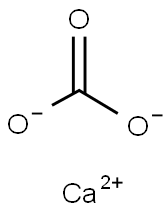
- 1317-65-3
- CCaO3
- 100.09
- All (868)
- China (56)
- (868)
- 792848-15-8
- CCaO3
- 100.08700
- All (868)
- China (56)
- (868)
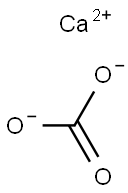
- 471-34-1
- CCaO3
- 100.0869
- All (868)
- China (56)
- (868)
- 89306-95-6
- C6H6CaO2
- 150.18900
- All (0)
- China (0)
- (0)

- 10043-52-4
- CaCl2
- 110.98
- All (479)
- China (34)
- (479)
- 81407-20-7
- CaO4++
- 104.07600
- All (0)
- China (0)
- (0)
- 87208-53-5
- C44H28CdN4O-
- 741.13000
- All (0)
- China (0)
- (0)
- 99886-95-0
- CaClI
- 202.43500
- All (0)
- China (0)
- (0)
- 14031-58-4
- CaClHO
- 92.53830
- All (0)
- China (0)
- (0)
Related Products More >

- 1305-62-0
- USD 270.0000
- 900kg
- 1305-62-0
- USD 117.0000
- 900kg
- 10035-04-8
- CNY 110.0000
- 25kg
- 471-34-1
- CNY 50.0000
- 25kg
- 10043-52-4
- USD 4.8000
- 25kg
- USD 35.0000
- 25kg
- 471-34-1
- Request For Quotation
- 1ton
- 471-34-1
- Request For Quotation
- 25kg


Explanation
To understand this interaction, we need to look at the nature of calcium ions and hydroxide ions. Calcium is a metal that forms a +2 cation, while hydroxide is an anion with a -1 charge. When these two ions combine, they form calcium hydroxide, a compound that has limited solubility in water.
The solubility of calcium hydroxide is influenced by several factors, including temperature and the presence of other ions. At room temperature, calcium hydroxide is only slightly soluble, meaning that only a small amount of it can dissolve in water to form a saturated solution. This limited solubility is due to the strong ionic bonds in the calcium hydroxide lattice, which require significant energy to break.
When calcium ions and hydroxide ions are introduced into water, they do not simply "dissolve" in the traditional sense. Instead, they react to form a precipitate if the concentration of either ion exceeds the solubility product constant (Ksp) of calcium hydroxide. The Ksp for Ca(OH)₂ is approximately 5.5 × 10⁻⁶ at 25°C, indicating that only a small amount of the compound can exist in solution.
Case Study: Application in Daily Life and the Chemical Industry
Daily Life
One of the most common applications of calcium hydroxide is in water treatment. It is used to adjust the pH of water and to remove impurities. For example, in municipal water treatment facilities, calcium hydroxide is added to soften water by precipitating out calcium and magnesium ions, which are responsible for water hardness. This process is crucial for ensuring that water is safe for consumption and use in households.
Chemical Industry
In the chemical industry, calcium hydroxide is used in various processes, including the production of paper, textiles, and construction materials. For instance, it is used in the production of bleaching powder, which is essential for the paper industry. Additionally, calcium hydroxide is a key ingredient in the production of mortar and plaster, where it reacts with carbon dioxide in the air to form calcium carbonate, providing strength and durability to these materials.
Precautions During Operation or Use
When handling calcium hydroxide, it is essential to take certain precautions due to its caustic nature. Here are some important considerations:
Protective Equipment: Always wear appropriate personal protective equipment (PPE), including gloves, safety goggles, and a lab coat, to prevent skin and eye contact.
Ventilation: Ensure that the work area is well-ventilated, especially when handling calcium hydroxide in powdered form, as it can create dust that may be harmful if inhaled.
Storage: Store calcium hydroxide in a cool, dry place in a tightly sealed container to prevent moisture absorption and reaction with carbon dioxide in the air, which can lead to the formation of calcium carbonate.
Disposal: Properly dispose of any waste containing calcium hydroxide in accordance with local regulations. Avoid releasing it into water bodies, as it can raise the pH and harm aquatic life.
Handling Spills: In case of a spill, clean it up immediately using appropriate methods, such as sweeping or using a vacuum designed for hazardous materials. Avoid using water, as it can lead to the formation of a caustic solution.
Calcium ions react with hydroxide ions to form calcium hydroxide (Ca(OH)₂). This is a precipitation reaction if the conditions are right, as calcium hydroxide has limited solubility in water. At low concentrations of both ions, calcium hydroxide may remain in solution as dissociated ions, but as the concentrations increase beyond its solubility product constant (Ksp), solid calcium hydroxide will precipitate out of the solution.
Reason:
The reaction between Ca²⁺ and OH⁻ is driven by the formation of a more stable compound, calcium hydroxide. The electrostatic attraction between the positively charged calcium ions and the negatively charged hydroxide ions leads to the formation of an ionic bond. The solubility of calcium hydroxide in water is relatively low, and when the product of the ion concentrations [Ca²⁺][OH⁻]² exceeds the Ksp value for calcium hydroxide, precipitation occurs according to Le Chatelier's principle, as the system tries to reduce the concentrations of the ions in the solution.
Case Study in Life or Chemical Industry:
In the chemical industry, in water treatment processes, calcium - containing compounds are often present in hard water. When hydroxide ions are added (for example, during the addition of lime, which dissociates to release Ca²⁺ and OH⁻), calcium hydroxide can form. This can help in the precipitation of other impurities and the softening of water by removing calcium ions from the solution as insoluble calcium carbonate (when carbon dioxide is also present). In the construction industry, slaked lime (calcium hydroxide) is produced by reacting quicklime (calcium oxide) with water. The calcium ions in quicklime interact with hydroxide - containing water molecules to form calcium hydroxide.
Precautions:
When working with solutions containing Ca²⁺ and OH⁻, one must be cautious as concentrated solutions of hydroxides are highly caustic and can cause severe burns to the skin and eyes. In industrial settings, proper personal protective equipment such as gloves, goggles, and protective clothing should be worn. Also, when precipitating calcium hydroxide, care must be taken to manage the resulting sludge properly to avoid environmental contamination. Since the reaction can be exothermic, especially when large amounts of reactants are involved, appropriate cooling and monitoring of the reaction temperature are necessary to prevent accidents.
When you mix calcium ions (Ca²⁺) and hydroxide ions (OH⁻) together in water, they actually don’t stay dissolved very well. Instead, they react with each other and form a solid called calcium hydroxide (Ca(OH)₂). It’s what we call a precipitate — meaning it kinda clumps together and falls out of the water instead of staying nicely mixed.
Calcium hydroxide isn’t super soluble in water. Only a little bit can dissolve. So yeah, if you throw a bunch of Ca²⁺ and OH⁻ into water, you’ll see that solid forming pretty fast. It’ll look cloudy, and after a while, the solid might even settle at the bottom.
In simple terms: Ca²⁺ doesn’t really "dissolve" OH⁻ — they actually team up and make a solid. They don't stay separate like table salt does in water.
So, bottom line: if you mix Ca²⁺ and OH⁻ in water, they’re gonna make calcium hydroxide, and most of it won’t stay dissolved. Only a tiny bit will stay floating around in the water.