


 Home
Home
I've been using phenol red in a small experiment at home and heard some mixed things about its safety. Is it dangerous to touch, inhale, or accidentally swallow? Can it cause long-term health problems or just minor irritation? Are there special precautions I should take even for small amounts? How safe is it really for everyday handling in a lab or school setting, and should I be worried about using it without gloves or protective gear?
Is Phenol Red Toxic?
Related Encyclopedia
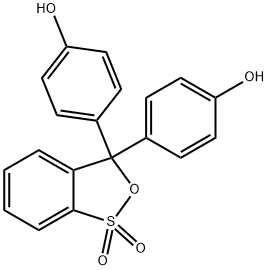
- 143-74-8
- C19H14O5S
- 354.38
- All (21)
- China (8)
- (21)
- 38814-96-9
- C19H14O5S
- 354.37600
- All (21)
- China (8)
- (21)
- 127590-04-9
- C19H12O5S--
- 352.36100
- All (0)
- China (0)
- (0)
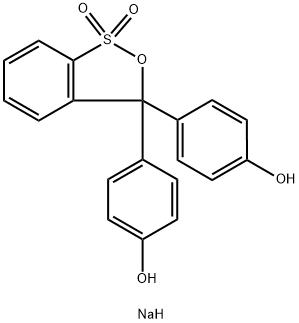
- 34487-61-1
- C19H15NaO5S
- 378.37
- All (0)
- China (0)
- (0)
- 75434-51-4
- C21H18O5S
- 382.43000
- All (0)
- China (0)
- (0)
Related Products More >

- 99792-79-7
- Request For Quotation
- kg
- 7440-38-2
- Request For Quotation
- 4430-20-0
- Request For Quotation
- 4430-20-0
- Request For Quotation
- 25kg/ea
- 4430-20-0
- Request For Quotation
- 4430-20-0
- Request For Quotation
- 4430-20-0
- Request For Quotation
- 4430-20-0
- Request For Quotation


If you’re just using it for school experiments or checking pH in liquids, treating it like any basic lab chemical—don’t eat it, wash your hands after, and avoid splashes—is usually totally fine. It’s not the kind of stuff that causes big health issues in normal handling.
In terms of toxicity, phenol red is generally considered low-risk under standard laboratory conditions. Its absorption through the skin is limited, and inhalation of the solid powder or concentrated solutions can potentially irritate respiratory tissues. Ingestion of small amounts is unlikely to result in systemic toxicity, but larger exposures may cause mild gastrointestinal discomfort. Industrial and medical applications emphasize careful handling protocols, including the use of gloves, lab coats, and eye protection, to minimize accidental exposure. Its physicochemical stability allows it to be stored and transported safely, although care is taken to avoid decomposition under high heat or prolonged exposure to light, which can affect both its color-changing properties and chemical integrity.
Beyond laboratory use, phenol red has found applications in cell biology as a pH indicator in culture media, where it serves as an indirect measure of metabolic activity. The color shift provides researchers with a simple, non-invasive method to monitor the condition of cultured cells over time. In educational settings, its visible color transitions make it an excellent teaching tool for illustrating acid-base chemistry. From an interdisciplinary perspective, its relatively low toxicity, combined with precise pH responsiveness, positions phenol red as a chemical that bridges chemistry, biology, and industrial processes, highlighting the balance between functionality and safety in practical applications.
Handling it responsibly ensures its benefits can be utilized without significant risk, while its chemical characteristics offer insight into the subtle ways molecules interact with their environment.
When evaluating phenol red’s acute toxicity, it is important to distinguish it from more hazardous phenol derivatives like phenol itself (C6H5OH), which is a corrosive substance that denatures proteins and causes severe tissue damage upon contact. Phenol red, by contrast, has low acute oral toxicity in mammals, with a median lethal dose (LD50) in rodents exceeding 1000 mg/kg body weight—this places it in the “practically non-toxic” category for oral exposure under standard toxicological classifications. However, this low acute toxicity does not negate potential risks in specific scenarios: for example, in aquatic environments, phenol red can be toxic to freshwater invertebrates like Daphnia magna at concentrations above 5 mg/L, as its aromatic structure may disrupt membrane integrity or interfere with metabolic pathways in these smaller organisms. Professionals in environmental engineering must account for this aquatic toxicity when designing wastewater treatment protocols for facilities that use phenol red (such as research labs or pharmaceutical manufacturers), as untreated releases could disrupt local aquatic ecosystems even if the compound poses minimal risk to humans via oral exposure.
In laboratory settings, a common误解 is that phenol red’s presence in cell culture media indicates inherent toxicity to all cell types, but this is not universally true. Most standard mammalian cell lines (e.g., HeLa, CHO cells) tolerate the typical concentration of phenol red (5–10 μg/mL) in media without adverse effects, as the dye is not readily metabolized into toxic byproducts and is excluded from the cell interior by the plasma membrane. However, specialized cell types like embryonic stem cells or primary hormone-sensitive cells (e.g., breast epithelial cells) may exhibit sensitivity to even low concentrations, as the dye’s structural mimicry of estrogens can activate or inhibit signaling pathways critical for cell differentiation or proliferation. This distinction is vital for cell biologists, who must select phenol red-free media for such sensitive cultures to ensure experimental validity, rather than avoiding the dye entirely based on a generalized assumption of toxicity. Additionally, in in vitro toxicology assays, phenol red is sometimes excluded from test systems to prevent interference with readouts like colorimetric cell viability assays (e.g., MTT or XTT assays), where the dye’s own color could overlap with the assay’s detection signal—this is a technical consideration, not a reflection of the dye’s toxicity to the test cells.
For industrial and occupational safety, phenol red is classified as a mild irritant to the skin and eyes, primarily due to the acidic nature of its carboxylic acid group, which can cause localized redness or discomfort upon prolonged contact. Unlike strong irritants or corrosives, it does not cause chemical burns, and rinsing with water typically resolves mild exposure symptoms. Inhalation risk is low because the dye has low volatility at room temperature, and airborne particles are only a concern in powder form (e.g., during reagent preparation), which is mitigated by using fume hoods or dust masks. Professionals in occupational health focus on these mild irritant properties rather than acute toxicity when developing safety protocols, as the primary risk lies in repeated, unprotected contact rather than severe, acute exposure. This contrasts with other dye compounds used in similar applications, such as bromothymol blue or methylene blue, which have comparable pH-indicating properties but may exhibit different toxicity profiles—for example, methylene blue is toxic at higher doses due to its ability to bind to nucleic acids, highlighting the need for professionals to evaluate each dye’s unique properties rather than grouping them by function. Understanding these nuanced differences allows for more targeted and effective safety measures, ensuring that phenol red is handled appropriately without overestimating or underestimating its potential risks.
In cell biology, phenol red’s toxicity profile is context-dependent. While it demonstrates minimal acute toxicity at conventional concentrations (e.g., 5-20 mg/L), prolonged exposure or high concentrations may exhibit estrogen-like effects in sensitive systems due to structural similarities to nonylphenol. Such interactions could potentially interfere with hormone-responsive assays, though this is not universally observed across all cell types. The compound’s redox activity remains negligible within physiological pH ranges, preventing significant oxidative stress under normal culture conditions.
Practical applications leverage its low toxicity for continuous monitoring. For instance, in mammalian cell culture, phenol red serves as an early indicator of microbial contamination through premature acidification, or of nutrient depletion via alkaline shift. Biotechnology industries utilize this property to optimize feeding schedules in bioreactors without requiring frequent sampling or invasive probes. Another example includes its use in sperm viability assays, where the dye’s color change correlates with metabolic activity without impairing cellular function. These implementations rely on the compound’s predictable behavior within biological thresholds where cytotoxic effects are absent.