


 Home
Home
Have you ever come across a bright red or yellow liquid in a school lab or read about it in a science experiment and wondered what it actually is? Why does it change color sometimes, and what makes it so useful for testing things like liquids or even in some medical settings? Could it be something more than just a colorful chemical, and how do people usually use it in everyday experiments or simple science projects? What exactly is phenol red and why is it so commonly seen in labs and classrooms?
What Is Phenol Red and How Is It Used?
Related Encyclopedia
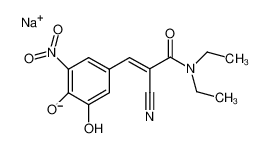
- 1047659-02-8
- C14H14N3NaO5
- 327.26800
- All (0)
- China (0)
- (0)
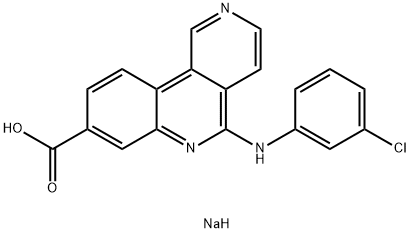
- 1309357-15-0
- C19H13ClN3NaO2
- 373.77
- All (0)
- China (0)
- (0)
- 92598-79-3
- C11H17N2NaO3
- 248.25405
- All (0)
- China (0)
- (0)
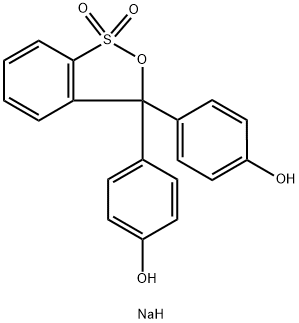
- 34487-61-1
- C19H15NaO5S
- 378.37
- All (0)
- China (0)
- (0)
![Benzenepropanoic acid, β-1-propyn-1-yl-4-[[4'-(trifluoromethyl)[1,1'-biphenyl]-3-yl]methoxy]-, sodium salt , (βS)-](https://chemcloud-1304660855.cos.ap-shanghai.myqcloud.com/compound/c7b3e615e078462ab1185143feed995c.png?imageMogr2/format/webp)
- 865231-45-4
- C26H21F3NaO3
- 461.42800
- All (0)
- China (0)
- (0)
![sodium,3-[3-tert-butylsulfanyl-1-[[4-(6-ethoxypyridin-3-yl)phenyl]methyl]-5-[(5-methylpyridin-2-yl)methoxy]indol-2-yl]-2,2-dimethylpropanoate](https://chemcloud-1304660855.cos.ap-shanghai.myqcloud.com/compound/fb14b23f7e8c43f7a104cf48e877c6c4.png?imageMogr2/format/webp)
- 1196070-26-4
- C38H42N3NaO4S
- 659.81300
- All (0)
- China (0)
- (0)
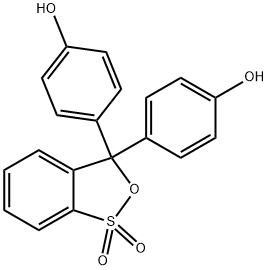
- 143-74-8
- C19H14O5S
- 354.38
- All (21)
- China (8)
- (21)
- 38814-96-9
- C19H14O5S
- 354.37600
- All (21)
- China (8)
- (21)
- 127590-04-9
- C19H12O5S--
- 352.36100
- All (0)
- China (0)
- (0)
![N-[N-[[(6-deoxy-α-L-mannopyranosyl)oxy]hydroxyphosphinyl]-L-leucyl]- L-tryptophan,sodium salt (1:1)](https://chemcloud-1304660855.cos.ap-shanghai.myqcloud.com/compound/202502120313040497.gif?imageMogr2/format/webp)
- 164204-38-0
- C23H35N3NaO10P
- 567.51
- All (0)
- China (0)
- (0)
Related Products More >

- 55310-46-8
- CNY Request For Quotation
- 136-30-1 DibutylCarbamodithioic acid sodium salt
- CNY Request For Quotation
- 863-57-0
- Request For Quotation
- 35807-85-3
- Request For Quotation
- 127-09-3
- CNY 80.0000
- 25kg
- 68414-18-6
- Request For Quotation
- 25kg/drum25kg/drum
- 1184-16-3
- Request For Quotation
- 25kg/drum25kg/drum
- 24292-60-2
- Request For Quotation
- 25kg/drum25kg/drum


Beyond the laboratory, phenol red finds applications in medical and biological settings. It is often incorporated in cell culture media to provide a visual indication of cellular metabolism, as living cells produce acids that gradually alter the surrounding pH. This allows scientists and technicians to quickly assess the health and activity of cultures without complex instrumentation. Industrially, phenol red can be utilized in processes where pH monitoring is essential, such as water treatment, food and beverage production, and chemical manufacturing, offering a straightforward visual cue that informs operational adjustments. Its stability, reproducibility, and clear color transitions make it advantageous in contexts that require consistent and interpretable results.
In terms of physical and chemical behavior, phenol red is soluble in water and behaves predictably under different thermal and chemical conditions, maintaining its indicator properties over a broad range of environments. Its structure allows for reversible color transitions, which is critical for repeated measurements and long-term monitoring. Cross-disciplinary applications extend into education, where it is used to teach principles of acid-base chemistry, and even into environmental science, where its presence can assist in rapid field assessments. Phenol red thus exemplifies a chemical tool that bridges theoretical understanding with practical utility, serving both as a visual guide in experimental setups and as an informative element in broader scientific and industrial workflows.
In biological and biochemical research, phenol red is most prominently used in cell culture media, where it serves as a non-toxic visual marker for changes in pH that could signal cell health or media degradation. Mammalian cells, for instance, produce metabolic waste products like lactic acid during glycolysis, which gradually lowers the pH of the culture medium over time. As the medium becomes more acidic (pH < 6.8), phenol red shifts to yellow, alerting researchers that the medium needs replacement to prevent cell stress or death. Conversely, if the medium becomes too alkaline (e.g., due to improper CO₂ balance in a cell incubator, where CO₂ helps maintain a physiological pH via bicarbonate buffering), phenol red turns bright red, indicating a disruption in the environment necessary for cell growth. Unlike other pH indicators such as bromothymol blue (which operates in a higher pH range of 6.0–7.6) or methyl red (effective at pH 4.4–6.2), phenol red’s range aligns closely with the physiological pH (typically 7.2–7.4) of most mammalian cell cultures, making it uniquely suited for this application.
A common misconception about phenol red is that it interferes with biological assays, particularly those involving spectrophotometry or fluorescence measurements, due to its own color. While it is true that phenol red absorbs light at wavelengths around 430 nm (yellow form) and 550 nm (red form), this interference is easily mitigated by using phenol red-free media for assays sensitive to these wavelengths, or by including a blank control containing phenol red to correct for background absorption. Another misunderstanding is conflating phenol red with phenol (C₆H₅OH), a toxic compound that can denature proteins and damage cells. Despite sharing the “phenol” prefix, the two substances are chemically distinct: phenol red contains additional sulfonic acid and lactone groups that reduce its toxicity and endow it with indicator properties, making it safe for use in cell culture at typical concentrations (0.01–0.02 g/L), whereas phenol is never used in such contexts due to its cytotoxicity.
In clinical settings, phenol red also finds application in diagnostic tests, such as the phenol red thread test for assessing tear production in patients with dry eye syndrome. This test uses a thread impregnated with phenol red; when placed in the lower conjunctival sac, tears (which have a pH around 7.4, within the indicator’s red range) hydrate the thread, causing it to turn red. The length of the red portion of the thread after a set time (usually 15 seconds) correlates with tear volume, helping clinicians diagnose conditions like keratoconjunctivitis sicca. Here, its utility lies in its rapid color change and compatibility with biological fluids, as it does not irritate ocular tissues and provides a clear, quantifiable readout—advantages over more invasive tear volume measurement techniques. Unlike pH paper, which uses a mixture of indicators to cover a broad pH range, the phenol red thread is optimized for the narrow physiological pH of tears, ensuring high specificity for the target measurement.
In cell culture laboratories, phenol red is integrated into growth media as a visual monitor for metabolic activity and contamination. For instance, as cells metabolize nutrients and produce acidic byproducts like carbon dioxide, the medium shifts from red to yellow, signaling the need for a medium change to maintain optimal pH. Conversely, a sharp increase in pH often indicates bacterial contamination, prompting immediate intervention. This real-time feedback allows researchers to maintain cell health without requiring external pH meters, streamlining workflows while reducing costs.
Beyond cell biology, phenol red finds use in swimming pool test kits where it helps assess water alkalinity. A sample of pool water mixed with the indicator turns yellow if acidic, prompting the addition of bases to prevent corrosion or skin irritation. Similarly, in educational settings, it demonstrates acid-base titration principles, offering students a clear, visual representation of chemical equilibria. Such practical examples underscore its role as an accessible yet robust tool across scientific and industrial domains.