


 Home
Home
Have you ever wondered why so many people recommend boric acid for getting rid of ants? It seems like a simple powder, but somehow it’s powerful enough to wipe out entire ant colonies. Does it poison them instantly or work slowly over time? And what exactly happens inside an ant’s body when it eats boric acid? Does it affect their stomach, their nervous system, or something else entirely? How does this everyday substance turn into such an effective ant killer?
How Does Boric Acid Kill Ants?
Related Encyclopedia
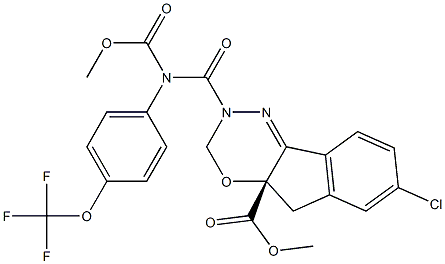
- 174060-41-4
- C22H17ClF3N3O7
- 527.8344896
- All (20)
- China (0)
- (20)
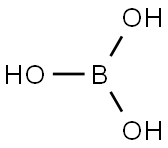
- 11113-50-1
- BH3O3
- 61.83
- All (30)
- China (20)
- (30)
- 68498-84-0
- CH5BO3
- 75.85960
- All (0)
- China (0)
- (0)
- 67859-78-3
- C4H12BNO4
- 148.95300
- All (0)
- China (0)
- (0)
- 68072-56-0
- CH7BN2O4
- 121.88800
- All (0)
- China (0)
- (0)
- 55199-96-7
- C2H7BO4
- 105.88600
- All (0)
- China (0)
- (0)
- 20786-60-1
- BH3KO3
- 100.93100
- All (0)
- China (0)
- (0)
- 58272-25-6
- C4H15BNO3+
- 135.97800
- All (0)
- China (0)
- (0)
- 70331-86-1
- C6H7BO4
- 153.92800
- All (0)
- China (0)
- (0)
- 145384-46-9
- BDH2O3
- 62.83920
- All (0)
- China (0)
- (0)
Related Products More >

- 96958-96-2
- Request For Quotation
- 25kg
- 96958-96-2
- Request For Quotation
- 1ton
- 96958-96-2
- Request For Quotation
- 25kg
- 96958-96-2
- Request For Quotation
- 1ton
- 96958-96-2
- Request For Quotation
- 25kg
- 96958-96-2
- Request For Quotation
- 1kg
- 96958-96-2
- Request For Quotation
- 25kg
- 96958-96-2
- Request For Quotation
- 1ton


What makes it really effective is that ants feed the rest of the colony, including the queen. So, when they bring the poisoned food back, the whole colony gets hit. That’s why it takes time, but it wipes out more than just the ants you see. It’s like using their teamwork against them, and that’s why people like boric acid for long-term control.
The toxicity mechanism involves interference with cellular energy production. Boric acid binds to metabolic enzymes in the ant’s midgut, inhibiting ATP synthesis and causing starvation. Additionally, its abrasive properties compromise the waxy layer of the exoskeleton, leading to severe desiccation. Social behaviors amplify its effect: ants share the toxin through trophallaxis, gradually spreading it to larvae and queens.
In practical scenarios, a homemade bait might combine powdered boric acid with honey, placed near ant trails. Over several days, the colony’s foraging declines as workers cease returning food. For persistent infestations, low-concentration baits prove more effective than high doses, as they allow time for transporters to distribute the toxin before succumbing. This approach targets the nest structure rather than merely eliminating visible scouts.
Environmental persistence allows boric acid to remain active in dry indoor areas, though moisture reduces its efficacy outdoors. Unlike synthetic insecticides, it poses minimal risk to mammals at bait-level concentrations, making it a preferred choice in integrated pest management systems.
Ants are not immediately killed by boric acid, which is a key factor in its effectiveness. Instead, the slow-acting nature allows foraging ants to carry the substance back to the colony, where it is shared with other ants, including the queen. This contrasts with fast-acting poisons that might kill foragers before they can return, leaving the colony intact. The low toxicity of boric acid to mammals, due to differences in metabolic pathways, also sets it apart from many synthetic insecticides, making it a preferred option in environments where non-target species are a concern.
A common misconception is that boric acid works by dehydrating ants, but this is not the case. Dehydration is typically associated with substances like diatomaceous earth, which abrades the exoskeleton. Boric acid’s impact is purely biochemical, targeting internal processes rather than physical structure. Another misunderstanding is that high concentrations are more effective, but in reality, excessively high doses can deter ants from consuming the bait, reducing its ability to spread through the colony. Balancing concentration to ensure ingestion while maintaining toxicity is essential for optimal results.
When ants ingest boric acid, the primary mechanism of action involves disruption of their digestive system. Unlike mammals, ants rely on a simple gut structure and enzyme-based metabolism for nutrient absorption. Boric acid acts as both a stomach poison and a physical abrasive. On ingestion, it interferes with nutrient uptake by damaging the insect’s gut lining and disrupting enzymatic activity essential for energy conversion. Over time, this causes dehydration, internal bleeding, and eventual starvation. Because the concentration is kept low when mixed with bait such as sugar, ants do not detect it as harmful, allowing them to carry the substance back to the colony.
This delayed toxicity is critical from an ecological and behavioral perspective. Ants exhibit trophallaxis, the sharing of food among colony members, including larvae and the queen. By exploiting this social structure, boric acid does not just eliminate foraging workers but penetrates the core of the colony, leading to systemic collapse. This strategy minimizes repeated applications and reduces chemical load compared to broad-spectrum insecticides.
Beyond pest control, boric acid holds relevance in industrial and medical fields due to its antifungal, antiseptic, and buffering properties. Its selective toxicity toward insects highlights a broader concept in toxicology and ecology: how physiological differences across species can be leveraged for targeted control without significantly harming humans or the environment. In the context of integrated pest management, its slow action, affordability, and minimal resistance development underscore its enduring importance in both residential and agricultural settings.