


 Home
Home
I keep seeing ants crawling around my kitchen and wonder if boric acid could help get rid of them. How exactly do you use it without making a mess or putting pets and kids at risk? Is it better to sprinkle it directly or mix it with something else? How long does it take to see results, and are there tips for keeping ants away after treatment? Are there any common mistakes I should avoid when using boric acid to kill ants?
How to Use Boric Acid to Kill Ants Safely and Effectively?
Related Encyclopedia
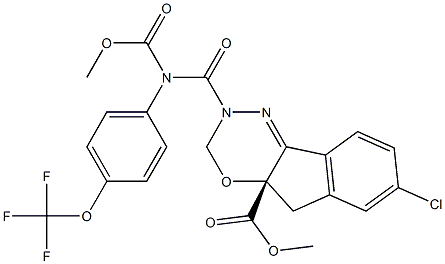
- 174060-41-4
- C22H17ClF3N3O7
- 527.8344896
- All (20)
- China (0)
- (20)
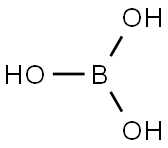
- 11113-50-1
- BH3O3
- 61.83
- All (30)
- China (20)
- (30)
- 1319-33-1
- BCaNaO3
- 121.87700
- All (0)
- China (0)
- (0)
- 53529-07-0
- BK2NaO3
- 159.99600
- All (0)
- China (0)
- (0)
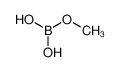
- 68498-84-0
- CH5BO3
- 75.85960
- All (0)
- China (0)
- (0)
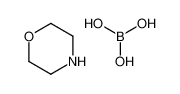
- 67859-78-3
- C4H12BNO4
- 148.95300
- All (0)
- China (0)
- (0)
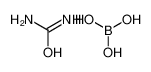
- 68072-56-0
- CH7BN2O4
- 121.88800
- All (0)
- China (0)
- (0)
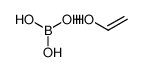
- 55199-96-7
- C2H7BO4
- 105.88600
- All (0)
- China (0)
- (0)
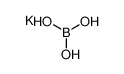
- 20786-60-1
- BH3KO3
- 100.93100
- All (0)
- China (0)
- (0)
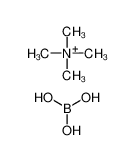
- 58272-25-6
- C4H15BNO3+
- 135.97800
- All (0)
- China (0)
- (0)
Related Products More >

- 96958-96-2
- Request For Quotation
- 25kg
- 96958-96-2
- Request For Quotation
- 1ton
- 96958-96-2
- Request For Quotation
- 25kg
- 96958-96-2
- Request For Quotation
- 1ton
- 96958-96-2
- Request For Quotation
- 25kg
- 96958-96-2
- Request For Quotation
- 1kg
- 96958-96-2
- Request For Quotation
- 25kg
- 96958-96-2
- Request For Quotation
- 1ton


If you like, I can also give a couple of alternative ways to make the bait more effective for faster results. Do you want me to do that?
A common application method involves creating homemade bait stations. A typical recipe mixes a teaspoon of boric acid with a cup of a sweet attractant like sugar water or honey. The sugary solution lures sugar-feeding ants, while protein-based baits mixed with boric acid can target other species. The low concentration of boric acid—usually around 1-2%—is critical; higher doses kill worker ants too quickly, preventing them from carrying the bait back to the nest and thereby failing to reach the brood and reproductive members.
In practice, placing small containers of this mixture near ant trails or entry points allows for targeted intervention. The ants are attracted to the bait, consume it, and transport it to the nest. Over several days, the toxin spreads throughout the colony, disrupting cellular function and the digestive process. This approach requires patience, as colony collapse may take a week or more, but it addresses the problem at its source rather than merely repelling visible foragers. Proper placement and bait formulation are essential for success, making it a method grounded in understanding ant behavior and biology.
To effectively use boric acid against ants, proper formulation is key, as its efficacy depends on both palatability and particle size. Ants are unlikely to consume pure boric acid, so it is typically mixed with a carbohydrate-rich bait, such as sugar water or honey, to attract them. The concentration is critical—too high and the bait may repel the ants; too low and it may not deliver a lethal dose. Unlike some insecticides that require direct application to the insect, boric acid leverages ants' foraging and trophallaxis behaviors, where workers carry the bait back to the colony and share it with others, including the queen. This makes it effective against entire colonies rather than just individual foragers, a significant advantage over contact sprays that only target visible ants.
A common misconception is that boric acid works through dehydration, but this is inaccurate. While it can have mild desiccant properties in high concentrations, its primary mode of action in ant control is metabolic disruption. Another misunderstanding is assuming it is harmful to all organisms in the same way; its toxicity is highly species-dependent. For humans and larger animals, boric acid has low acute toxicity when used as directed, as their metabolic systems do not process it in the same manner as ants. This selectivity is what makes it a practical choice for household ant control, as it can be applied in areas accessible to ants without posing significant risks to humans or pets when used responsibly.
In practical use, boric acid can be incorporated into bait stations, combined with sweet or protein-based substances that attract ants. Placement is critical; it should be positioned along trails or near entry points while remaining inaccessible to children or pets. Its low volatility and stability ensure that it retains efficacy over time without the rapid degradation that affects many other insecticides. This characteristic makes it suitable not only for domestic pest control but also in industrial or agricultural settings where long-term management of ant populations is necessary.
Beyond its immediate insecticidal effect, boric acid has broader ecological and chemical significance. Its low mammalian toxicity compared to synthetic pesticides makes it a relatively safe option for integrated pest management strategies. Understanding how boric acid functions at a physiological level in ants highlights the delicate balance between chemical intervention and ecological safety. In homes, consistent application alongside sanitation practices can substantially reduce ant infestations, while in larger-scale operations, it can complement other control methods, reducing reliance on more hazardous chemicals. Its role exemplifies the intersection of chemistry, biology, and practical problem-solving in everyday life.
This approach demonstrates how a single chemical agent, when understood and applied correctly, can effectively manage pest populations while minimizing broader environmental impact.