


 Home
Home
Hi there, I wanted to ask something that confuses me whenever I see products labeled with polyurethane. Sometimes it feels like plastic, but other times it acts like rubber. So I’m wondering, is polyurethane actually the same as rubber, or is it just a material that can behave like it? If it isn’t the same, then what makes polyurethane so versatile, and why do some people treat it like a rubber substitute? Could you explain in simple words how they are connected and in what situations one might be chosen over the other?
Is Polyurethane Rubber or Something Different?
Related Encyclopedia
- 9009-54-5
- C3H8N2O
- 0
- All (13)
- China (0)
- (13)
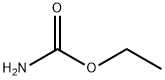
- 51-79-6
- C3H7NO2
- 89.09
- All (22)
- China (0)
- (22)
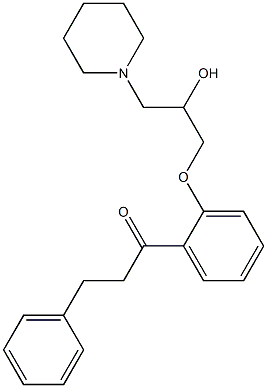
- 63148-67-4
- C23H29NO3
- 367.48126
- All (0)
- China (0)
- (0)
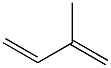
- 9006-04-6
- C5H8
- 68.11702
- All (0)
- China (0)
- (0)
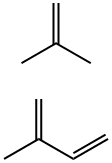
- 9010-85-9
- C9H16
- 124.23
- All (2)
- China (0)
- (2)
- 2043-25-6
- C6H9NO3
- 143.14100
- All (0)
- China (0)
- (0)
- 98025-56-0
- C3H6N2O3
- 118.09100
- All (0)
- China (0)
- (0)
- 108636-68-6
- C3H5NO3
- 103.07700
- All (0)
- China (0)
- (0)

- 51252-84-7
- C3H4O2
- 72.06270
- All (0)
- China (0)
- (0)
- 25191-16-6
- C6H12O6
- 180.15600
- All (0)
- China (0)
- (0)
Related Products More >

- CNY Request For Quotation
- CNY Request For Quotation
- CNY Request For Quotation
- 9003-55-8
- CNY Request For Quotation


For example, when used in shoe soles, polyurethane often feels flexible and springy, almost like rubber, which makes it comfortable for walking. On the other hand, the same material can be made into a hard, durable coating for wood floors that doesn’t feel rubbery at all. Rubber, especially the natural type, doesn’t have that same range of possibilities.
In everyday life, you’ll see polyurethane replacing rubber in things like wheels for skateboards, seals, or even some phone cases because it’s strong and long-lasting. But when people ask if polyurethane is rubber, the simple answer is no—it’s a different material that can sometimes act in very similar ways. So when you hear polyurethane being compared to rubber, it’s really more about how it performs in that specific product.
What makes polyurethane fascinating is its ability to mimic rubber-like behavior under certain formulations. Through adjusting the ratio of its soft and hard segments, polyurethane can achieve elasticity comparable to rubber while offering superior resistance to abrasion, oil, and solvents. For example, polyurethane elastomers are often used in applications where traditional rubber would degrade quickly, such as industrial wheels, conveyor belts, or automotive bushings. This adaptability comes from the microphase separation within its structure, where soft domains allow flexibility and hard domains reinforce strength.
In everyday life, polyurethane might not immediately be recognized as distinct from rubber because products such as athletic shoe soles, skateboard wheels, or protective coatings feel and perform like elastic rubbers. Yet, the chemical backbone and performance spectrum are broader than traditional rubbers. In industries that require materials exposed to harsh conditions, polyurethane often replaces rubber due to its longer service life. This demonstrates that while polyurethane is not rubber by definition, it operates in a middle ground, bridging plastics and rubbers in both functionality and design versatility.
From a structural perspective, rubber’s elasticity arises from entanglement of its polymer chains and reversible cross-links, which absorb energy during deformation. Polyurethane elastomers achieve similar behavior through phase separation: hard segments (from diisocyanates) form crystalline domains that act as physical cross-links, while soft segments (from polyols) create amorphous regions that allow flexibility. This dual-phase structure gives TPU its unique combination of toughness and resilience, much like how reinforced concrete uses steel bars (hard) within cement (soft) to resist both tension and compression.
In practical applications, polyurethane’s rubber-like variants are ubiquitous. TPU is used in smartphone cases, automotive bumpers, and medical tubing, where its abrasion resistance and biocompatibility outperform traditional rubber. In footwear, polyurethane soles offer lighter weight and better durability than rubber, leveraging chemical stability to resist degradation from oils or UV light. The distinction matters in industries like aerospace, where materials must meet strict performance criteria: polyurethane’s predictable aging behavior (unlike natural rubber’s susceptibility to oxidation) makes it preferable for seals and gaskets. This cross-disciplinary relevance underscores a broader trend in materials engineering: designing polymers to emulate natural materials’ functions while improving performance, sustainability, and manufacturability.
Polyurethane, by contrast, is a broad class of polymers formed by reacting polyols and diisocyanates, with cross-link density as the key variable. Rigid polyurethane (used in insulation or structural panels) has a dense, three-dimensional cross-linked network that resists stretching, behaving more like a hard plastic than rubber. Flexible polyurethane (e.g., foam cushions, sealants) uses long-chain polyols to create fewer cross-links, allowing polymer segments to move—this mimics rubber’s elasticity but via a different mechanism: its cross-links are covalent bonds (stronger than rubber’s sulfur links), making it more resistant to oil, chemicals, and high temperatures than most rubbers. For example, polyurethane gaskets in automotive engines withstand oil exposure and 150°C+ temperatures, while rubber gaskets would degrade or harden over time.
Critical differences emerge in durability and functionality. Rubber, especially natural rubber, is prone to oxidation (hardening with age) and swelling in solvents, limiting its lifespan in harsh environments. Flexible polyurethane, with its robust covalent cross-links, resists oxidation and chemical attack, maintaining elasticity for years—this is why it’s preferred for industrial hoses or medical devices (e.g., catheter tubes) where longevity matters. Additionally, polyurethane’s properties are highly tunable: adjusting polyol chain length or diisocyanate type can create materials ranging from soft foam (shore A 20) to semi-rigid elastomers (shore D 50), while rubber’s elasticity range is narrower, often limited to softer durometers.
Common misconceptions blur these lines. One myth is that “flexible polyurethane is a type of rubber”—it’s an elastomer but not rubber, as its chemical composition (polyurethane vs. polyisoprene or SBR) and cross-linking chemistry differ fundamentally. Another is that “polyurethane can replace rubber in all applications”—rubber still excels in low-temperature flexibility (natural rubber remains elastic at -60°C, while flexible polyurethane may stiffen below -20°C) and high-stretch scenarios (e.g., rubber bands), where its linear chains stretch more easily than polyurethane’s cross-linked structure.
In engineering and manufacturing, this distinction guides material selection. For example, rubber is chosen for door seals in cold climates to maintain flexibility, while polyurethane is used for heavy-duty conveyor belts to resist oil and abrasion. Understanding that polyurethane is a distinct polymer class—with flexible variants that mimic but do not equal rubber—ensures designs leverage each material’s strengths, avoiding failures from misapplication (e.g., using rubber in oil-rich environments or polyurethane in extreme cold). This clarity also highlights polymer science’s role in creating tailored solutions: polyurethane’s tunability fills gaps rubber cannot, while rubber’s unique low-temperature performance remains irreplaceable in specific use cases.