


 Home
Home
Hi, I’m curious about finishing my wooden furniture and I’m wondering if it’s okay to apply a water based polyurethane over an oil based coat I already put down. Will it stick properly? Are there special steps I need to follow to avoid peeling or uneven drying? Could it affect the appearance or durability of the finish? I’ve heard mixed advice online and want to make sure I do it right. How can I safely layer these two types of polyurethane without ruining my project?
Can You Put Water Based Polyurethane Over Oil Based? Tips for a Smooth Finish
Related Encyclopedia
- 9009-54-5
- C3H8N2O
- 0
- All (13)
- China (0)
- (13)
![3-[(E)-4,6-dimethylhept-2-enyl]oxolane-2,5-dione,2-[3-(oxiran-2-ylmethoxy)propoxymethyl]oxirane,4-(oxiran-2-yl)-7-oxabicyclo[4.1.0]heptane](https://chemcloud-1304660855.cos.ap-shanghai.myqcloud.com/compound/bbb16ce2863d42899585d90674283a10.png?imageMogr2/format/webp)
- 52368-54-4
- C30H48O9
- 552.69700
- All (0)
- China (0)
- (0)
- (C14H13NO)n
- 211.26000
- All (0)
- China (0)
- (0)
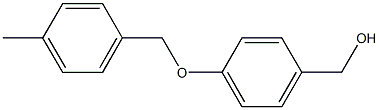
- 201058-08-4
- C15H16O2
- 228.28634
- All (0)
- China (0)
- (0)
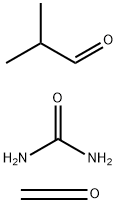
- 28931-47-7
- C6H14N2O3
- 162.19
- All (0)
- China (0)
- (0)

- 11041-12-6
- C27H47N
- 385.66878
- All (0)
- China (0)
- (0)
- 9003-74-1
- C10H18
- 0
- All (7)
- China (4)
- (7)
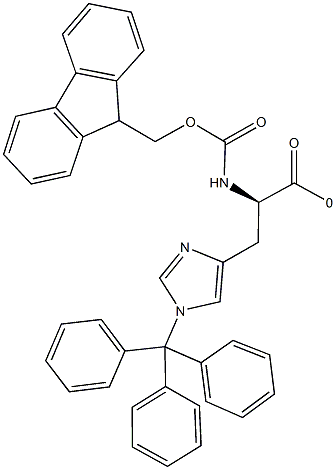
- 55844-94-5
- C40H32N3O3R
- 602.70038
- All (3)
- China (0)
- (3)

- 39319-11-4
- C18H15P
- 262.285461
- All (1)
- China (0)
- (1)
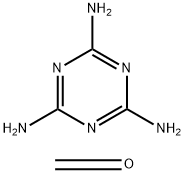
- 9003-08-1
- C4H8N6O
- 156.15
- All (1)
- China (1)
- (1)
Related Products More >

- 9002-86-2
- CNY Request For Quotation
- CNY Request For Quotation
- CNY Request For Quotation
- CNY Request For Quotation
- 465-42-11
- CNY Request For Quotation
- 465-42-10
- CNY Request For Quotation
- 465-42-9
- CNY Request For Quotation
- CNY Request For Quotation


Another tip is to clean the wood after sanding to remove any dust or oils that might block adhesion. Applying a thin coat of water based polyurethane at first lets you see how it sticks before adding more layers. This approach is often used for furniture or cabinets when someone wants the quick-drying, low-odor benefits of water based polyurethane but already has an oil based layer underneath. Taking these precautions makes the finish more durable and helps avoid issues like peeling or uneven gloss.
The timing between coatings is also critical. An oil based coat needs to be fully cured—this often takes several days depending on temperature, humidity, and the specific formulation. Applying a water based coat too early can lead to wrinkling, lifting, or poor bonding. In everyday projects like furniture refinishing or cabinetry, people often lightly sand an existing oil based finish, clean the surface to remove dust or oils, and then apply a thin first coat of water based polyurethane. This not only improves adhesion but also allows you to test the compatibility before committing to multiple layers.
A practical example can be seen in a kitchen cabinet makeover where homeowners want the quick drying and low odor of water based polyurethane but already have an oil based protective layer. By carefully sanding and cleaning the surface, then applying thin, successive layers of water based polyurethane, they can achieve a smooth, durable, and glossy finish that combines the benefits of both types of coatings. Following these steps ensures long-term performance and prevents common issues like peeling or uneven sheen.
The key to success lies in two critical steps: ensuring the oil-based polyurethane is fully cured and aggressively sanding its surface. Full curing of oil-based polyurethane takes 72–96 hours under ideal conditions (20–25°C, 40–60% humidity), as its slow solvent evaporation and cross-linking process continue long after the surface feels dry. Rushing application of water-based polyurethane over partially cured oil-based polyurethane traps residual solvents, causing bubbling or wrinkling as vapors escape through the water-based layer. After full curing, sanding with 180–220 grit sandpaper creates micro-roughness, breaking the oil-based film’s smooth, hydrophobic surface to expose fresh polymer chains. This sanding manufactures “micro-anchors” for the water-based polyurethane, allowing its reactive components (aliphatic diisocyanates and polyols) to grip the abraded surface mechanically—compensating for the lack of chemical compatibility between water and oil solvents.
A bonding primer formulated for oil-to-water transitions is an optional but recommended extra step. These primers contain amphiphilic components that bond to both the oil-based film (via organic functional groups) and the water-based polyurethane (via hydrophilic sites), acting as a chemical bridge that enhances adhesion. Without a primer, even sanded oil-based surfaces may still repel water-based polyurethane over time, especially in high-moisture areas (e.g., kitchens or bathrooms).
Common misconceptions derail many attempts. One myth is that “light sanding is enough”—insufficient abrasion leaves most of the oil-based film’s hydrophobic surface intact, leading to poor bonding. Another is that “any water-based polyurethane works,” but low-quality formulations with low solids content may lack the flexibility to adhere to the rigid oil-based film, resulting in cracking. It’s also critical to distinguish this process from applying oil-based over water-based polyurethane: oil-based polyurethane’s solvents can dissolve water-based films, making that combination impossible, whereas water-based over oil-based is feasible with preparation.
This combination differs from using water-based polyurethane over bare wood or water-based stain, where porosity aids adhesion; over oil-based polyurethane, adhesion relies entirely on mechanical grip from sanding and optional chemical priming. By prioritizing full curing, aggressive sanding, and (when needed) a bonding primer, you leverage the strengths of both types—oil-based polyurethane’s durability and water-based polyurethane’s low VOCs and fast drying—creating a finish that balances performance and environmental friendliness. Skipping these steps, however, results in a temporary layer that fails to protect the underlying oil-based film, undermining the purpose of adding a topcoat.
From a physical perspective, the oil-based layer’s smooth, low-surface-energy texture resists wetting by water-based coatings, preventing uniform film formation. This mirrors how water droplets bead on a waxed car hood rather than spreading evenly. To overcome this, surface preparation is critical: light sanding with 220-grit paper roughens the oil-based finish, creating micro-scratches that enhance mechanical interlocking, much like how dental adhesives bond to etched enamel. Additionally, wiping the surface with a solvent like mineral spirits or denatured alcohol removes residual oils and waxes, increasing surface polarity and improving wetting—a principle borrowed from industrial coating pretreatments for metal substrates.
In practical applications, this layering technique is common in furniture refinishing, where oil-based stains provide deep wood penetration and water-based polyurethane offers low odor and fast drying. However, testing adhesion on a scrap piece is essential, as some oil-based finishes may contain additives that inhibit bonding. Industrial parallels exist in automotive refinishing, where self-etching primers bridge the gap between non-polar metal and polar topcoats. By aligning surface chemistry with coating properties, this approach enables durable, aesthetically pleasing finishes across sectors, from cabinetry to flooring, demonstrating how material science principles solve real-world compatibility challenges.