


 Home
Home
Hi, I’m wondering about finishing wood projects at home. I just stained a piece of furniture, and I’m not sure when it’s safe to apply polyurethane on top. I’ve heard that applying it too soon can mess up the color or make the surface sticky, but waiting too long might also cause issues. How long should I ideally wait after staining before putting on a coat of polyurethane to make sure the finish is smooth and durable?
How Long After Staining Can You Polyurethane? Tips for a Smooth and Durable Finish
Related Encyclopedia
- 9009-54-5
- C3H8N2O
- 0
- All (13)
- China (0)
- (13)
![3-[(E)-4,6-dimethylhept-2-enyl]oxolane-2,5-dione,2-[3-(oxiran-2-ylmethoxy)propoxymethyl]oxirane,4-(oxiran-2-yl)-7-oxabicyclo[4.1.0]heptane](https://chemcloud-1304660855.cos.ap-shanghai.myqcloud.com/compound/bbb16ce2863d42899585d90674283a10.png?imageMogr2/format/webp)
- 52368-54-4
- C30H48O9
- 552.69700
- All (0)
- China (0)
- (0)
- (C14H13NO)n
- 211.26000
- All (0)
- China (0)
- (0)
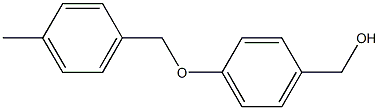
- 201058-08-4
- C15H16O2
- 228.28634
- All (0)
- China (0)
- (0)
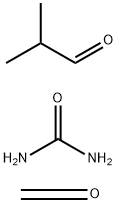
- 28931-47-7
- C6H14N2O3
- 162.19
- All (0)
- China (0)
- (0)

- 11041-12-6
- C27H47N
- 385.66878
- All (0)
- China (0)
- (0)
- 9003-74-1
- C10H18
- 0
- All (7)
- China (4)
- (7)
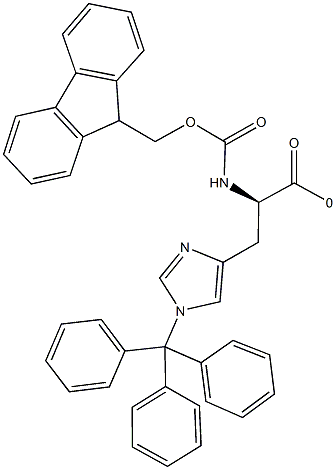
- 55844-94-5
- C40H32N3O3R
- 602.70038
- All (3)
- China (0)
- (3)

- 39319-11-4
- C18H15P
- 262.285461
- All (1)
- China (0)
- (1)
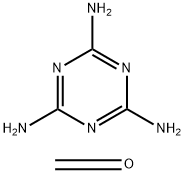
- 9003-08-1
- C4H8N6O
- 156.15
- All (1)
- China (1)
- (1)
Related Products More >

- 9002-86-2
- CNY Request For Quotation
- CNY Request For Quotation
- CNY Request For Quotation
- CNY Request For Quotation
- 465-42-11
- CNY Request For Quotation
- 465-42-10
- CNY Request For Quotation
- 465-42-9
- CNY Request For Quotation
- Request For Quotation


Water-based stains dry faster, with surface dryness achievable in 4–6 hours, but full curing—where water fully evaporates and pigments stabilize in wood pores—requires 12–24 hours. Applying polyurethane too soon over water-based stain triggers a different issue: pigment bleeding. Water-based stain pigments are held in place by weak physical bonds until fully dry; the polyurethane’s water or solvent carrier disrupts these bonds, pulling pigments upward into the wet polyurethane and creating uneven, blotchy coloration. For example, a woodworker staining oak with a water-based blue stain and applying polyurethane after 3 hours might see blue streaks in the clear coat, as the reactivated pigment mixes with the polyurethane’s carrier.
Common misconceptions distort this timeline. One myth is that “touch dry means ready”—touch dry only indicates surface solvent evaporation, not full removal of moisture or oils from wood’s interior. Another is that oil-based stains “need extra time to deepen color,” but extending drying beyond 48 hours can cause the stain’s surface to oxidize excessively, forming a smooth, non-porous layer that reduces polyurethane adhesion (light sanding with 220-grit paper after 48 hours fixes this). Professionals also adjust for environmental conditions: high humidity (above 60%) slows evaporation, adding 12–24 hours to both oil- and water-based stain dry times, while low temperatures (below 18°C) delay oxidation in oil-based stains.
This timeline differs from applying polyurethane to bare wood, where no prior chemical layer complicates bonding. After staining, the goal is to let the stain’s solvents and oils fully dissipate so the polyurethane can bond directly to the wood and sealed pigments. By following stain-specific dry times—24–48 hours for oil-based, 12–24 hours for water-based—and testing with a hidden area (applying a polyurethane dot to check for bubbling or bleeding), you ensure the stain enhances wood color without undermining the polyurethane’s cross-linked protective film, creating a durable, even finish that lasts for years.
From a chemical perspective, oil-based stains use mineral spirits or alkyd resins, which evaporate slowly, allowing pigments to settle deeply into the wood. Applying polyurethane too soon traps residual solvents, leading to a cloudy finish or poor adhesion—a phenomenon akin to painting over wet concrete, where trapped moisture weakens structural integrity. Water-based stains, while faster-drying, risk raising the wood’s grain, necessitating light sanding before polyurethane application. This step ensures a smooth surface, much like how dental technicians polish ceramic crowns to optimize bonding with adhesives.
In practical terms, environmental factors like humidity and temperature significantly influence drying times. High humidity slows solvent evaporation, prolonging the wait, while low temperatures can delay chemical curing in oil-based products. Industrial settings often use forced-air drying or infrared heaters to accelerate this process, ensuring consistent results. Conversely, DIY projects in humid climates may require extended drying periods, underscoring the importance of adapting techniques to local conditions.
Cross-disciplinary insights reveal parallels in food packaging, where coatings must cure fully before contact with consumables to avoid contamination. Similarly, in biomedical engineering, hydrogel coatings on implants require precise drying to maintain biocompatibility. By understanding the kinetics of solvent loss and material interactions, the timing between staining and polyurethane application becomes a critical variable in achieving durable, aesthetically pleasing finishes across woodworking, construction, and artistic applications.
The wood species, ambient humidity, and temperature also influence drying times. Dense hardwoods or high-humidity conditions can slow down the curing process, making a quick polyurethane application risky. A practical approach is to test a small, inconspicuous area: if the surface feels dry to the touch and no tackiness remains, it’s usually safe to proceed. For instance, furniture makers often stain a tabletop in the evening and begin polyurethaning the next day, ensuring that the color is locked in and the finish adheres smoothly. Waiting the proper interval also helps the polyurethane form a consistent protective layer, improving durability and wear resistance.
By carefully timing the transition from staining to finishing, woodworkers can avoid common issues like blotching, uneven sheen, or peeling, while achieving a clean, long-lasting appearance. This interplay between stain absorption and surface curing is key to producing high-quality results in both DIY and professional woodworking projects.