


 Home
Home
Hi, I’m curious about the difference between polyurethane and lacquer. Both are finishes used on furniture, floors, and wood surfaces, but I’m not sure when to use one over the other. Are there big differences in how they look, feel, or hold up over time? Do they react differently to scratches, heat, or water? I’ve also heard that one might be easier to apply than the other—does that matter for a beginner trying a DIY project? How can I decide which one is better for a particular piece of furniture or home improvement task?
What's the Difference Between Polyurethane and Lacquer: Which Finish Should You Choose?
Related Encyclopedia
- 9009-54-5
- C3H8N2O
- 0
- All (13)
- China (0)
- (13)
![3-[(E)-4,6-dimethylhept-2-enyl]oxolane-2,5-dione,2-[3-(oxiran-2-ylmethoxy)propoxymethyl]oxirane,4-(oxiran-2-yl)-7-oxabicyclo[4.1.0]heptane](https://chemcloud-1304660855.cos.ap-shanghai.myqcloud.com/compound/bbb16ce2863d42899585d90674283a10.png?imageMogr2/format/webp)
- 52368-54-4
- C30H48O9
- 552.69700
- All (0)
- China (0)
- (0)
- (C14H13NO)n
- 211.26000
- All (0)
- China (0)
- (0)
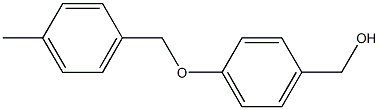
- 201058-08-4
- C15H16O2
- 228.28634
- All (0)
- China (0)
- (0)
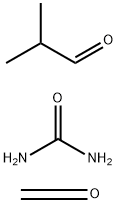
- 28931-47-7
- C6H14N2O3
- 162.19
- All (0)
- China (0)
- (0)

- 11041-12-6
- C27H47N
- 385.66878
- All (0)
- China (0)
- (0)
- 9003-74-1
- C10H18
- 0
- All (7)
- China (4)
- (7)
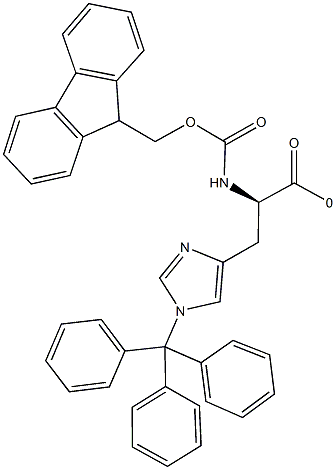
- 55844-94-5
- C40H32N3O3R
- 602.70038
- All (3)
- China (0)
- (3)

- 39319-11-4
- C18H15P
- 262.285461
- All (1)
- China (0)
- (1)
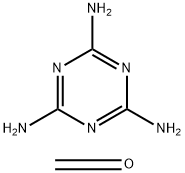
- 9003-08-1
- C4H8N6O
- 156.15
- All (1)
- China (1)
- (1)
Related Products More >

- 9002-86-2
- CNY Request For Quotation
- CNY Request For Quotation
- CNY Request For Quotation
- CNY Request For Quotation
- 465-42-11
- CNY Request For Quotation
- 465-42-10
- CNY Request For Quotation
- 465-42-9
- CNY Request For Quotation
- CNY Request For Quotation


Lacquer, on the other hand, dries really fast and gives a super smooth, shiny look. It’s often sprayed on, so it’s common in furniture shops or on cabinets. The finish is thinner than polyurethane, so it can chip more easily if something hits it. But it looks really nice and can be buffed to a high gloss.
For a simple DIY, polyurethane is usually easier—you can brush it on at home, and it’s more forgiving. Lacquer is amazing for a professional glossy finish, but spraying it at home is trickier. Basically, pick polyurethane for durability and everyday use, and lacquer if you want a shiny, showpiece look.
Lacquer, by contrast, is typically a solution of nitrocellulose or acrylic resins dissolved in volatile organic solvents. It dries primarily through solvent evaporation rather than chemical cross-linking, which accounts for its fast-drying nature. The resulting film is thinner and more flexible but less impact-resistant than polyurethane. Lacquer’s rapid drying makes it ideal for achieving a smooth, high-gloss finish on furniture or cabinetry, and it can be layered multiple times to build depth and luster. Because it dries quickly, touch-ups or multiple coats can be applied in a single day, which is advantageous in commercial woodworking.
In practical terms, the choice between the two depends on the performance requirements and application environment. Polyurethane is preferred when durability is critical, for instance, on a kitchen countertop exposed to spills, heat, and frequent cleaning. Lacquer is advantageous when aesthetic quality is prioritized, such as on decorative cabinets, musical instruments, or fine furniture, where a clear, glossy finish enhances the appearance. Understanding the curing mechanisms and physical properties of each coating helps professionals select the appropriate finish for both functional and visual outcomes.
Lacquer, by contrast, is a solvent-based finish typically made of nitrocellulose (a cellulose nitrate polymer) or acrylic resins, dissolved in highly volatile organic solvents (e.g., acetone, toluene). It cures via solvent evaporation alone: as the solvents rapidly vaporize, the resin particles coalesce into a thin film with minimal cross-linking between molecules. This coalesced structure, while hard, lacks the inter-molecular strength of polyurethane’s cross-linked network, making it more susceptible to damage from physical impact or chemicals.
These structural differences drive key performance gaps. Polyurethane dries more slowly (2–6 hours touch-dry for water-based, 4–8 hours for oil-based) but offers superior durability: its cross-linked network resists scratches, stains (e.g., coffee, wine), and harsh solvents (e.g., alcohol), and water-based versions avoid yellowing under UV light—critical for light-colored woods like maple. Lacquer dries extremely fast (15–30 minutes touch-dry), making it ideal for projects needing rapid turnaround (e.g., mass-produced furniture), but it scratches easily, yellows over time, and cannot withstand heavy use or solvent exposure, limiting it to decorative pieces rather than high-traffic surfaces like dining tables.
Application methods also differ. Lacquer’s thin consistency and fast solvent evaporation require spray application (HVLP or airless) to avoid brush marks—brushing would leave uneven coverage as solvents dry mid-application. Polyurethane, with higher viscosity and slower drying, works well with brushes, rollers, or sprayers; its extended dry time allows for self-leveling, reducing imperfections. Additionally, lacquer needs 4–6 thin coats to build sufficient thickness (each coat is very thin), while polyurethane achieves adequate protection with 3–4 coats due to its higher solids content and thicker cured film.
Common misconceptions blur these lines. One myth is that “lacquer is as durable as polyurethane”—in reality, lacquer’s lack of cross-linking means it wears quickly on high-use surfaces. Another is that “water-based lacquer matches water-based polyurethane’s performance”—water-based lacquer still relies on resin coalescence, not cross-linking, and remains less durable. Professionals choose lacquer for vintage furniture refinishing or decorative pieces where speed and a “natural” thin finish are prioritized, and polyurethane for functional surfaces where long-term protection is non-negotiable. Understanding these chemical and practical differences ensures the right finish is selected, aligning with the project’s aesthetic goals and functional needs.
From a physical standpoint, lacquer’s solvent-based curing produces a brittle film that yellows under UV exposure, a limitation mirrored in early plastics that degraded in sunlight. Polyurethane, however, exhibits superior chemical resistance and flexibility, with water-based variants offering UV stability and oil-based types providing deeper penetration into substrates like wood. This durability makes polyurethane ideal for high-traffic surfaces such as floors, whereas lacquer’s rapid drying and ease of repair suit decorative applications like musical instruments or cabinetry, where frequent touch-ups are practical.
In industrial contexts, lacquer remains prevalent in automotive refinishing for its fast recoat times, enabling efficient production lines, while polyurethane dominates in aerospace coatings for its resistance to extreme temperatures and fuels. Medical applications further highlight these differences: lacquer-based coatings on surgical instruments prioritize smooth, non-reactive surfaces, whereas polyurethane’s biocompatibility and flexibility make it preferable for implantable devices. By aligning material properties with functional demands, these coatings exemplify how chemical engineering bridges performance gaps, ensuring solutions tailored to environmental, mechanical, and physiological challenges without unnecessary compromises.