


 Home
Home
Hi, I’ve been curious about something I keep seeing in recipes and science experiments. Sodium bicarbonate, or baking soda, is often mixed with water, but I’m not entirely sure how it interacts with it. Does it completely dissolve, or does it only partially mix? And what happens if you add too much to the water? I’d love to understand how soluble sodium bicarbonate really is in everyday situations and why it behaves that way. Can someone explain this in simple terms?
Is Sodium Bicarbonate Soluble in Water and How Does It Behave?
Related Encyclopedia
- 32119-90-7
- DOT
- 22.02930
- All (50)
- China (13)
- (50)
- 20272-95-1
- DOT
- 21.02960
- All (50)
- China (13)
- (50)

- 358616-29-2
- H3O2
- 35.02260
- All (50)
- China (13)
- (50)
- 61468-85-7
- OT2
- 23.03120
- All (50)
- China (13)
- (50)
- 53774-37-1
- OT2
- 24.03130
- All (50)
- China (13)
- (50)
- 32113-92-1
- HOT
- 22.02320
- All (50)
- China (13)
- (50)
- 32119-89-4
- HOT
- 21.02310
- All (50)
- China (13)
- (50)
- 32113-93-2
- DOT
- 23.02930
- All (50)
- China (13)
- (50)
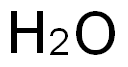
- 7732-18-5
- H2O
- 18.01
- All (50)
- China (13)
- (50)
- 12325-19-8
- H2O-
- 19.02320
- All (0)
- China (0)
- (0)
Related Products More >

- 9003-05-8
- USD 30.0000
- 25kg
- 9003-05-8
- USD 30.0000
- 25kg
- 1336-21-6
- CNY 500.0000
- 1ton


The solubility of sodium bicarbonate increases with temperature, as higher kinetic energy enables water molecules to more effectively disrupt the ionic bonds holding the compound together. At 20°C, approximately 9.6 grams of NaHCO₃ dissolve per 100 milliliters of water, a figure that rises significantly with heating. This temperature dependence is critical in industrial processes like dyeing or electroplating, where precise control over solubility ensures uniform mixing and reaction rates. Conversely, in cold environments, lower solubility may lead to precipitation, a phenomenon leveraged in some cleaning formulations to target acidic residues through controlled release of CO₂ upon dissolution.
In practical terms, sodium bicarbonate’s water solubility underpins its versatility across fields. In medicine, aqueous solutions neutralize stomach acid by reacting with hydrogen ions (H⁺) to form carbonic acid (H₂CO₃), which decomposes into water and CO₂, providing rapid relief. In baking, dissolved NaHCO₃ reacts with acidic ingredients like lemon juice to release CO₂, creating air pockets that leaven dough. Environmentally, its solubility aids in wastewater treatment, where it adjusts pH to optimal levels for microbial degradation of pollutants. These applications highlight how a fundamental chemical property—solubility—bridges molecular behavior and tangible solutions, demonstrating the interconnectedness of theory and practice in improving human life.
In practical terms, this solubility underpins its use in everyday life. In baking, dissolving sodium bicarbonate ensures it reacts fully with acidic ingredients, producing carbon dioxide that makes dough rise. In cleaning, it disperses evenly in water to act as a mild abrasive and neutralizer. Even in health applications, such as antacid solutions, its ability to dissolve fully ensures predictable buffering action in the stomach. The chemical principle here is that the polar nature of water interacts with the charged ions in sodium bicarbonate, overcoming the ionic lattice and allowing them to move freely in solution.
Understanding this mechanism also explains limits: while sodium bicarbonate is highly soluble, there is a saturation point. Exceeding this amount results in undissolved powder remaining, which can affect both chemical reactions and practical uses. In environmental or industrial scenarios, this knowledge helps in dosing for water treatment, pH adjustment, or effervescent formulations. Overall, the solubility of sodium bicarbonate in water is a key property that drives its diverse functionality across culinary, health, and industrial contexts.
This specific solubility profile is critical in numerous applications. In pharmaceuticals, it ensures that sodium bicarbonate can be formulated into effervescent tablets where controlled dissolution in water triggers the release of CO₂, enhancing drug delivery and patient compliance. In food science, its partial solubility allows it to disperse evenly in batters while retaining some granularity for texture. In chemical processes, its moderate solubility makes it suitable for use in buffer solutions where a gradual, controlled release of bicarbonate ions is necessary to maintain stable pH, such as in biological assays or water treatment systems. A key distinction must be made between sodium bicarbonate and sodium carbonate (Na₂CO₃), the latter being significantly more soluble in water (over 20 g/100mL at 20°C) due to its different ionic structure and stronger hydration energy.
A common misconception is that all "baking" or "soda" compounds exhibit similar solubility. Sodium bicarbonate's relatively lower solubility compared to sodium carbonate means it cannot be used interchangeably in processes requiring high ion concentration, such as certain cleaning agents or industrial precipitations. Another misunderstanding is attributing its solubility solely to its sodium content; the bicarbonate ion itself, with its larger size and propensity for hydrogen bonding, plays a defining role in limiting the solubility compared to simpler anions like chloride. Thus, the solubility of sodium bicarbonate is not just a physical property but a functional characteristic that dictates its utility across medicine, industry, and daily life, emphasizing the need for precise material selection in professional contexts.