


 Home
Home
Hi, I’ve come across the terms polyurethane and urethane while looking into coatings and plastics, and I’m a bit confused. Are they actually the same thing, or do they refer to different materials? Do they behave differently in everyday applications like wood finishing, furniture, or foam products? I want to understand if using one term instead of the other makes a difference when shopping for DIY projects or industrial materials. How should I think about polyurethane versus urethane?
Is Polyurethane the Same as Urethane or Are They Different?
Related Encyclopedia
- 9009-54-5
- C3H8N2O
- 0
- All (13)
- China (0)
- (13)
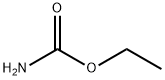
- 51-79-6
- C3H7NO2
- 89.09
- All (22)
- China (0)
- (22)
- 2043-25-6
- C6H9NO3
- 143.14100
- All (0)
- China (0)
- (0)
- 98025-56-0
- C3H6N2O3
- 118.09100
- All (0)
- China (0)
- (0)
- 108636-68-6
- C3H5NO3
- 103.07700
- All (0)
- China (0)
- (0)

- 51252-84-7
- C3H4O2
- 72.06270
- All (0)
- China (0)
- (0)
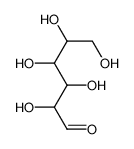
- 25191-16-6
- C6H12O6
- 180.15600
- All (0)
- China (0)
- (0)
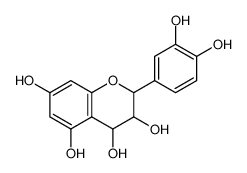
- 27015-21-0
- C15H14O7
- 306.26700
- All (0)
- China (0)
- (0)
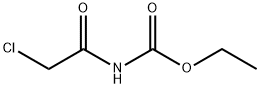
- 6092-47-3
- C5H8ClNO3
- 165.57
- All (0)
- China (0)
- (0)
- 96151-96-1
- C13H24N2O4
- 272.34100
- All (0)
- China (0)
- (0)
Related Products More >

- 9003-55-8
- CNY Request For Quotation
- CNY Request For Quotation
- CNY Request For Quotation
- 112945-52-5
- Request For Quotation


In practical terms, most of the products you encounter—like varnishes, foams, or coatings—are polyurethanes, which means they contain lots of urethane links. So when someone says “urethane” in a casual way, they often mean polyurethane, but technically, it’s a broader chemical term.
For DIY projects, it usually doesn’t make much difference. If you’re buying wood finish, foam padding, or protective coatings, the product labeled polyurethane will perform as expected. Just remember that polyurethane can be rigid or flexible depending on its formulation, while urethane on its own is rarely used as a standalone material in everyday products.
In professional fields like materials engineering, construction, or automotive manufacturing, this difference is non-negotiable. Polyurethane’s polymer structure allows it to be formulated into coatings, foams, adhesives, or elastomers (e.g., TPU), each tailored for specific functions: foam insulation relies on polyurethane’s closed-cell structure for thermal resistance, while automotive gaskets use its elastic polymer networks for sealing. Urethane, as a small molecule, lacks this structural versatility; it cannot form films, foams, or durable components, making it irrelevant for most industrial or consumer applications where “urethane” is colloquially referenced. This distinguishes the two from similar terminology mix-ups (e.g., “plastic” vs. “polyethylene”)—here, one is a foundational molecule, the other a complex polymer built from that molecule.
A common misconception is that “urethane” is a shorthand for “polyurethane” in all cases; while this is true in casual speech (e.g., “urethane coating” often means polyurethane), it is inaccurate in technical contexts. Another misunderstanding is assuming urethane exhibits the same properties as polyurethane—for example, confusing urethane’s chemical reactivity with polyurethane’s durability, which could lead to incorrect material choices (e.g., using urethane intermediates in place of polyurethane coatings, resulting in failure). In practice, professionals rely on the distinction to ensure performance: specifying “polyurethane” guarantees a polymer-based material with engineered properties, while “urethane” refers to a simple molecule with narrow, specialized uses, underscoring the importance of precise terminology in materials science and engineering.
The properties of polyurethane derive directly from the density and arrangement of urethane linkages. For example, rigid polyurethane is used in furniture, insulation panels, and floor coatings because the cross-linked structure provides hardness and durability. Flexible polyurethane, commonly found in foam cushions, shoe soles, or elastic seals, relies on longer soft segments in the polymer chain that allow stretching and compression without breaking. These variations illustrate how manipulating urethane chemistry at the polymer level can tailor materials for specific performance requirements.
In real-world practice, this distinction informs product selection. A wood varnish labeled as polyurethane offers a hard, protective surface, while a flexible gasket made from polyurethane foam absorbs mechanical stress effectively. Though the term “urethane” is sometimes used interchangeably in casual contexts, specifying “polyurethane” clarifies the actual material and expected properties. This precise understanding ensures designers and engineers choose the right formulation for durability, flexibility, or protective function across different industries.
From a chemical perspective, the synthesis of polyurethane involves a two-step process: prepolymer formation (reaction of polyol with excess diisocyanate) followed by chain extension with a diol or diamine, creating a cross-linked structure absent in simple urethane. This distinction is critical in applications like automotive seating, where polyurethane foams provide cushioning through controlled cell structure formation, a property unattainable with monomeric urethane. Similarly, in medical devices, polyurethane’s biocompatibility and tunable elasticity make it suitable for catheters and implants, whereas urethane’s toxicity and brittleness limit its use to non-biological contexts.
Cross-disciplinary impacts highlight broader implications. In construction, polyurethane spray foams insulate buildings by expanding to fill gaps, leveraging their reactive chemistry to create airtight seals, a function urethane cannot perform due to its lack of foamability. Conversely, in analytical chemistry, urethane serves as a calibration standard for gas chromatography due to its volatility and stability, illustrating how molecular simplicity can be advantageous in controlled environments. These examples underscore a universal principle: terminology precision in material science is not pedantic but foundational, as conflating "polyurethane" and "urethane" risks misapplying properties, compromising safety, and stifling innovation across fields from sustainable architecture to precision medicine.