


 Home
Home
Hey, I’ve been looking into finishes for my wooden furniture, and I keep seeing both “urethane” and “polyurethane” mentioned. I’m a bit confused because sometimes people seem to use them interchangeably, but are they actually the same thing? Does it matter which one I choose for durability or appearance, and are there certain situations where one is better than the other? Can you explain the differences in a way that’s easy to understand without getting too technical?
Is Urethane the Same as Polyurethane or Are They Different Materials?
Related Encyclopedia
- 9009-54-5
- C3H8N2O
- 0
- All (13)
- China (0)
- (13)
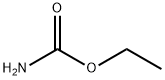
- 51-79-6
- C3H7NO2
- 89.09
- All (22)
- China (0)
- (22)
![3-[(E)-4,6-dimethylhept-2-enyl]oxolane-2,5-dione,2-[3-(oxiran-2-ylmethoxy)propoxymethyl]oxirane,4-(oxiran-2-yl)-7-oxabicyclo[4.1.0]heptane](https://chemcloud-1304660855.cos.ap-shanghai.myqcloud.com/compound/bbb16ce2863d42899585d90674283a10.png?imageMogr2/format/webp)
- 52368-54-4
- C30H48O9
- 552.69700
- All (0)
- China (0)
- (0)
- 2043-25-6
- C6H9NO3
- 143.14100
- All (0)
- China (0)
- (0)
- 98025-56-0
- C3H6N2O3
- 118.09100
- All (0)
- China (0)
- (0)
- 108636-68-6
- C3H5NO3
- 103.07700
- All (0)
- China (0)
- (0)
- (C14H13NO)n
- 211.26000
- All (0)
- China (0)
- (0)
- 201058-08-4
- C15H16O2
- 228.28634
- All (0)
- China (0)
- (0)
- 28931-47-7
- C6H14N2O3
- 162.19
- All (0)
- China (0)
- (0)

- 11041-12-6
- C27H47N
- 385.66878
- All (0)
- China (0)
- (0)
Related Products More >

- 9002-86-2
- CNY Request For Quotation
- 9003-55-8
- CNY Request For Quotation
- CNY Request For Quotation
- CNY Request For Quotation


In practical terms, this means polyurethane coatings or materials are widely used in flooring, furniture, automotive finishes, and industrial applications because they form a tough, resilient layer that protects surfaces from scratches, moisture, and wear. Urethane itself, while part of the chemical structure, is rarely used in isolation in such contexts because it lacks the mechanical stability provided by the polymer network. For example, an oil-based polyurethane floor finish will create a hard, long-lasting surface that can withstand heavy foot traffic, whereas simple urethane compounds wouldn’t achieve the same protective effect.
Understanding the difference also helps in choosing materials. Polyurethane formulations can be customized—water-based for low odor and fast drying, or oil-based for a richer finish and higher abrasion resistance. Urethane-based polymers may be incorporated in coatings, foams, and elastomers, demonstrating versatility in engineering applications. By recognizing that urethane is the chemical building block and polyurethane is the engineered polymer, one can better appreciate why polyurethane dominates in both consumer and industrial use.
The distinction becomes critical in practical applications. For instance, urethane-based adhesives or coatings are rare due to their low molecular weight and brittleness, whereas polyurethane dominates these markets. In furniture, polyurethane foams provide cushioning through controlled gas expansion during polymerization, a process impossible with simple urethanes. Similarly, automotive bumpers or shoe soles rely on polyurethane’s tunable hardness—from soft elastomers to rigid plastics—by adjusting polyol chain length or isocyanate type. Even in medicine, polyurethane’s biocompatibility supports its use in catheters or heart valves, while urethane’s toxicity restricts it to non-implantable roles.
Cross-disciplinary implications highlight this divergence. In material science, polyurethane’s structure-property relationships inspire biodegradable variants for sustainable packaging, whereas urethane’s simplicity aids in designing drug-delivery systems with controlled release rates. Environmental studies note polyurethane’s persistence, driving research into recycling methods, while urethane’s role in industrial byproducts raises toxicity concerns. Understanding these differences prevents misuse—such as substituting urethane for polyurethane in coatings, which would lead to premature failure—and underscores how molecular design dictates a material’s suitability for specific challenges, from everyday products to advanced technologies.
This structural difference dictates their roles in professional fields. Urethane, as a functional group, is a component of larger molecules beyond polyurethanes (e.g., some pharmaceuticals or adhesives), but it is never a finished material. Polyurethane, however, is a versatile engineering material used in coatings, foams, elastomers, and composites. For example, in flooring, polyurethane coatings form a crosslinked network that resists scratches and moisture—this durability comes from the polymer’s dense urethane-linked structure, not isolated urethane groups. In automotive manufacturing, polyurethane foam uses a less crosslinked structure to balance cushioning and support, a property enabled by controlling the number and arrangement of urethane repeats in the polymer chain.
A common misconception is using “urethane” as a shorthand for polyurethane, especially in consumer contexts like wood finishes. This mix-up can lead to errors in material selection: a product labeled “urethane finish” is actually a polyurethane coating, but assuming “urethane” refers to a distinct material might lead someone to use an incompatible adhesive or primer. In materials science, precision matters—urethane’s role as a functional group vs. polyurethane’s as a polymer determines compatibility with other chemicals (e.g., solvents, paints) and performance under stress (e.g., heat, wear). For instance, a polyurethane sealant bonds to concrete because its polymer chains can flex with the substrate, while a material with isolated urethane groups would lack this flexibility, leading to cracking. Understanding this distinction ensures professionals in construction, manufacturing, and design select materials that meet technical requirements, avoiding costly failures or compromised performance.