


 Home
Home
Hi, I’ve been curious about the role of sodium bicarbonate in the body. I know it’s often used for heartburn or acid control, but I heard it can also affect potassium levels. How exactly does this happen? Is it safe to use it to adjust potassium, and under what conditions would this effect take place? I’m trying to understand the mechanism and whether this is something that could happen just from taking it orally or if it’s only in medical treatments. Could someone explain this in simple terms?
How Does Sodium Bicarbonate Lower Potassium Levels in the Body?
Related Encyclopedia
- 144-55-8
- CHNaO3
- 84.01
- All (83)
- China (59)
- (83)
![SODIUM BICARBONATE, [14C]](https://chemcloud-1304660855.cos.ap-shanghai.myqcloud.com/compound/4ca1cb1df0ef47f58653c7f46f805e3b.png?imageMogr2/format/webp)
- 7279-86-9
- CHNaO3
- 86.02000
- All (0)
- China (0)
- (0)
Related Products More >
- CNY Request For Quotation
- CNY Request For Quotation
- CNY Request For Quotation
- 144-55-8
- CNY 100.0000
- 25kg
- 144-55-8
- USD 225.0000
- 25kg
- 144-55-8
- USD 7.5000
- 25kg
- 9012-76-4
- Request For Quotation
- 144-55-8
- Request For Quotation


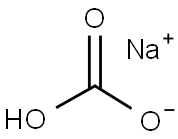
From a chemical perspective, sodium bicarbonate’s dissociation into Na⁺ and HCO₃⁻ in blood alters ion balances. The rise in HCO₃⁻ buffers excess H⁺, while the accompanying Na⁺ may transiently increase extracellular osmolarity, though its primary role is to support cellular potassium uptake. Additionally, the alkaline environment induced by sodium bicarbonate reduces renal tubular reabsorption of potassium. In the kidneys, acidosis (low pH) promotes K⁺ retention, whereas alkalosis (high pH) stimulates its excretion. By elevating blood pH, sodium bicarbonate indirectly signals the kidneys to excrete more K⁺, further lowering serum levels.
In medical practice, this dual mechanism—intracellular shift and renal excretion—makes sodium bicarbonate a cornerstone of hyperkalemia treatment, often used alongside insulin and glucose or calcium gluconate. Its industrial relevance, however, lies in its role as a pH regulator in processes like water treatment, where controlling ion activity is essential. Understanding sodium bicarbonate’s potassium-lowering effects bridges biochemistry and clinical medicine, highlighting how a simple compound can manipulate cellular and systemic ion dynamics to restore homeostasis, a principle with far-reaching implications in both health and engineering.
This mechanism is particularly significant in clinical contexts where hyperkalemia—elevated potassium levels—poses a risk of cardiac arrhythmias. For example, patients with renal impairment or acute metabolic acidosis may receive controlled doses of sodium bicarbonate intravenously to lower serum potassium while other interventions, such as dialysis or potassium-binding medications, are prepared. It is important to note that this effect is transient and primarily redistributes potassium rather than removing it from the body.
In practical applications, this principle is also reflected in emergency medicine protocols. For instance, if a patient presents with hyperkalemia and accompanying metabolic acidosis, sodium bicarbonate can be used as an immediate stabilizing measure. This approach is carefully monitored to avoid complications like volume overload or shifts in other electrolytes. The same concept underlies why routine dietary or over-the-counter use of sodium bicarbonate has minimal effect on potassium for healthy individuals, highlighting that the mechanism is context-dependent and most relevant in medically managed settings.
The critical mechanism linking this pH change to potassium is the function of the cellular hydrogen-potassium (H⁺/K⁺) antiporter. This transporter, present on many cell membranes including those of muscle and red blood cells, functions to maintain electrochemical balance by exchanging intracellular hydrogen ions for extracellular potassium ions. In states of acidosis (low pH), this exchanger is highly active, pumping H⁺ out of the cell and K⁺ into the cell to help correct the blood acidity. Conversely, when the extracellular environment is rapidly alkalinized by bicarbonate, the activity of this antiporter is reduced. Furthermore, the resulting electrochemical gradient favors the movement of potassium ions from the extracellular fluid back into the cells to restore equilibrium. This intracellular shift effectively lowers the concentration of potassium measured in the blood serum.
It is paramount to distinguish this treatment from other modalities for hyperkalemia, such as potassium-binding resins (e.g., sodium polystyrene sulfonate) or dialysis. While binding resins directly complex with potassium in the GI tract for excretion, and dialysis physically removes it from the blood, bicarbonate does not remove potassium from the body; it merely redistributes it from the vascular space into cells. This is a temporizing measure, not a definitive treatment for potassium overload. A significant misconception is that bicarbonate is a first-line or highly effective monotherapy for all hyperkalemia. Its efficacy is most pronounced in patients with concurrent metabolic acidosis. In patients with normal or alkaline pH, its ability to lower potassium is considerably less effective and its use may contribute to complications like sodium overload or metabolic alkalosis. Thus, its application is a targeted intervention based on the patient's acid-base status, not a universal remedy for high potassium.