


 Home
Home
Hi, I was wondering about something I keep seeing in recipes and cleaning guides. Sodium bicarbonate is often mentioned, but I’m not sure if it’s acidic or basic. When I use it in baking or around the house, does it act like an acid? How does it behave in water or other liquids, and should I be worried about it being corrosive or reactive? Could someone explain whether sodium bicarbonate is acidic and what that really means in practical terms?
Is Sodium Bicarbonate Acidic or Does It Act Differently in Everyday Use?
Related Encyclopedia
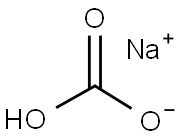
- 144-55-8
- CHNaO3
- 84.01
- All (83)
- China (59)
- (83)
![SODIUM BICARBONATE, [14C]](https://chemcloud-1304660855.cos.ap-shanghai.myqcloud.com/compound/4ca1cb1df0ef47f58653c7f46f805e3b.png?imageMogr2/format/webp)
- 7279-86-9
- CHNaO3
- 86.02000
- All (0)
- China (0)
- (0)
Related Products More >

- CNY Request For Quotation
- CNY Request For Quotation
- CNY Request For Quotation
- 144-55-8
- CNY 100.0000
- 25kg
- 144-55-8
- USD 225.0000
- 25kg
- 144-55-8
- USD 7.5000
- 25kg
- 144-55-8
- Request For Quotation
- 144-55-8
- Request For Quotation
- according to buyer instruction


In physiological systems, sodium bicarbonate’s basicity is leveraged to neutralize excess stomach acid, making it a common antacid. Its ability to buffer pH is critical in medical emergencies like metabolic acidosis, where it temporarily raises blood pH by binding hydrogen ions (H⁺). This mechanism mirrors its industrial use in wastewater treatment, where it stabilizes pH to prevent corrosion or optimize chemical reactions. Unlike strong bases such as sodium hydroxide (NaOH), sodium bicarbonate’s mild reactivity allows for controlled adjustments without causing violent neutralization reactions, a property that enhances safety in both biological and engineered systems.
A common misunderstanding arises from its ability to react with acids, leading some to conflate its reactivity with acidity. However, this duality—acting as a base in neutral solutions or an acid in highly alkaline environments—stems from its amphoteric character, not inherent acidity. In baking, for example, sodium bicarbonate’s basicity reacts with acidic ingredients like lemon juice to produce CO₂, causing dough to rise. This reaction underscores its role as a base in everyday applications, from cooking to firefighting (where it smothers flames by releasing CO₂). By clarifying its chemical behavior, we recognize sodium bicarbonate as a versatile, foundational compound whose basicity underpins its utility across disciplines.
However, in the presence of a stronger base, the same bicarbonate ion can donate a proton, acting as a weak acid to form the carbonate ion (CO₃²⁻). This does not make the compound itself acidic; rather, it highlights the reactivity of the bicarbonate ion within the broader carbonate equilibrium system (CO₂ + H₂O ⇌ H₂CO₃ ⇌ H⁺ + HCO₃⁻ ⇌ 2H⁺ + CO₃²⁻). It is this very equilibrium that allows sodium bicarbonate to serve as an effective buffer, resisting pH changes in everything from biological fluids to swimming pools.
A critical distinction must be made between being an acidic compound and participating in an acid-producing reaction. For instance, when sodium bicarbonate is heated, it decomposes to sodium carbonate, water, and carbon dioxide. The release of CO₂, which can form carbonic acid in water, is sometimes misinterpreted as evidence of an inherent acidic character. This is incorrect; the decomposition is a thermal reaction, not a reflection of its innate acidity. Similarly, while carbonic acid is weak and unstable, sodium bicarbonate remains a source of basicity in most practical applications. Its value in chemistry, physiology, and industry stems from this buffering capacity, not from any intrinsic acidity. Misunderstanding its amphoteric nature can lead to incorrect applications, such as using it in a system where a strong, stable base is truly required.
From an industrial or household perspective, sodium bicarbonate’s ability to moderate pH levels makes it invaluable. In baking, it reacts with acidic ingredients such as vinegar, lemon juice, or yogurt to release carbon dioxide, which helps dough or batter rise. In swimming pools, it can be added to stabilize pH and maintain water quality. In personal care, it is used to relieve heartburn or minor skin irritations, leveraging its mild alkalinity to counteract excess acidity.
Mechanistically, the bicarbonate ion can act as a buffer, temporarily absorbing hydrogen ions from acids to form carbonic acid, which subsequently decomposes to carbon dioxide and water. This reaction underpins its role in both culinary and chemical contexts. Sodium bicarbonate’s weak base property also explains why it is safe to handle under normal conditions and can be used in contact with food, water, or skin without causing strong corrosive effects. Its neutralizing capacity, mildness, and reactivity make it a practical agent across a wide spectrum of daily life and technical uses.