


 Home
Home
I was looking at a list of common kitchen items—cooking oil, cornstarch, table salt, and baking soda—and I became curious about their scientific makeup. I've heard the term "ionic compound" before but I'm not entirely sure what it means in practice. From this group, how can I tell which ones are ionic? What specific properties do these ionic substances have that set them apart from the others on the list?
Identifying Ionic Compounds: A Look at Oil, Cornstarch, Salt, and Baking Soda
Related Encyclopedia
- 144-55-8
- CHNaO3
- 84.01
- All (83)
- China (59)
- (83)
![SODIUM BICARBONATE, [14C]](https://chemcloud-1304660855.cos.ap-shanghai.myqcloud.com/compound/4ca1cb1df0ef47f58653c7f46f805e3b.png?imageMogr2/format/webp)
- 7279-86-9
- CHNaO3
- 86.02000
- All (0)
- China (0)
- (0)
- 7647-14-5
- ClNa
- 58.44
- All (45)
- China (29)
- (45)

- 20510-56-9
- ClNa
- 60.46000
- All (0)
- China (0)
- (0)

- 20510-55-8
- ClNa
- 58.44000
- All (0)
- China (0)
- (0)
- 95860-64-3
- ClCsNa
- 191.34800
- All (0)
- China (0)
- (0)
- 95860-66-5
- ClKNa
- 97.54110
- All (0)
- China (0)
- (0)
- 66650-11-1
- ClH2NaO
- 76.45810
- All (0)
- China (0)
- (0)
- 107472-99-1
- Cl3Na3-
- 175.32800
- All (0)
- China (0)
- (0)
- 124151-79-7
- Cl4NaOTc
- 279.70700
- All (0)
- China (0)
- (0)
Related Products More >

- CNY Request For Quotation
- CNY Request For Quotation
- CNY Request For Quotation
- 144-55-8
- CNY 100.0000
- 25kg
- 144-55-8
- USD 225.0000
- 25kg
- 144-55-8
- USD 7.5000
- 25kg
- 7647-14-5
- Request For Quotation
- 25kg Bag
- 7647-14-5
- Request For Quotation
- 100g;1kg;25g


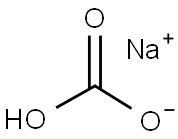
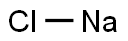
You can see this in how they behave. For example, they both dissolve easily in water and can even conduct a tiny bit of electricity when they do, which is a classic sign of an ionic compound. They also tend to form crystals, like the grains of salt you see. On the other hand, cornstarch and cooking oil are very different. They're made from molecules that don't have those same strong charges. Oil repels water and cornstarch clumps up in cold water instead of dissolving neatly. So, while salt and baking soda are ionic, oil and cornstarch are not.
In contrast, cornstarch is a polymeric carbohydrate composed of glucose units linked by covalent bonds, and oil is a complex mixture of non-polar organic lipids. The distinction is practically significant. For instance, the ionic nature of sodium chloride is why it readily dissociates into Na⁺ and Cl⁻ ions in water, a mechanism crucial for its role in regulating osmotic balance in biological systems and enhancing the conductivity of an electrolyte. Similarly, sodium bicarbonate’s ionic character allows it to dissociate and participate in acid-base reactions, which is the principle behind its use as a leavening agent in baking; the released CO₂ gas forms the pockets that cause dough to rise.
The practical test for ionic character often hinges on these properties. A simple demonstration of electrolysis using a battery and electrodes in an aqueous solution of sodium chloride will show gas evolution at the electrodes, confirming electrical conductivity. Conversely, subjecting cornstarch or oil to the same test yields no result, as their covalent bonds do not produce free-moving ions. This fundamental difference in bonding dictates their application across industries, from food science to electrochemistry.
Physically, the ionic nature of sodium chloride and sodium bicarbonate drives key properties that define their practical uses, while the non-ionic character of oil and cornstarch dictates their roles in daily and industrial contexts. Ionic compounds like sodium chloride and sodium bicarbonate are highly soluble in polar solvents (e.g., water), as water molecules surround and separate their ions (hydration), allowing them to conduct electricity when dissolved or melted—this conductivity arises from the free movement of charged ions. Sodium chloride, for example, dissolves easily in water to form saline solutions, used in medicine for intravenous hydration or nasal irrigation, and in food as a seasoning; its ionic bonds also give it a high melting point (801°C), making it stable for cooking. Sodium bicarbonate, too, dissolves in water to release Na⁺ and HCO₃⁻ ions, enabling its use as a pool buffer (regulating pH via bicarbonate ions) or antacid (neutralizing stomach acid with HCO₃⁻). Oil, being non-ionic and nonpolar, is insoluble in water (a polar solvent) and does not conduct electricity; this immiscibility makes it useful in cooking (as a heat transfer medium) or cosmetics (as a moisturizer), while its covalent structure gives it a low melting point, allowing it to remain liquid at room temperature. Cornstarch, a non-ionic organic polymer, is only slightly soluble in cold water and forms a colloidal suspension when heated—its large, uncharged molecules trap water, creating a thickening effect used in sauces, soups, or biodegradable packaging.
The distinction between ionic and non-ionic substances in this group carries broader implications for sustainability, safety, and industrial efficiency. Sodium chloride and sodium bicarbonate, as ionic compounds, are readily produced and recycled: sodium chloride is extracted from salt mines or seawater, with minimal environmental impact when processed, and sodium bicarbonate is synthesized via low-waste reactions, making both ideal for large-scale use in food, medicine, and water treatment. Their ionic nature also ensures they break down into harmless ions in biological systems—sodium chloride is an essential electrolyte for human health, while sodium bicarbonate is metabolized into CO₂ and water—reducing toxicity risks. Oil and cornstarch, as non-ionic organics, offer sustainability benefits too: plant-based oils (e.g., corn oil) are renewable, and cornstarch is biodegradable, replacing synthetic plastics in products like disposable餐具. However, their non-ionic character limits their use in applications requiring conductivity or pH adjustment, where ionic compounds like sodium chloride (in electrolyte drinks) or sodium bicarbonate (in fire extinguishers) are irreplaceable. This contrast highlights how molecular structure—ionic vs. non-ionic—dictates not just chemical behavior, but also the ability of substances to meet diverse societal needs, from feeding populations to reducing environmental harm.
In contrast, oil and cornstarch are covalent (molecular) substances. Oil, typically a triglyceride, consists of nonpolar hydrocarbon chains linked via ester bonds, rendering it insoluble in water and electrically nonconductive. Cornstarch, a polysaccharide, comprises glucose monomers connected by glycosidic bonds, forming a granular, water-absorbent but insoluble structure. These properties explain their roles as energy storage (oil) or thickening agents (cornstarch) in food and industrial products.
A common misconception is conflating ionic and molecular substances based on physical state. For example, sodium chloride is a solid at room temperature, like cornstarch, but their behaviors diverge drastically in solution: NaCl dissociates into ions, conducting electricity, while cornstarch remains intact, acting as a colloidal stabilizer. Similarly, sodium bicarbonate’s ionic nature allows it to buffer pH by accepting protons, unlike oil, which lacks reactive functional groups. Understanding these distinctions ensures proper selection in fields ranging from culinary arts to chemical engineering.