


 Home
Home
Hi there, I’m curious about a chemical I came across called Ethylene glycol isooctyl ether. I’ve seen it mentioned in some cleaning products and industrial solutions, but I’m not sure what makes it different from other glycol ethers. How exactly does it work, and why is it used in paints, coatings, or cleaners? Are there any safety or handling tips I should know about if I encounter it? Could you explain what its main features and common applications are?
Understanding What is Ethylene Glycol Isooctyl Ether and Its Everyday Uses
Related Encyclopedia
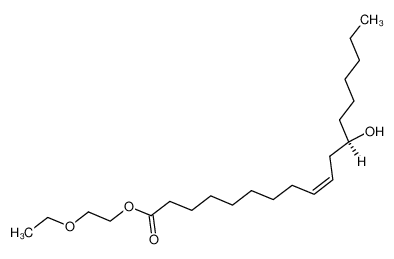
- 10031-89-7
- C22H42O4
- 370.56600
- All (0)
- China (0)
- (0)
- 197704-34-0
- C29H50O2
- 430.70600
- All (0)
- China (0)
- (0)
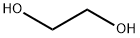
- 107-21-1
- C2H6O2
- 62.07
- All (551)
- China (111)
- (551)
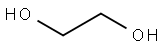
- 15054-86-1
- C2H6O2
- 62.07
- All (551)
- China (111)
- (551)
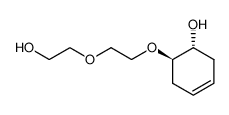
- 140458-39-5
- C10H18O4
- 202.24800
- All (0)
- China (0)
- (0)
- 29928-00-5
- C72H146O37
- 1603.91000
- All (0)
- China (0)
- (0)
- 148571-67-9
- C2H4Cl4O2Ti
- 249.73100
- All (0)
- China (0)
- (0)
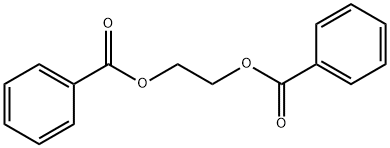
- 94-49-5
- C16H14O4
- 270.28
- All (0)
- China (0)
- (0)

- 67353-85-9
- C2H4O
- 44.05260
- All (0)
- China (0)
- (0)
- 60289-60-3
- C2H7BO4
- 105.88600
- All (0)
- China (0)
- (0)
Related Products More >

- 143-24-8
- Request For Quotation
- 25322-68-3
- Request For Quotation
- 93-46-9
- CNY 4500.0000
- 1ton
- 107-21-1
- CNY 15.0000
- 25kg
- 112-27-6
- CNY 10.0000
- 25kg
- 127-21-1
- CNY Request For Quotation
- 71902-18-6
- Request For Quotation
- 25kg
- 71902-18-6
- Request For Quotation
- 1ton


You’ll often find it in industrial cleaners or specialty coatings because it can loosen oils and residues better than plain water alone. It’s also used in paint formulations to improve flow and finish so the final surface looks even and smooth.
Even though it’s not as strong as some other solvents, it’s smart to handle it carefully—use gloves, avoid breathing in vapors, and work in a ventilated area. It’s the kind of ingredient you might not notice in everyday products, but it plays a big role in making them work effectively and safely.
In engineering applications, EGIOE’s role as a slow-evaporating coupling agent is pivotal in solvent-borne and waterborne systems exposed to prolonged processing or elevated temperatures, such as automotive coatings, printing inks, and metal cleaning agents. Its ability to stabilize emulsions and prevent phase separation ensures consistent product quality, while its moderate hydrophilicity bridges aqueous and organic phases, improving compatibility in hybrid formulations. Physiologically, EGIOE’s branched structure reduces dermal penetration compared to linear glycol ethers, though inhalation risks persist due to its low vapor pressure. A common misconception is conflating EGIOE with diethylene glycol isooctyl ether (DEGIOE), which incorporates an additional ethylene glycol unit. While both share an isooctyl terminus, DEGIOE’s extended polyether backbone increases hydrophilicity, favoring aqueous systems, whereas EGIOE’s simpler structure suits solvent-borne applications requiring controlled evaporation and robust film formation. This distinction underscores EGIOE’s niche in balancing performance, safety, and regulatory compliance across diverse industrial sectors.
In practical terms, this chemical is commonly found in paints, coatings, inks, and cleaning agents. For example, in a waterborne paint, ethylene glycol isooctyl ether helps the pigments and binders stay evenly suspended, improves flow, and reduces streaking or surface defects as the paint dries. In cleaning solutions, it can help remove greasy residues and enhance the overall efficiency of the product, working better than plain water because it can interact with oily compounds.
Its role in these applications is tied to its molecular structure: the ether linkage stabilizes the molecule, while the glycol portion interacts with polar substances. This balance allows formulators to fine-tune viscosity, drying rates, and compatibility with other ingredients. Handling it requires basic precautions—gloves, good ventilation, and avoiding ingestion or inhalation—because, like most solvents, prolonged exposure could irritate the skin or respiratory system. Ethylene glycol isooctyl ether quietly improves everyday products, making them more effective and easier to use without being obvious to the end user.
In industrial and specialty applications, EGIOE’s unique combination of branched lipophilicity, low volatility, and moderate viscosity addresses needs that linear or shorter-chain glycol ethers cannot. In heavy-duty industrial cleaning, it is a key component in degreasers for automotive engines, industrial machinery, and aerospace components, where its ability to dissolve thick, aged oil deposits and carbonized greases surpasses that of linear ethers— the branched isooctyl chain penetrates into tight spaces (e.g., engine valves, gear teeth) more effectively, ensuring thorough contaminant removal without evaporating prematurely. In agricultural formulations, it acts as a surfactant and adjuvant for oil-based pesticides and herbicides, improving their spreadability on leaf surfaces by reducing surface tension— the branched structure helps the pesticide adhere to waxy plant cuticles, preventing runoff and enhancing active ingredient absorption. In coatings for hydrophobic substrates (e.g., plastic films, powder-coated metals), EGIOE functions as a wetting agent and secondary solvent, displacing residual surface oils and ensuring the coating spreads uniformly; its low volatility allows the coating to level out fully before curing, avoiding defects like “orange peel” or pinholes that arise from rapid solvent loss. In personal care, it finds use in high-end skin exfoliants and hair conditioners, where its lipophilicity helps dissolve oil-based exfoliants (e.g., salicylic acid) or blend with hair lipids, while its low odor and moderate viscosity enhance product texture.
EGIOE’s broader significance lies in its role as a sustainable alternative to hazardous lipophilic solvents and its contribution to specialized industrial efficiency. As a replacement for chlorinated solvents (e.g., perchloroethylene) or aromatic hydrocarbons (e.g., xylene) in degreasing and agricultural applications, it helps manufacturers comply with strict environmental and occupational health regulations— its low volatility reduces VOC emissions, and its lower toxicity minimizes risks to workers and non-target organisms (e.g., pollinators in agriculture). In the shift toward water-based industrial cleaners and agricultural formulations, EGIOE’s ability to solubilize nonpolar components in aqueous systems eliminates the need for petroleum-based solvent-borne alternatives, cutting reliance on fossil fuels and reducing environmental contamination from runoff. For end-users, this translates to more efficient degreasers that reduce equipment maintenance downtime and agricultural products that improve crop protection while lowering ecological impact. In emerging fields like bioplastics manufacturing, EGIOE is also explored as a plasticizer for biodegradable polymers (e.g., PLA), where its branched structure enhances polymer flexibility without compromising biodegradability— demonstrating how its tailored properties adapt to evolving industrial needs while advancing sustainability across sectors.