


 Home
Home
Hi, I’m trying to figure out how to keep my swimming pool water balanced. I know sodium bicarbonate can help adjust alkalinity, but I’m not sure how much I should actually add without overdoing it. I’ve heard that adding too much or too little can affect the water clarity and comfort. How can I determine the right amount of sodium bicarbonate to add so the pool stays safe and clean for swimming?
How Much Sodium Bicarbonate to Add to Pool for Proper Alkalinity Balance
Related Encyclopedia
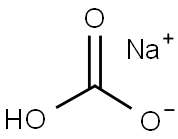
- 144-55-8
- CHNaO3
- 84.01
- All (83)
- China (59)
- (83)
![SODIUM BICARBONATE, [14C]](https://chemcloud-1304660855.cos.ap-shanghai.myqcloud.com/compound/4ca1cb1df0ef47f58653c7f46f805e3b.png?imageMogr2/format/webp)
- 7279-86-9
- CHNaO3
- 86.02000
- All (0)
- China (0)
- (0)
Related Products More >

- CNY Request For Quotation
- CNY Request For Quotation
- CNY Request For Quotation
- 144-55-8
- CNY 100.0000
- 25kg
- 144-55-8
- USD 225.0000
- 25kg
- 144-55-8
- USD 7.5000
- 25kg
- 144-55-8
- Request For Quotation
- 144-55-8
- Request For Quotation
- according to buyer instruction


In engineering and water treatment contexts, maintaining TA between 80–120 ppm (parts per million) is essential to prevent pH fluctuations, which can cause corrosion, scaling, or ineffective chlorination. For every 10,000 gallons of pool water, adding approximately 1.5 pounds of sodium bicarbonate typically raises TA by 10 ppm. However, precise dosing requires testing water with a reliable kit to determine the existing TA deficit. A common misconception is assuming sodium bicarbonate can replace sodium carbonate for pH correction; while both are sodium salts, sodium carbonate’s stronger basicity (higher pH impact) makes it unsuitable for TA-focused adjustments. Additionally, overuse of sodium bicarbonate can lead to cloudy water or scaling if TA exceeds 150 ppm, emphasizing the need for incremental additions and retesting. This nuanced approach ensures optimal water balance, protecting pool infrastructure and enhancing swimmer comfort through stable, non-irritating conditions.
As a general guideline, to raise TA by 10 ppm in a 10,000-gallon pool, approximately 1.5 pounds (0.68 kg) of sodium bicarbonate is needed; for a 20,000-gallon pool, this doubles to 3 pounds (1.36 kg), and so on. However, precise calculations require accounting for current levels: if a 15,000-gallon pool has a current TA of 60 ppm (20 ppm below the 80 ppm target), the required amount is (20 ppm ÷ 10 ppm) × 1.5 pounds × (15,000 ÷ 10,000) = 4.5 pounds (2.04 kg). Application steps are critical to avoid clumping or localized high alkalinity: sodium bicarbonate should be dissolved in a bucket of pool water first (never added directly as a dry powder, which can settle on the pool floor and damage concrete or clog filters) and poured evenly around the pool’s perimeter while the pump and filter run. After addition, the water should circulate for 4–6 hours before retesting TA and pH—this allows the bicarbonate ions to distribute uniformly and the buffering system to stabilize. Overdosing is rare but can raise TA above 150 ppm, leading to cloudy water (due to mineral precipitation) or reduced chlorine efficacy (high alkalinity lowers free chlorine’s sanitizing power); in such cases, diluting the pool with fresh water or using a TA reducer (e.g., muriatic acid) may be necessary.
The broader significance of proper sodium bicarbonate dosing extends beyond water clarity to pool maintenance efficiency, equipment longevity, and user safety. Maintaining optimal TA with sodium bicarbonate prevents pH crashes, which can corrode metal components (e.g., ladders, pumps) and etch concrete surfaces, while also avoiding pH spikes that cause calcium scaling on filters and heater elements—both issues increase maintenance costs and shorten equipment lifespan. For swimmers, balanced TA and pH reduce skin and eye irritation: low TA leads to acidic water that strips skin’s natural oils, while high TA creates alkaline water that dries eyes and irritates mucous membranes. In commercial pools, precise dosing also ensures compliance with health regulations that mandate specific TA and pH ranges to prevent bacterial growth (e.g., Legionella) and maintain effective chlorine levels. Environmentally, proper sodium bicarbonate use minimizes the need for harsher chemicals (like strong acids or bases) that can disrupt local water systems when pool water is drained, aligning with sustainable water management practices. Even for casual pool owners, understanding the science behind sodium bicarbonate dosing transforms it from a guesswork task to a targeted process, ensuring the pool remains safe, efficient, and enjoyable year-round.
For example, a standard 10,000-gallon pool with an alkalinity reading below 80 ppm might require roughly 1.5 pounds of sodium bicarbonate to raise the alkalinity by about 10 ppm. The chemical should be added gradually, ideally by sprinkling it evenly across the surface while the pool pump circulates the water. This ensures proper dissolution and uniform distribution. After a few hours or a full day, retesting the alkalinity allows adjustment in incremental steps without overshooting the target.
In practice, this approach avoids sudden pH swings, which could otherwise make chlorine less effective and lead to cloudy water. Many pool owners use this method seasonally or after heavy rainfall, which can dilute or change alkalinity levels. By carefully monitoring and adjusting, sodium bicarbonate not only keeps the water comfortable for swimmers but also prolongs the life of pool equipment and coatings. Each addition is a small, manageable step toward a well-balanced, inviting pool environment.