


 Home
Home
Hi, I’m curious about two common household chemicals: sodium bicarbonate and sodium carbonate. I often see both in recipes and cleaning products, but I’m not sure how they differ in their properties, uses, or strength. Are they interchangeable in cooking or cleaning tasks, or do they behave differently? Could you explain in simple terms how these two compounds are not the same and what practical impact that has in daily life?
What is the Difference Between Sodium Bicarbonate and Sodium Carbonate in Everyday Use?
Related Encyclopedia
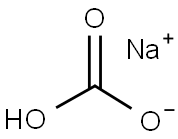
- 144-55-8
- CHNaO3
- 84.01
- All (83)
- China (59)
- (83)
![SODIUM BICARBONATE, [14C]](https://chemcloud-1304660855.cos.ap-shanghai.myqcloud.com/compound/4ca1cb1df0ef47f58653c7f46f805e3b.png?imageMogr2/format/webp)
- 7279-86-9
- CHNaO3
- 86.02000
- All (0)
- China (0)
- (0)
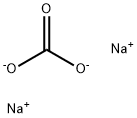
- 497-19-8
- CH2O3.2Na
- 105.99
- All (113)
- China (64)
- (113)
- 93673-48-4
- CNa2O3
- 107
- All (0)
- China (0)
- (0)
- 10424-09-6
- CKNaO3
- 122.1
- All (0)
- China (0)
- (0)
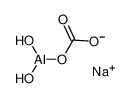
- 16482-55-6
- CH2AlNaO5
- 143.99500
- All (0)
- China (0)
- (0)
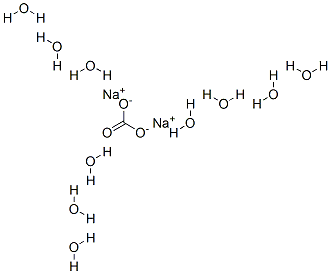
- 6132-02-1
- CH20Na2O13
- 286.14
- All (3)
- China (1)
- (3)
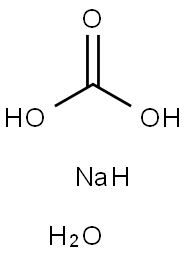
- 5968-11-6
- CH5NaO4
- 104.04
- All (7)
- China (4)
- (7)
- 24551-51-7
- CH20Na2O13
- 286.14
- All (3)
- China (1)
- (3)
- 57127-86-3
- CNaNpO5
- 351.99700
- All (0)
- China (0)
- (0)
Related Products More >

- CNY Request For Quotation
- CNY Request For Quotation
- CNY Request For Quotation
- 497-19-8
- USD 240.0000
- 25kg
- 497-19-8
- USD 200.0000
- 25kg
- 144-55-8
- CNY 100.0000
- 25kg
- 497-19-8
- USD 238.0000
- 40kg
- 144-55-8
- USD 225.0000
- 25kg


In industrial contexts, sodium bicarbonate’s mild reactivity is pivotal in food processing, pharmaceuticals, and firefighting foams, where controlled neutralization or effervescence is desired. Sodium carbonate’s robust alkalinity, however, dominates glass manufacturing, detergent formulation, and water treatment, where it dissolves silica, emulsifies oils, and precipitates heavy metals. A common misconception is equating their cleaning efficacy; while both can remove grease, sodium carbonate’s higher pH (around 11.6 vs. sodium bicarbonate’s ~8.3) makes it more effective for industrial-scale degreasing but also more corrosive to sensitive surfaces. Additionally, sodium bicarbonate’s thermal decomposition into sodium carbonate, CO₂, and H₂O at temperatures above 50°C explains its use in baking leavening agents, whereas sodium carbonate remains stable under heat, reinforcing its role in high-temperature processes like glass melting. These distinctions highlight their complementary roles in chemistry and engineering, tailored to specific reactivity, safety, and environmental requirements.
In everyday and industrial contexts, the contrast in basicity and reactivity between sodium bicarbonate and sodium carbonate makes each suited to specific, non-interchangeable roles. In household use, sodium bicarbonate is a staple in baking, where its reaction with acidic ingredients (e.g., buttermilk, cream of tartar) releases CO₂ gas to leaven dough, creating light, fluffy textures in breads or cakes—its weak basicity prevents excessive browning or bitter flavors. It also functions as a mild abrasive cleaner for surfaces like sinks or ovens, where its gentle grit removes stains without scratching, and as an antacid to neutralize excess stomach acid, leveraging its weak base properties to avoid irritating the digestive tract. Sodium carbonate, by contrast, is too strongly basic for baking or antacid use; instead, it excels in heavy-duty cleaning, such as removing grease from laundry (as a component in laundry detergents) or dissolving tough stains like coffee or wine, where its high pH breaks down organic compounds more effectively than sodium bicarbonate. Industrially, sodium carbonate is critical in glass manufacturing, where it lowers the melting point of silica to form molten glass, and in paper production, where it helps separate cellulose fibers from wood pulp—applications that rely on its stability at high temperatures and strong reactivity.
The distinction between these two compounds also carries broader implications for sustainability, safety, and resource management across sectors. Sodium bicarbonate is often preferred in consumer products and food applications due to its low toxicity and ability to decompose into harmless byproducts (CO₂, water, sodium carbonate), making it environmentally benign and safe for direct contact with food or skin. Sodium carbonate, while still non-toxic in controlled use, requires careful handling to avoid skin or eye irritation due to its strong basicity, and its production (primarily via the Solvay process) relies on raw materials like limestone and salt, with byproducts that demand proper management to minimize environmental impact. In water treatment, sodium bicarbonate is used to adjust pH in drinking water without raising it to corrosive levels, while sodium carbonate is employed to soften hard water by precipitating calcium and magnesium ions—each addressing a specific water quality challenge based on their basicity. Even in emergency situations, sodium bicarbonate is used in medical settings to treat acidosis (excess blood acidity) due to its gentle buffering capacity, whereas sodium carbonate’s strength makes it unsuitable for such applications. These examples highlight how understanding the structural and chemical differences between these two compounds is not just a matter of academic knowledge, but a practical necessity for optimizing performance, ensuring safety, and advancing sustainable practices across household, industrial, and medical domains.
The key difference lies in their chemical reactivity and pH levels. Sodium bicarbonate has a pH around 8–9 in water, so it’s safe for food use and mild household applications. Sodium carbonate, with a pH around 11, is stronger and can cause skin or surface irritation if used directly. In everyday life, this distinction matters: using sodium bicarbonate in cooking helps leaven bread or neutralize odors, while sodium carbonate is preferred for laundry detergents or removing tough stains where stronger alkalinity is needed.
Their mechanism also differs. Sodium bicarbonate reacts gradually with acids, slowly producing bubbles of carbon dioxide, which is why it’s effective for rising dough. Sodium carbonate, being more alkaline, can break down grease, saponify fats, and modify water hardness quickly. Understanding this difference allows people to choose the right compound for culinary, cleaning, or industrial purposes without unintended effects, ensuring both safety and efficiency in practical applications.