


 Home
Home
Hey there! I’ve been trying to figure out something about common household chemicals. I often see sodium carbonate and sodium bicarbonate mentioned, especially in cleaning or baking, and they seem pretty similar. I’m curious—how are they actually different? Are they interchangeable, or do they have specific uses? For example, can I use baking soda for heavy-duty cleaning, or should I pick the other one? I’d love a simple breakdown to understand their roles better. Could you explain the difference between sodium carbonate and sodium bicarbonate?
What’s the Key Difference Between Sodium Carbonate and Sodium Bicarbonate?
Related Encyclopedia
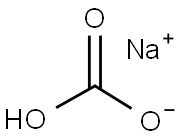
- 144-55-8
- CHNaO3
- 84.01
- All (83)
- China (59)
- (83)
![SODIUM BICARBONATE, [14C]](https://chemcloud-1304660855.cos.ap-shanghai.myqcloud.com/compound/4ca1cb1df0ef47f58653c7f46f805e3b.png?imageMogr2/format/webp)
- 7279-86-9
- CHNaO3
- 86.02000
- All (0)
- China (0)
- (0)
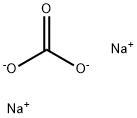
- 497-19-8
- CH2O3.2Na
- 105.99
- All (113)
- China (64)
- (113)
- 93673-48-4
- CNa2O3
- 107
- All (0)
- China (0)
- (0)
- 10424-09-6
- CKNaO3
- 122.1
- All (0)
- China (0)
- (0)
- 16482-55-6
- CH2AlNaO5
- 143.99500
- All (0)
- China (0)
- (0)
- 6132-02-1
- CH20Na2O13
- 286.14
- All (3)
- China (1)
- (3)
- 5968-11-6
- CH5NaO4
- 104.04
- All (7)
- China (4)
- (7)
- 24551-51-7
- CH20Na2O13
- 286.14
- All (3)
- China (1)
- (3)
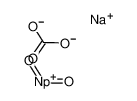
- 57127-86-3
- CNaNpO5
- 351.99700
- All (0)
- China (0)
- (0)
Related Products More >

- CNY Request For Quotation
- CNY Request For Quotation
- CNY Request For Quotation
- 497-19-8
- USD 240.0000
- 25kg
- 497-19-8
- USD 200.0000
- 25kg
- 144-55-8
- CNY 100.0000
- 25kg
- 497-19-8
- USD 238.0000
- 40kg
- 144-55-8
- USD 225.0000
- 25kg


On the other hand, sodium carbonate is often sold as washing soda or soda ash. It’s much stronger and more alkaline, so it’s awesome for tough jobs like stripping grease off dishes or unclogging drains. But it can irritate skin, so I’d wear gloves when using it. While both can clean, baking soda is milder for everyday stuff, and washing soda packs a bigger punch for heavy-duty tasks. So, no, they’re not really interchangeable—you wouldn’t want to bake a cake with washing soda!
These structural and chemical differences dictate their non-interchangeable roles in everyday and industrial use. In households, sodium bicarbonate is a staple in baking: its reaction with acidic ingredients (e.g., buttermilk, cream of tartar) releases CO₂ to leaven dough, and its weak basicity prevents bitter flavors or over-browning. It also functions as a mild abrasive cleaner for delicate surfaces (e.g., glass, enamel) and an antacid to neutralize excess stomach acid, leveraging its gentle reactivity to avoid irritating the digestive tract. Sodium carbonate, too strong for baking or antacids, excels in heavy-duty cleaning: as a component in laundry detergents, its high pH breaks down grease and organic stains (e.g., grass, wine) more effectively than sodium bicarbonate, and it softens hard water by precipitating calcium and magnesium ions. Industrially, sodium carbonate is critical in glass manufacturing—lowering silica’s melting point to form molten glass—and paper production, where it separates cellulose fibers from wood pulp, applications that rely on its stability at high temperatures. Sodium bicarbonate, meanwhile, is used in fire extinguishers (releasing CO₂ to smother flames) and pool maintenance (gradually raising total alkalinity without spiking pH), roles that depend on its mild reactivity and decomposition behavior.
The distinction between these two compounds also carries broader implications for safety, sustainability, and resource management. Sodium bicarbonate’s low toxicity and ability to decompose into harmless byproducts (CO₂, water, sodium carbonate) make it ideal for consumer products and food applications, requiring no specialized handling beyond basic precautions. Sodium carbonate, while non-toxic in controlled use, demands careful handling to avoid skin or eye irritation due to its strong basicity, and its production (primarily via the Solvay process) relies on raw materials like limestone and salt, with byproducts that need proper management to minimize environmental impact. In water treatment, sodium bicarbonate adjusts pH gently for drinking water, while sodium carbonate treats hard water or neutralizes strong acidic wastewater—each addressing specific challenges based on their basicity. Even in emergency settings, sodium bicarbonate’s weak base nature makes it safe for medical use (e.g., treating acidosis), whereas sodium carbonate’s strength renders it unsuitable. These examples highlight how understanding molecular structure and reactivity is not just academic—it is essential for optimizing performance, ensuring safety, and advancing sustainable practices across household, industrial, and medical domains.
In contrast, sodium bicarbonate contains one sodium ion and one bicarbonate ion (HCO₃⁻), which acts as a weaker base. It accepts only one proton to form carbonic acid, resulting in a milder alkaline solution (pH ~8.3 in pure water). This property is critical in applications requiring controlled adjustments, such as stabilizing total alkalinity (TA) in pools without drastically altering pH. Overusing sodium carbonate can overshoot pH targets, causing scaling or skin irritation, whereas sodium bicarbonate’s gradual reactivity minimizes such risks.
A common misconception is assuming these compounds are interchangeable. While both can adjust pH, sodium carbonate’s strength suits scenarios demanding rapid, significant changes, while sodium bicarbonate excels in fine-tuning alkalinity. For example, in baking, sodium bicarbonate reacts with acidic ingredients to produce CO₂ for leavening, whereas sodium carbonate’s intense alkalinity would disrupt texture and flavor. Understanding these distinctions ensures optimal performance across chemical, industrial, and domestic contexts.
Sodium bicarbonate, or baking soda, is a milder acid salt of carbonic acid. Its defining characteristic is its thermal decomposition; when heated above 50°C (122°F), it releases carbon dioxide gas. This endothermic reaction is the primary leavening mechanism in baking, causing dough to rise. Furthermore, its ability to undergo a mild acid-base reaction makes it a suitable buffering agent, both in pharmaceuticals to control tablet dissolution and in personal care products like toothpaste to moderate abrasiveness and pH.
In practical application, their strength dictates their use. For instance, in a laboratory, sodium carbonate is employed to adjust the pH of swimming pools significantly, while sodium bicarbonate is used for more delicate pH buffering in chemical solutions. Another clear example is in fire suppression; sodium bicarbonate is used in Class B and C fire extinguishers because its decomposition rapidly smothers flames by releasing CO₂ and cooling the fire, a role for which sodium carbonate is unsuitable.