


 Home
Home
Hi, I'd like to ask—What is the accurate chemical formula of phosphoric acid? How is this formula derived based on the structure of phosphoric acid molecules? What do each of the symbols and numbers in the formula H3PO4 represent? Are there different expressions of the chemical formula for phosphoric acid in different contexts? Can the formula reflect the chemical properties of phosphoric acid? Thanks!
What Is the Accurate Chemical Formula Used to Represent Phosphoric Acid?
Related Encyclopedia
- 121062-07-5
- C51H71N15O9
- 1038.20000
- All (0)
- China (0)
- (0)
- 121076-35-5
- C49H67N15O9
- 1010.15000
- All (0)
- China (0)
- (0)
- 121076-34-4
- C63H90N18O12
- 1291.50000
- All (0)
- China (0)
- (0)
- 122235-72-7
- C62H88N18O12
- 1277.48000
- All (0)
- China (0)
- (0)
- 122330-54-5
- C47H63N15O9
- 982.09800
- All (0)
- China (0)
- (0)
- 122330-53-4
- C48H65N15O9
- 996.12500
- All (0)
- China (0)
- (0)
- 1243620-45-2
- C35H69NO6
- 599.92500
- All (0)
- China (0)
- (0)
- 1173020-75-1
- H3O4P
- 97.97720
- All (50)
- China (42)
- (50)
- 44042-50-4
- O4PT3
- 104.02000
- All (50)
- China (42)
- (50)
- 7664-38-2
- H3O4P
- 98
- All (50)
- China (42)
- (50)
Related Products More >

- 7664-38-2
- CNY Request For Quotation
- CNY Request For Quotation
- CNY Request For Quotation
- CNY Request For Quotation


In the formula H3PO4, each part has a specific meaning. The symbol H stands for hydrogen, and the subscript 3 shows there are three hydrogen atoms in the molecule. P represents phosphorus, with no subscript indicating only one phosphorus atom is present. O denotes oxygen, and the subscript 4 means there are four oxygen atoms.
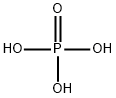
While H3PO4 is the standard form, in some contexts, it may be written as (HO)3PO to highlight the three hydroxyl groups. This way of writing emphasizes the arrangement of atoms and helps clarify why the compound acts as an acid.
The formula H3PO4 also gives clues about its chemical properties. It shows that phosphoric acid can release up to three hydrogen ions (H+) in solution, making it a triprotic acid. The presence of phosphorus in a +5 oxidation state, as indicated by the structure and formula, affects how it reacts, such as in forming phosphate salts or participating in various chemical processes.
In international trade, phosphoric acid appears in various forms, including technical grade, food grade, and pharmaceutical grade. Each grade must meet specific purity standards, with the H3PO4 formula serving as the foundational reference for quality control. For example, food-grade phosphoric acid must contain minimal impurities, as regulated by the FDA and international food safety standards. The formula helps manufacturers verify compliance by enabling precise calculation of elemental composition through analytical methods like inductively coupled plasma mass spectrometry (ICP-MS).
Different contexts may express phosphoric acid's formula in varying ways. The molecular formula H3PO4 is standard, but the structural formula illustrates the bonding pattern, while the empirical formula remains the same since it’s already in simplest terms. In solution, phosphoric acid partially dissociates, releasing hydrogen ions sequentially. This behavior is represented by equilibrium equations: H3PO4 ⇌ H+ + H2PO4− for the first dissociation, followed by two more steps. These reactions are critical in industries like fertilizer production, where phosphoric acid’s acidity and phosphate content are essential for crop nutrition.
The formula also reflects key chemical properties, such as phosphoric acid’s role as a triprotic acid. Each hydrogen ion can dissociate under different pH conditions, making it versatile in applications ranging from metal cleaning to food additives. Recent research highlights its use in lithium-ion battery electrolytes, where its proton conductivity is vital for energy storage efficiency. Thus, H3PO4 is more than just a chemical formula—it’s a critical reference point for trade, manufacturing, and scientific innovation.
Each component of the formula H3PO4 represents specific atoms in the molecule. The symbol H stands for hydrogen, P for phosphorus, and O for oxygen. The subscript numbers indicate the quantity of each atom present in one molecule—three hydrogen atoms, one phosphorus atom, and four oxygen atoms. This precise count is essential for understanding the compound's stoichiometry and reactivity. In some cases, phosphoric acid may be represented in different forms depending on the context. For example, in ionic solutions, it partially dissociates into H+ ions and H2PO4- ions, reflecting its weak acid properties. The empirical formula remains H3PO4, but its ionic form varies with pH levels.
The formula H3PO4 directly relates to the chemical properties of phosphoric acid. As a triprotic acid, it can donate three protons sequentially, with three distinct dissociation constants. This property makes it valuable in buffer solutions and pH regulation. The presence of three hydroxyl groups attached to phosphorus contributes to its acidity and solubility in water. The P=O double bond adds polarity to the molecule, enhancing its interaction with polar solvents.
In industrial applications, phosphoric acid is often used in concentrated solutions, typically around 85% by mass. While the molecular formula remains H3PO4, the physical properties differ significantly from the pure compound. The formula also plays a critical role in agriculture, where phosphoric acid is a precursor for phosphate fertilizers. These fertilizers release phosphorus ions into the soil, supporting plant growth.
The molecular geometry of phosphoric acid is tetrahedral around the phosphorus atom, with bond angles close to 109.5 degrees. This arrangement results from sp3 hybridization of phosphorus. The P=O bond is shorter and stronger than the P-O-H bonds, influencing the molecule's reactivity. The acidity of phosphoric acid stems from the ease with which the hydrogen atoms attached to oxygen can dissociate, a process governed by the stability of the resulting conjugate base.
Understanding H3PO4 requires knowledge of its molecular structure and bonding. The formula not only defines the composition but also predicts behavior in chemical reactions. From neutralization to esterification, the properties of phosphoric acid are deeply connected to its molecular formula. The formula serves as a foundation for exploring its role in various scientific and industrial fields.
In H3PO4, each symbol stands for an element: H is hydrogen, P is phosphorus, O is oxygen. The 3 after H means three hydrogen atoms, 4 after O means four oxygen atoms, and no number after P means just one phosphorus atom.
I’ve seen it mostly as H3PO4 in labs and textbooks. Sometimes it’s written as PO(OH)3 to show the hydroxyl groups, but that’s rare. The formula hints at its properties too—those three H atoms can release as H+ ions, making it a triprotic acid, which explains why it reacts with bases to form salts.