


 Home
Home
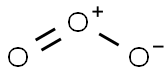
Why does ozone have a bent molecular geometry?How does O₃'s polarity affect its role in atmospheric chemistry?Compare O₃'s polarity with other allotropes of oxygen (O₂).
Why Does Ozone Have a Bent Molecular Structure?
Related Encyclopedia
- 10028-15-6
- O3
- 47.9982
- All (5)
- China (1)
- (5)

- 119623-14-2
- O3
- 52.99750
- All (5)
- China (1)
- (5)
- 167874-66-0
- O3
- 51.99740
- All (5)
- China (1)
- (5)
- 167874-65-9
- O3
- 49.99770
- All (5)
- China (1)
- (5)
- 26057-96-5
- O3
- 49.99800
- All (5)
- China (1)
- (5)
- 21424-30-6
- O3
- 52.99750
- All (5)
- China (1)
- (5)
- 21424-25-9
- O3
- 50.99740
- All (5)
- China (1)
- (5)
- 80731-27-7
- C7H8O3
- 140.13700
- All (0)
- China (0)
- (0)

- 153851-84-4
- O3
- 47.99820
- All (0)
- China (0)
- (0)
- 84508-01-0
- H2O4
- 66.01350
- All (0)
- China (0)
- (0)



O₃'s polarity influences its role in atmospheric chemistry by enhancing its reactivity. The partial negative charges on the terminal oxygens make ozone more likely to participate in reactions that involve electron transfer or nucleophilic attack. This property is vital for processes like the breakdown of pollutants and the formation of the ozone layer, which protects Earth from harmful UV radiation.
Compared to O₂, which is nonpolar due to its linear structure and equal sharing of electrons, O₃'s bent shape and unequal charge distribution make it significantly more polar. This difference affects their chemical behaviors; while O₂ is stable and less reactive, O₃ is highly reactive and plays a dynamic role in various atmospheric processes.
The polarity of O₃ significantly impacts its role in atmospheric chemistry. The partial negative charges on the terminal oxygens enhance its reactivity, allowing it to engage in various chemical reactions. For instance, ozone can react with pollutants such as nitrogen oxides and volatile organic compounds, breaking them down into less harmful substances. Additionally, its polarity facilitates the formation of the ozone layer in the stratosphere, where it absorbs ultraviolet radiation from the sun, protecting life on Earth from harmful UV rays.
When comparing O₃'s polarity with other allotropes of oxygen, such as O₂, the differences become apparent. Oxygen gas (O₂) has a linear structure with no lone pairs, resulting in a symmetrical distribution of electrons and making it nonpolar. This lack of polarity contributes to O₂'s stability and lower reactivity compared to O₃. The high reactivity of O₃, driven by its polarity, makes it a key player in numerous atmospheric processes, including the self-cleaning mechanisms of the troposphere and the regulation of climate through its influence on temperature profiles in the stratosphere.
The polarity of O₃ profoundly affects its role in atmospheric chemistry. The partial negative charges on the terminal oxygens increase its reactivity, enabling it to participate in various chemical reactions. For example, ozone can react with pollutants such as nitrogen oxides (NOₓ) and volatile organic compounds (VOCs), breaking them down into less harmful substances. This process is crucial for maintaining air quality and reducing smog formation. Moreover, the polarity of O₃ facilitates the formation of the ozone layer in the stratosphere, where it absorbs ultraviolet radiation from the sun. This protective layer shields life on Earth from harmful UV rays, preventing damage to DNA and other biological molecules.
In contrast to O₃, other allotropes of oxygen, such as O₂, exhibit different properties due to their distinct molecular structures. Oxygen gas (O₂) has a linear structure with no lone pairs, resulting in a symmetrical distribution of electrons and making it nonpolar. This lack of polarity contributes to O₂'s stability and lower reactivity compared to O₃. While O₂ is essential for respiration and combustion processes, its role in atmospheric chemistry is more passive compared to the dynamic involvement of O₃. The high reactivity of O₃, driven by its polarity, makes it a key player in numerous atmospheric processes, including the self-cleaning mechanisms of the troposphere and the regulation of climate through its influence on temperature profiles in the stratosphere.
Furthermore, the polarity of O₃ also affects its solubility and transport in the atmosphere. Being polar, O₃ is more soluble in water and can be transported via precipitation, influencing the distribution of ozone in the troposphere. This solubility also allows O₃ to participate in aqueous-phase reactions, contributing to the formation of secondary pollutants and affecting the chemistry of clouds and rainwater. In summary, the bent molecular geometry and resultant polarity of O₃ are fundamental to its diverse roles in atmospheric chemistry, setting it apart from other oxygen allotropes like O₂.