


 Home
Home
If keratin, a protein usually found in hair and nails, can be processed into a form that repairs tooth enamel, could this really change the way we prevent cavities? Traditional fluoride toothpaste has been used for decades, but many people are concerned about its long-term effects. Would a keratin-based toothpaste offer a safer or more natural alternative? How effective would it be compared to fluoride in strengthening enamel and stopping decay? Could this also mean that human hair waste might be recycled for dental health?
Could Sustainable Toothpaste Made From Hair Become the Next Big Thing in Oral Care?
Related Encyclopedia
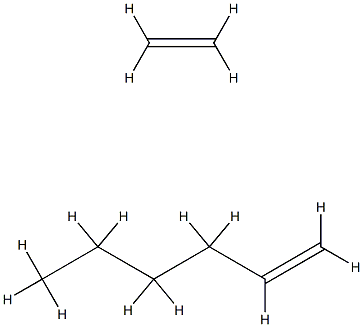
- 25213-02-9
- C8H16
- 112.21264
- All (24)
- China (2)
- (24)
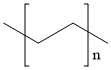
- 9002-88-4
- (C2H4)n
- 28.05316
- All (24)
- China (2)
- (24)
- 118090-85-0
- C3+
- 36.03210
- All (95)
- China (15)
- (95)
- 141219-98-9
- C36
- 432.38500
- All (95)
- China (15)
- (95)
- 129066-02-0
- C9
- 108.09600
- All (95)
- China (15)
- (95)
- 139055-01-9
- C11
- 132.11800
- All (95)
- China (15)
- (95)
- 145270-74-2
- C17
- 204.18200
- All (95)
- China (15)
- (95)
- 145270-72-0
- C15
- 180.16000
- All (95)
- China (15)
- (95)
- 145270-70-8
- C13
- 156.13900
- All (95)
- China (15)
- (95)
- 7440-44-0
- C
- 12.011
- All (95)
- China (15)
- (95)
Related Products More >

- 63231-66-3
- CNY Request For Quotation
- CNY Request For Quotation
- CNY Request For Quotation
- CNY Request For Quotation
- 9002-88-4
- Request For Quotation
- 7440-44-0
- Request For Quotation
- Request For Quotation
- 25322-68-3
- Request For Quotation


In practice, keratin-based solutions could be integrated into daily toothpaste or applied professionally as a gel for severe cases, offering a user-friendly approach. Sourced from sheep’s wool—an abundant biowaste—this method aligns with sustainability, potentially expanding to human hair recycling. Compared to fluoride, it provides a natural alternative, addressing long-term safety concerns, while matching usability with a minty flavor and foaming texture. Set for public availability in 2–3 years, it aims for affordability, ensuring broad access. This innovation not only enhances cavity prevention by stopping erosion entirely but also promotes environmental sustainability through biowaste utilization, marking a significant shift in dental care practices.
Physiologically, tooth enamel is a non - regenerative tissue. Once damaged, it cannot repair itself naturally. Keratin, when mixed with the minerals in saliva, forms a protective coating that mimics the structure and function of natural enamel. This is a crucial chemical and physical mechanism. The keratin - saliva mixture creates a barrier that can stop enamel erosion completely, unlike traditional fluoride toothpaste which only slows it down.
From a cross - disciplinary perspective, this innovation combines biology and dentistry. Biologically, keratin is a well - known protein with reparative properties in hair care products. In dentistry, its application to enamel repair opens up new avenues for treatment.
In daily life, this could revolutionize oral hygiene. Instead of relying solely on fluoride toothpaste, which has raised concerns about long - term effects, a keratin - based toothpaste offers a potentially safer and more natural alternative. It could be available in the form of a daily toothpaste with a minty flavor and foaming texture, similar to standard fluoride paste, making it easy for the public to adopt.
In the industrial field, it presents an environmentally - friendly option. Currently, the test products are made from sheep's wool, a biowaste that is abundant and sustainable, benefiting farmers. In the future, there is even the possibility of recycling human hair waste to extract keratin for dental use.
Medically, it provides a new treatment approach for tooth decay. For minor enamel damage like micro - cracks or small defects, keratin can enable self - healing without the need for extensive dental procedures. In more severe cases, it could be applied as a professionally - administered gel, similar to nail varnish.
The broader significance lies in its potential to change the way we prevent cavities. It offers a more effective solution compared to fluoride in strengthening enamel and stopping decay. Its accessibility and affordability, as aimed by the researchers, could improve oral health on a global scale, making it a significant breakthrough in both dental science and public health.