


 Home
Home
Hi, I'd like to ask—what is the chemical formula of sodium hydroxide, and how does it relate to its molecular weight? What are the atomic weights of sodium, oxygen, and hydrogen, and how do they contribute to NaOH’s total molecular weight? Why is molecular weight important in stoichiometry and chemical reactions? Can you walk through the step-by-step calculation process for NaOH’s molecular weight? Are there practical applications where precise molecular weight calculation is essential, like in solution preparation? Thanks!
How to Calculate the Molecular Weight of Sodium Hydroxide (NaOH)?
Related Encyclopedia
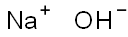
- 1310-73-2
- NaOH
- 39.99711
- All (130)
- China (116)
- (131)

- 12200-64-5
- H3NaO2
- 58.01240
- All (0)
- China (0)
- (0)
- 87331-12-2
- HNa3O
- 85.97670
- All (0)
- China (0)
- (0)
- 389873-17-0
- HNaO
- 40.99680
- All (0)
- China (0)
- (0)
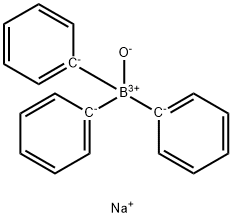
- 12113-07-4
- C18H15BNaO
- 281.12
- All (0)
- China (0)
- (0)
- 12179-02-1
- H3NaO2
- 58.01240
- All (0)
- China (0)
- (0)
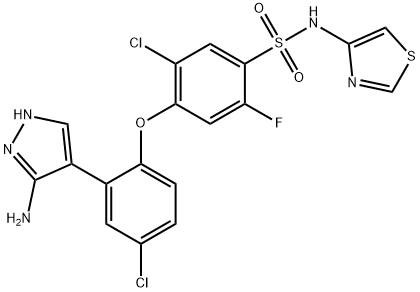
- 1235403-62-9
- C18H12Cl2FN5O3S2
- 500.35
- All (0)
- China (0)
- (0)
![1,1-dioxo-1λ6-benz[d]isothiazole-3-thione, compound of sodium-salt with sodium hydroxide](https://chemcloud-1304660855.cos.ap-shanghai.myqcloud.com/compound/0baa2f2e2d4e447ba1d868ee6e368753.png?imageMogr2/format/webp)
- 132625-48-0
- C7H5NNaO3S2
- 238.23900
- All (0)
- China (0)
- (0)
![2-[1-(2-hydroxyethyl)-2-undecyl-4,5-dihydroimidazol-1-ium-1-yl]acetic acid,sodium,hydroxide](https://chemcloud-1304660855.cos.ap-shanghai.myqcloud.com/compound/6693a34bb157411c9d4382ddc941778e.png?imageMogr2/format/webp)
- 26837-33-2
- C18H36N2NaO4
- 367.47900
- All (0)
- China (0)
- (0)
![Sodium hydroxide - [2-heptyl-1-(2-hydroxyethyl)-4,5-dihydro-1H-im idazol-1-ium-1-yl]acetate (1:1:1)](https://chemcloud-1304660855.cos.ap-shanghai.myqcloud.com/compound/23c6ba61894848ea9c3c4025e1e71755.png?imageMogr2/format/webp)
- 13039-35-5
- C14H27N2NaO4
- 310.36500
- All (0)
- China (0)
- (0)
Related Products More >

- 1310-73-2
- Request For Quotation
- 1310-73-2
- Request For Quotation
- 1310-73-2
- Request For Quotation
- 1310-73-2
- USD 1.0000
- 25kg
- 7446-19-7
- USD 10.0000
- 25kg
- 1310-73-2
- CNY 750.0000
- 1ton
- 1310-73-2
- CNY 2.6000
- 25kg
- 1310-73-2
- USD 450.0000
- 50kg


Molecular weight is fundamental in stoichiometry because it bridges mass and mole measurements, essential for balancing chemical equations and calculating reactant or product amounts. For instance, knowing NaOH’s molecular weight (40.00 g/mol) allows converting between grams and moles: 40.00 grams of NaOH equal one mole, a key ratio in solution preparation. In practical scenarios, such as making a 0.5 M NaOH solution, precise molecular weight calculations ensure accuracy: dissolving 20.00 grams (0.5 moles) of NaOH in water to form 1 liter yields the correct concentration. This precision is vital in laboratories, pharmaceutical manufacturing, and chemical analysis, where incorrect molecular weight data would lead to flawed reaction stoichiometry or misformulated solutions, compromising experimental results or product quality.
The atomic weights of sodium, oxygen, and hydrogen come from the periodic table and serve as the foundation for molecular weight calculations. Sodium has an atomic weight of approximately 22.99 atomic mass units (amu), oxygen weighs about 16.00 amu, and hydrogen is roughly 1.01 amu. These values represent the average mass of each element's atoms relative to carbon-12. When these numbers are combined, they provide the total molecular weight of NaOH. The calculation process involves adding these three values together: 22.99 (sodium) plus 16.00 (oxygen) plus 1.01 (hydrogen), resulting in a molecular weight of 40.00 amu. This means one molecule of sodium hydroxide has a mass of 40.00 amu, and one mole of NaOH weighs 40.00 grams.
Molecular weight serves as a critical bridge between the microscopic world of atoms and the macroscopic measurements used in laboratories. In stoichiometry, it allows chemists to convert between mass and moles, enabling precise calculations of reactant and product quantities. This is particularly important in chemical reactions, where the correct proportions of substances must be used to ensure complete reactions and predictable outcomes. Without accurate molecular weight information, chemists couldn't determine how much of each reactant is needed or predict how much product will form.
The practical applications of precise molecular weight calculations are especially evident in solution preparation. When preparing a sodium hydroxide solution of a specific molarity, chemists must know NaOH's molecular weight to calculate the exact mass needed for the desired concentration. For example, to prepare a 1 molar solution in 1 liter of water, exactly 40.00 grams of NaOH must be dissolved. This level of precision is equally important in industrial settings, where incorrect measurements could lead to product failures or safety hazards.
Beyond basic solution preparation, molecular weight calculations are essential in analytical chemistry techniques like titration, where precise molar ratios determine reaction endpoints. The pharmaceutical industry relies on these calculations to ensure accurate drug formulations, as even minor deviations can affect medication efficacy. In materials science, molecular weights help characterize polymers and other complex substances. Even in environmental monitoring, knowing the molecular weights of pollutants aids in detection and quantification.
The step-by-step calculation of NaOH's molecular weight demonstrates how fundamental atomic properties combine to create practical chemical knowledge. This process, while seemingly simple, forms the basis for countless applications in research, manufacturing, and quality control.
The atomic weights of the constituent elements are key to calculating the molecular weight of sodium hydroxide. Sodium, an alkali metal, has an atomic weight of approximately 22.99 atomic mass units (amu). This value is derived from the weighted average of the masses of its naturally occurring isotopes, with the most abundant isotope, sodium - 23, contributing significantly to this average. Oxygen, a highly reactive non - metal, has an atomic weight of about 16.00 amu. This figure reflects the combined influence of oxygen's isotopes, with oxygen - 16 being the most prevalent and having the greatest impact on the average atomic weight. Hydrogen, the lightest element, has an atomic weight of roughly 1.01 amu. Its atomic weight is determined by considering the relative abundances of its isotopes, hydrogen - 1 (protium) being the most common.
Calculating the molecular weight of NaOH is a straightforward process based on the atomic weights of its elements. First, we identify the number of each type of atom in the formula: one sodium atom, one oxygen atom, and one hydrogen atom. Then, we multiply the atomic weight of each element by the number of its atoms present in the compound. For sodium, it is 1 × 22.99 amu = 22.99 amu. Oxygen contributes 1 × 16.00 amu = 16.00 amu, and hydrogen adds 1 × 1.01 amu = 1.01 amu. Summing up these values, we get 22.99 amu + 16.00 amu + 1.01 amu = 40.00 amu. When expressed in the units of grams per mole (g/mol), which is commonly used in chemical calculations, the molecular weight of NaOH is 40.00 g/mol.
The concept of molecular weight is of immense importance in stoichiometry, the branch of chemistry that deals with the quantitative relationships between reactants and products in chemical reactions. In stoichiometric calculations, moles are used as the fundamental unit to measure the amount of substances. The molecular weight acts as a conversion factor between the mass of a substance, which can be directly measured in the laboratory using balances, and the number of moles. For example, consider the reaction between sodium hydroxide and hydrochloric acid (HCl): NaOH + HCl → NaCl + H₂O. The balanced chemical equation indicates a 1:1 mole ratio between NaOH and HCl. If a chemist wants to carry out this reaction and needs 3 moles of NaOH, knowing the molecular weight of NaOH (40.00 g/mol) allows them to calculate the required mass.
Precise molecular weight calculations are also essential in numerous practical applications, particularly in solution preparation. In a laboratory setting, chemists often need to prepare solutions of specific molarities. Molarity is defined as the number of moles of solute per liter of solution. To prepare a solution of a given molarity, say a 0.2 M solution of NaOH in a volume of 500 milliliters (0.5 liters), the first step is to calculate the number of moles of NaOH required. Using the formula for molarity (M = n/V, where M is molarity, n is the number of moles, and V is the volume in liters), we find that n = M × V = 0.2 mol/L × 0.5 L = 0.1 moles. Then, by using the molecular weight of NaOH, we can determine the mass of NaOH needed. Multiplying the number of moles (0.1 mol) by the molecular weight (40.00 g/mol), we get 4.00 grams. Weighing out exactly 4.00 grams of NaOH and dissolving it in enough water to make 500 milliliters of solution results in a 0.2 M NaOH solution.