


 Home
Home
Hi, I'd like to ask—what concentration of potassium chloride or sodium nitrate is usually used in a salt bridge? Does the choice of salt (like KCl vs. NaNO₃) affect the required concentration? How does adjusting the concentration impact ion mobility in the salt bridge? Thanks!
What Is the Typical Concentration of Potassium Chloride in a Salt Bridge for Electrochemical Cells?
Related Encyclopedia
- 1173022-53-1
- NNaO3
- 84.99100
- All (9)
- China (8)
- (9)
- 15621-57-5
- NNaO3
- 84.99470
- All (9)
- China (8)
- (9)
- 7631-99-4
- NNaO3
- 84.99
- All (9)
- China (8)
- (9)
- 7447-40-7
- KCl
- 74.55
- All (273)
- China (27)
- (273)

- 31432-45-8
- NNaO3
- 86
- All (0)
- China (0)
- (0)
- 20582-71-2
- Cl4HgK-
- 381.49000
- All (0)
- China (0)
- (0)

- 25443-63-4
- Cl6K3Ru
- 431.08
- All (0)
- China (0)
- (0)
- 15707-74-1
- Cl4KNbO
- 289.81600
- All (0)
- China (0)
- (0)
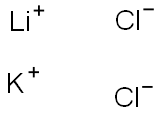
- 65567-96-6
- Cl2KLi
- 116.95
- All (0)
- China (0)
- (0)
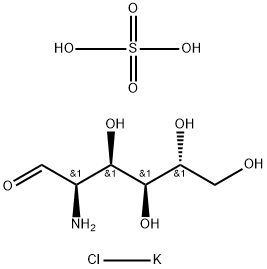
- 1296149-08-0
- C6H15ClKNO9S
- 351.79
- All (1)
- China (1)
- (1)
Related Products More >

- 7447-40-9
- CNY Request For Quotation
- 7447-40-8
- CNY Request For Quotation
- 7447-40-7
- CNY Request For Quotation
- 7631-99-4
- CNY 5.0000
- 25g
- 7447-40-7
- CNY 25.0000
- 25kg
- 7631-99-4
- USD 11.0000
- 25kg
- 7631-99-4
- Request For Quotation
- 25kg
- 7631-99-4
- Request For Quotation
- 1ton


Sodium nitrate, conversely, is often used at 0.1–1 M. Its lower concentration stems from two factors: NaNO₃ has lower solubility than KCl, and higher concentrations risk precipitation, especially in temperature fluctuating environments. The choice of salt directly influences concentration needs: KCl’s solubility enables saturated use, while NaNO₃ requires moderation to avoid crystal formation.
Adjusting concentration impacts ion mobility significantly. In KCl, saturated levels maximize ion availability, enhancing mobility and charge transport. Yet exceeding solubility leads to precipitation, disrupting conductivity. For NaNO₃, moderate concentrations balance mobility with solution stability. Higher NaNO₃ concentrations boost ion density but increase precipitation risks, while lower levels reduce mobility. Thus, concentration is tailored to the salt’s properties to ensure optimal ion flow and prevent operational issues.
For potassium chloride, its solubility in water at room temperature is approximately 340 grams per liter, which translates to a saturated solution concentration of about 4.6 M. However, in most practical applications for salt bridges, KCl is used at concentrations between 1.0 M and 2.0 M. This is because at these concentrations, there is a sufficient number of potassium (K⁺) and chloride (Cl⁻) ions available to carry the electrical charge between the two half cells of the electrochemical cell. Using a concentration too close to the saturation point can lead to issues such as crystal formation within the salt bridge over time, which can disrupt the flow of ions.
Sodium nitrate, on the other hand, has a higher solubility in water, with around 880 grams per liter dissolving at room temperature, corresponding to a saturated concentration of roughly 8.0 M. Nevertheless, for salt bridge applications, concentrations between 1.0 M and 2.5 M are typically preferred. Similar to KCl, using an appropriate concentration ensures a good balance of ion availability for charge transfer.
The choice of salt does have an impact on the required concentration. KCl is often a popular choice because the ionic radii of K⁺ and Cl⁻ are relatively similar, and their mobilities in solution are also comparable. This similarity in ion properties helps to minimize the liquid junction potential that can occur at the interfaces between the salt bridge and the half cell solutions. As a result, a relatively lower and more consistent concentration (around 1.0 1.5 M) can be used effectively. In contrast, for sodium nitrate, the sodium ion (Na⁺) is smaller and more mobile than the nitrate ion (NO₃⁻). To compensate for this difference in ion mobilities and to ensure a stable electrical connection, a slightly higher concentration might be required, usually in the range of 1.5 2.5 M. This higher concentration helps to equalize the rates at which the two ions migrate through the salt bridge, reducing potential differences caused by unequal ion movement.
Adjusting the concentration of the salt in the salt bridge has a significant effect on ion mobility. In dilute solutions, such as those with a concentration below 0.5 M, although the ions experience less interference from other ions due to the lower ion ion interactions, the overall number of ions available to conduct the charge is limited. This can result in a higher resistance in the salt bridge and slower charge transfer, leading to a decrease in the efficiency of the electrochemical cell. As the concentration increases within the optimal range (e.g., 1.0 2.0 M for KCl), the number of ions increases, enhancing the conductivity of the salt bridge. The ions are still able to move relatively freely through the solution or gel matrix of the salt bridge, and the increased ion density allows for more efficient charge transport.
However, when the concentration becomes too high, for example, above 3.0 M, ion mobility actually starts to decline. In highly concentrated solutions, the ions are in close proximity to each other, leading to increased electrostatic interactions. These interactions can cause the ions to form ion pairs or clusters, where cations and anions associate with each other. As a result, the effective number of free ions available for independent movement decreases, and the ions become more hindered in their ability to migrate through the salt bridge. This reduction in ion mobility can negatively impact the performance of the electrochemical cell, causing voltage drops and decreased reaction rates.
The choice of salt does play a role in determining the required concentration. When it comes to sodium nitrate, its ions, Na⁺ and NO₃⁻, have different mobilities compared to those of KCl. Na⁺ has a somewhat lower mobility than K⁺, and NO₃⁻ is larger than Cl⁻. As a result, the concentration of sodium nitrate in a salt bridge is usually set at 1 2 mol/L. This concentration is carefully adjusted to provide enough ions for efficient charge transfer while also minimizing the potential for the salt's ions to react with the substances in the half cells. For instance, if a half cell contains silver ions (Ag⁺), using KCl would lead to the formation of insoluble silver chloride (AgCl) precipitate, making NaNO₃ a more suitable choice in such a scenario.
Adjusting the concentration of the salt in the salt bridge has a direct impact on ion mobility. At higher concentrations, there is a greater number of ions available in the solution. This increased ion density enhances the conductivity of the salt bridge, reducing its internal resistance and allowing for more efficient flow of electrical current. However, if the concentration is pushed too high, ion pairing can occur. Ion pairing refers to the situation where ions form neutral complexes instead of remaining freely mobile, which actually decreases the overall ion mobility. On the other hand, a lower concentration means fewer ions are present to carry the charge. This results in higher resistance within the salt bridge, causing a voltage drop and ultimately reducing the efficiency of the electrochemical cell. For example, a salt bridge with a 0.1 mol/L KCl solution will exhibit slower ion movement and less effective charge neutralization compared to one with a 3 mol/L KCl solution. In practice, the selection of the appropriate salt and its concentration in a salt bridge requires careful consideration of the specific requirements of the electrochemical cell to ensure optimal performance.