


 Home
Home
Hi, I'd like to ask—what industries commonly use soda ash as a key raw material? In glass production, what role does sodium carbonate play in the melting process of silica and other additives? How is it used in detergent formulations to enhance cleaning efficiency? Are there specialized applications of soda ash in chemical synthesis, such as in the production of dyes or pharmaceuticals? Thanks!
What Are the Primary Industrial Uses of Soda Ash (Sodium Carbonate) in Manufacturing?
Related Encyclopedia
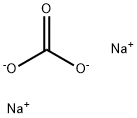
- 497-19-8
- CH2O3.2Na
- 105.99
- All (113)
- China (64)
- (113)
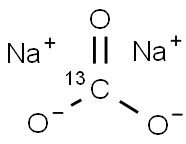
- 93673-48-4
- CNa2O3
- 107
- All (0)
- China (0)
- (0)
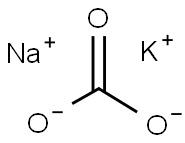
- 10424-09-6
- CKNaO3
- 122.1
- All (0)
- China (0)
- (0)
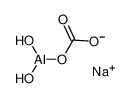
- 16482-55-6
- CH2AlNaO5
- 143.99500
- All (0)
- China (0)
- (0)
- 6132-02-1
- CH20Na2O13
- 286.14
- All (3)
- China (1)
- (3)
- 5968-11-6
- CH5NaO4
- 104.04
- All (7)
- China (4)
- (7)
- 24551-51-7
- CH20Na2O13
- 286.14
- All (3)
- China (1)
- (3)
- 57127-86-3
- CNaNpO5
- 351.99700
- All (0)
- China (0)
- (0)
- 85135-19-9
- CH2NaNpO6
- 370.01300
- All (0)
- China (0)
- (0)
- 85135-20-2
- CH2NaO6Pu
- 377.01300
- All (0)
- China (0)
- (0)
Related Products More >

- 497-19-8
- CNY Request For Quotation
- 497-19-8
- USD 240.0000
- 25kg
- 497-19-8
- USD 200.0000
- 25kg
- 497-19-8
- USD 238.0000
- 40kg
- 96036-03-2
- Request For Quotation
- 68855-54-9
- Request For Quotation
- 68855-54-9
- Request For Quotation
- 68855-54-9
- Request For Quotation


In detergents, soda ash acts as a water softener by removing calcium and magnesium ions from hard water. These ions can hinder surfactants’ ability to lather and clean, but soda ash precipitates them as insoluble carbonates, enhancing the detergent’s effectiveness. It also adjusts the solution’s pH to an alkaline range, which aids in dissolving grease and organic soils.
Soda ash has specialized roles in chemical synthesis. In dye production, it may regulate pH or catalyze reactions to form or apply dyes to fabrics. In pharmaceuticals, it can be used in synthesizing active ingredients or as an excipient, though such uses are more specialized and tightly regulated. Additionally, it is vital in the pulp and paper industry for processing wood into pulp, in water treatment to adjust pH, and in manufacturing chemicals like sodium bicarbonate and sodium silicates. Each application relies on its alkaline properties and reactivity to facilitate specific industrial processes, making it a versatile component across diverse sectors.
In detergent formulations, soda ash is used to enhance cleaning efficiency through multiple mechanisms. First, it acts as a water softener. Hard water contains calcium and magnesium ions that can inhibit the effectiveness of surfactants, the active cleaning agents in detergents. Sodium carbonate reacts with these ions to form insoluble carbonates, removing them from the water and allowing surfactants to lather and break down grease more effectively. Additionally, soda ash maintains the alkalinity of the detergent solution. This alkaline environment helps saponify fats and oils, converting them into watersoluble soaps that can be rinsed away. In laundry detergents, this property aids in stain removal and prevents dirt from redepositing on fabrics, making the overall cleaning process more efficient.
Soda ash also has specialized applications in chemical synthesis, including in the production of dyes and pharmaceuticals. In the dye industry, it is often used to adjust the pH of reaction mixtures, which is crucial for the proper formation of dye molecules. For example, in the synthesis of azo dyes, sodium carbonate may be added to control acidity, ensuring the chemical reactions proceed as needed to create the desired color compounds. In pharmaceuticals, highpurity grades of soda ash can serve as buffering agents in drug formulations or as intermediates in the synthesis of active ingredients.
Other industries that utilize soda ash include paper manufacturing, where it helps dissolve lignin from wood fibers during the pulping process, and textiles, where it is used to fix dyes to fabrics and neutralize acidic residues.
The wide range of applications for soda ash underscores its importance as a fundamental industrial chemical. From lowering melting points in glass production to enhancing cleaning performance in detergents and supporting specialized chemical reactions, its ability to act as a flux, pH regulator, and reactant makes it indispensable across diverse sectors.
In detergent formulations, soda ash enhances cleaning efficiency through several mechanisms. First, it acts as a pH buffer, maintaining an alkaline environment that helps break down grease and oils by saponification, a process where fats react with alkalis to form soaplike compounds. Additionally, sodium carbonate functions as a water softener by precipitating calcium and magnesium ions—common in hard water—that can inhibit detergent performance. By binding these metal ions, soda ash prevents them from reacting with surfactants in the detergent, allowing the surfactants to focus on lifting dirt and stains from fabrics. This also reduces the formation of soap scum, making rinsing more effective. In laundry detergents, soda ash is often used alongside other builders like phosphates or zeolites to improve overall cleaning power, especially in cold water where surfactant activity is lower.
In chemical synthesis, soda ash has specialized applications in producing dyes, pharmaceuticals, and other organic compounds. In dye manufacturing, it is used to adjust pH during azo dye synthesis, facilitating coupling reactions that form the colored molecules. Its alkaline properties help dissolve certain intermediates and ensure proper reaction conditions for stable dye formation. In pharmaceuticals, sodium carbonate may act as a base in neutralization reactions or as a component in formulations for antacids, though its use in drug production is highly regulated and depends on the specific compound. For example, it can be involved in the synthesis of certain APIs (active pharmaceutical ingredients) by controlling acidity or aiding in precipitation processes. Additionally, soda ash is used in the production of sodium bicarbonate (baking soda), a common ingredient in antacids and effervescent tablets, through a reaction with carbon dioxide.
Other industries benefit from soda ash’s properties as well. In the textile industry, it is used in scouring and bleaching processes to remove impurities from fibers and adjust dye bath pH for better color absorption. In paper manufacturing, it helps recover chemicals in the pulping process, particularly in the soda pulping method for nonwood fibers like straw or bamboo. In water treatment, soda ash adjusts water pH and neutralizes acidity, making it useful for industrial wastewater management or swimming pool maintenance.
When using soda ash in industrial settings, safety considerations are essential due to its alkaline nature, which can cause skin or eye irritation. Proper handling requires protective gear, and storage should avoid moisture to prevent caking. In glass production, the release of CO₂ during melting contributes to industrial emissions, prompting some manufacturers to explore lowcarbon alternatives or carbon capture technologies. In detergents, environmental concerns about phosphatebased builders have led to shifts toward soda ash and other biodegradable alternatives to reduce water pollution. Overall, soda ash’s multifunctionality across diverse industries highlights its importance as a foundational chemical in modern manufacturing and processing. Please provide the next keyword.