


 Home
Home
Hi, I'd like to ask—what’s the freezing point of seawater compared to freshwater? How does the sodium chloride content in seawater lower its freezing point? Are there other dissolved salts that affect this temperature, and what’s the typical range of seawater freezing points? Thanks!
At What Temperature Does Seawater Freeze and How Does Salt Concentration Impact It?
Related Encyclopedia
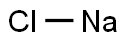
- 7647-14-5
- ClNa
- 58.44
- All (45)
- China (29)
- (45)

- 20510-56-9
- ClNa
- 60.46000
- All (0)
- China (0)
- (0)

- 20510-55-8
- ClNa
- 58.44000
- All (0)
- China (0)
- (0)
- 95860-64-3
- ClCsNa
- 191.34800
- All (0)
- China (0)
- (0)
- 95860-66-5
- ClKNa
- 97.54110
- All (0)
- China (0)
- (0)
- 66650-11-1
- ClH2NaO
- 76.45810
- All (0)
- China (0)
- (0)
- 107472-99-1
- Cl3Na3-
- 175.32800
- All (0)
- China (0)
- (0)
- 124151-79-7
- Cl4NaOTc
- 279.70700
- All (0)
- China (0)
- (0)
Related Products More >

- 7647-14-5
- Request For Quotation
- 25kg Bag
- 7647-14-5
- Request For Quotation
- 100g;1kg;25g
- 7647-14-5
- Request For Quotation
- 25kg*880bag,total25tons/20fcl
- 7647-14-5
- Request For Quotation
- 25kg/drum
- 7647-14-5
- Request For Quotation
- 25Kg / 50Kg / 200Kg / or as your request Woven Bag/PE Bag
- 7647-14-5
- Request For Quotation
- 50kg/bag
- 7647-14-5
- Request For Quotation
- BAGS
- 7647-14-5
- Request For Quotation
- 25kg/bag


Besides sodium chloride, seawater contains other dissolved salts such as magnesium chloride, calcium sulfate, and potassium bromide. Although NaCl is the most abundant (comprising about 77% of total dissolved salts), these additional ions also contribute to freezing point depression. Each type of ion disrupts the water molecules’ ability to align into ice, with the cumulative effect of all dissolved ions lowering the freezing point further. For average seawater with a salinity of around 35 parts per thousand (ppt), the freezing point is approximately 1.9°C. Areas with higher salinity, like the Red Sea (up to 41 ppt), may have slightly lower freezing points, while regions with lower salinity due to freshwater inputs (e.g., near rivers or melting ice) may have values closer to 1.5°C.
To accurately measure 5ml of liquid, several laboratory tools are commonly used, each with different characteristics suitable for varying precision requirements. Graduated cylinders are a basic choice, often available in sizes such as 10ml or 25ml. A 10ml graduated cylinder might have a graduation interval of 0.1ml, allowing for the approximate measurement of 5ml with moderate precision. However, due to the relatively wide bore of graduated cylinders, surface tension and meniscus effects can introduce small errors, making them suitable for rough measurements rather than highly precise work.
Pipettes offer higher accuracy and are essential for precise volume transfer. Volumetric pipettes are designed to deliver a single fixed volume, such as a 5ml volumetric pipette calibrated to dispense exactly 5ml of liquid at a specified temperature (typically 20°C). These pipettes have a narrow neck with a single graduation mark, minimizing errors from meniscus reading and bore diameter, with a precision often around ±0.01ml to ±0.02ml. Mohr pipettes (graduated pipettes) are another type, marked with multiple graduation lines to measure variable volumes within their range. A 5ml Mohr pipette might have graduations every 0.1ml, enabling the measurement of 5ml with slightly lower precision than volumetric pipettes but greater flexibility for different volume needs.
Burettes are mainly used for titrations, where precise delivery of variable volumes is required. A 10ml burette has graduations every 0.1ml and allows the measurement of 5ml by dispensing liquid from the zero mark to the 5ml mark. The precision of burettes is comparable to that of pipettes, with errors typically around ±0.02ml, but their long, narrow structure and stopcock mechanism make them ideal for incremental additions rather than singlevolume measurements.
There are significant differences in measurement precision among these tools, especially for small volumes. Volumetric pipettes are the most precise, as they are dedicated to a single volume and undergo strict calibration. Graduated pipettes and burettes, while versatile, have slightly lower precision due to the need to read multiple graduations or potential operator errors during dispensing. Graduated cylinders, with their wider bores and larger graduation intervals, are the least precise, suitable only for applications where approximate volumes are sufficient. For instance, in analytical chemistry, where trace amounts of reagents can affect results, a volumetric pipette would be preferred for measuring 5ml, while a graduated cylinder might be used for preparing cleaning solutions or noncritical dilutions.
When handling and disposing of 5ml of hazardous chemicals, strict safety protocols must be followed to prevent environmental contamination and harm to personnel. First, personal protective equipment (PPE), such as gloves, goggles, and lab coats, should be worn throughout the process to avoid direct contact with or inhalation of hazardous substances. During transfer, tools like pipettes should be used carefully to prevent spills; if a spill occurs, it must be cleaned up immediately with appropriate absorbents, and the contaminated materials should be disposed of as hazardous waste.
For disposal, hazardous chemicals cannot be poured down the drain or thrown into regular trash. Instead, they must be categorized by type—such as organic solvents, acids, bases, or heavy metal solutions—and collected in labeled, leakproof containers designated for hazardous waste. For example, 5ml of a toxic organic solvent like chloroform should be stored in a sealed glass bottle marked "hazardous organic waste," while a corrosive solution like hydrochloric acid should be placed in a chemically resistant container labeled "acidic waste."
When sodium chloride dissolves in water, it dissociates into sodium (Na⁺) and chloride (Cl⁻) ions. These ions become surrounded by water molecules in a process called hydration, which prevents water molecules from bonding together to form a crystalline ice structure. For each mole of NaCl dissolved in a kilogram of water, the freezing point decreases by about 3.72°C. This is because each NaCl unit produces two ions, effectively doubling the concentration of solute particles in the solution. Seawater has an average salinity of around 35 parts per thousand (ppt), meaning there are 35 grams of dissolved salts—mostly NaCl—in every kilogram of water. This high concentration of ions leads to the significant freezing point depression observed in seawater.
While sodium chloride is the dominant salt, other dissolved substances in seawater also contribute to lowering its freezing point. For example, magnesium chloride (MgCl₂) dissociates into three ions (one Mg²⁺ and two Cl⁻) when dissolved, and magnesium sulfate (MgSO₄) dissociates into two ions (Mg²⁺ and SO₄²⁻). Although these salts are present in lower concentrations than NaCl, their dissociation into multiple ions increases the total number of solute particles, further enhancing the freezing point depression. However, their overall impact is less pronounced than that of sodium chloride due to their smaller quantities in most seawater samples.
The freezing point of seawater can vary within a range depending on its salinity, which is influenced by factors such as location, evaporation rates, and the influx of freshwater from sources like rivers or melting ice. In regions with high evaporation, such as subtropical seas, higher salinity can lower the freezing point slightly below the average range. In contrast, areas with significant freshwater input, such as near river mouths or in coastal regions with melting glaciers, lower salinity can raise the freezing point closer to that of freshwater. Despite these variations, the typical freezing point of most seawater lies between 1.8°C and 2°C. This property has important implications for marine ecosystems and climate systems, as it affects the formation and melting of sea ice, ocean circulation patterns, and the survival of marine organisms adapted to cold, saline environments.