


 Home
Home
Hi, I'd like to ask—can you provide everyday examples of chemical compounds, such as water (H₂O) or sodium chloride (NaCl)? How do elements like hydrogen and oxygen bond to form water molecules, and what distinguishes compounds from elemental substances like pure iron or oxygen gas? Thanks!
What Are Practical Examples of Chemical Compounds Like Water or Sodium Chloride?
Related Encyclopedia
- 1173022-42-8
- CO2
- 43.98980
- All (4)
- China (4)
- (4)

- 138832-57-2
- CO2
- 44.00950
- All (4)
- China (4)
- (4)
- 1031883-92-7
- C2O
- 40.02080
- All (4)
- China (4)
- (4)
- 75042-80-7
- CO2
- 47.00160
- All (4)
- China (4)
- (4)
- 75042-81-8
- CO2
- 48.00160
- All (4)
- China (4)
- (4)

- 124-38-9
- CO2
- 44.01
- All (4)
- China (4)
- (4)
- 20273-06-7
- CO2
- 50.00160
- All (4)
- China (4)
- (4)
- 1173022-38-2
- CO2
- 47.99830
- All (4)
- China (4)
- (4)
- 1317-65-3
- CCaO3
- 100.09
- All (868)
- China (56)
- (868)
- 792848-15-8
- CCaO3
- 100.08700
- All (868)
- China (56)
- (868)
Related Products More >

- 124-38-9
- CNY 2500.0000
- 1ton
- 471-34-1
- CNY 50.0000
- 25kg
- 471-34-1
- Request For Quotation
- 1ton
- 471-34-1
- Request For Quotation
- 25kg
- 471-34-1
- Request For Quotation
- 1ton
- 471-34-1
- Request For Quotation
- 25kg
- 471-34-1
- Request For Quotation
- 1kg
- 471-34-1
- Request For Quotation
- 1ton


Hydrogen and oxygen form water through covalent bonding. Each hydrogen atom has one valence electron, and oxygen needs two electrons to fill its outer shell. The hydrogen atoms share their electrons with oxygen, creating a covalent bond where the electrons are attracted to both nuclei. Oxygen’s higher electronegativity makes the bond polar, giving water its unique properties like high surface tension and the ability to dissolve many substances.
Compounds differ from elemental substances because they consist of two or more elements chemically combined. Elemental substances, such as pure iron (Fe) or oxygen gas (O₂), are made of identical atoms or molecules of the same element. In contrast, compounds like H₂O or NaCl have fixed compositions and properties distinct from their constituent elements. For instance, sodium is a reactive metal that explodes in water, and chlorine is a toxic gas, but together they form harmless NaCl, showing how chemical bonding transforms properties entirely.
The formation of compounds like water involves chemical bonding, where atoms share or transfer electrons to achieve stability. In H₂O, hydrogen (H) and oxygen (O) atoms bond covalently—each hydrogen shares one electron with oxygen, which has six valence electrons and needs two more to complete its outer shell. This sharing creates a bent molecular structure, making water polar, with oxygen slightly negative and hydrogens slightly positive.
In contrast, elemental substances like pure iron (Fe) or oxygen gas (O₂) consist of identical atoms or molecules. Iron, a transition metal, is solid at room temperature, malleable, and conducts electricity, while oxygen gas exists as diatomic molecules (O₂), supporting combustion and respiration. The key difference is that elements retain their inherent properties, whereas compounds exhibit entirely new characteristics. For example, sodium (Na), a soft, reactive metal, and chlorine (Cl), a toxic green gas, combine to form NaCl, a stable, crystalline solid essential for life.
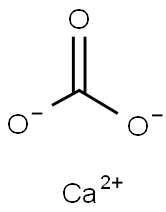
Another example is methane (CH₄), the primary component of natural gas, used for heating and cooking. Methane forms when one carbon atom bonds with four hydrogen atoms via covalent bonds, creating a nonpolar molecule that burns cleanly to produce CO₂ and water. Similarly, calcium carbonate (CaCO₃), found in limestone and eggshells, consists of calcium, carbon, and oxygen in a rigid lattice structure, giving it hardness and resistance to weathering.
The distinction between compounds and elements extends to their behavior in chemical reactions. Compounds can be broken down into simpler substances only through chemical changes (e.g., electrolysis of water into H₂ and O₂), while elements cannot be simplified further. For instance, rust (iron oxide, Fe₂O₃) forms when iron reacts with oxygen and water, demonstrating how elements combine to create new materials with different properties.
Ultimately, compounds are the building blocks of matter, enabling everything from biological processes to technological advancements. Whether it’s the silicon (Si) in computer chips or the caffeine (C₈H₁₀N₄O₂) in coffee, compounds define the materials and substances that sustain and enhance our daily lives.
Carbon dioxide (CO₂) is a compound we encounter frequently. We exhale CO₂ as a by - product of cellular respiration. It is also the gas responsible for the fizz in carbonated beverages. When CO₂ is dissolved in water under pressure, it forms carbonic acid, which gives sodas their characteristic tang. Ethanol (C₂H₅OH), the active ingredient in alcoholic beverages, is a compound made from the fermentation of sugars by yeast. It is used not only in drinks but also as a solvent in various industries and as a fuel additive.
To understand how elements combine to form compounds like water, we need to look at chemical bonding. Hydrogen has one valence electron, and its goal is to achieve a stable electron configuration, similar to that of helium, which has two electrons in its outer shell. Oxygen, on the other hand, has six valence electrons and aims to have eight electrons in its outer shell to follow the octet rule. In a water molecule, each hydrogen atom shares its single electron with the oxygen atom through a covalent bond. Oxygen shares two of its electrons, one with each hydrogen atom. This sharing of electrons allows both hydrogen and oxygen to achieve stable electron configurations. The covalent bond in water is polar because oxygen is more electronegative than hydrogen. This means that oxygen attracts the shared electrons more strongly, resulting in a partial negative charge on the oxygen atom and partial positive charges on the hydrogen atoms.
Compounds are distinctly different from elemental substances. Elemental substances consist of only one type of atom. For example, pure iron (Fe) is made up entirely of iron atoms. These atoms are held together by metallic bonds, which give iron its characteristic properties such as high thermal and electrical conductivity, malleability, and ductility. Oxygen gas (O₂) is an elemental substance where two oxygen atoms are covalently bonded to form a molecule. Elements in their pure form retain their individual chemical and physical properties.
In contrast, compounds are formed by the chemical combination of two or more different elements in a fixed ratio. The properties of compounds are often entirely different from those of their constituent elements. Take sodium chloride again. Sodium is a highly reactive metal that can explode when in contact with water, and chlorine is a toxic gas. However, when they react and form sodium chloride, the resulting compound is a stable, edible solid that we use every day. The bonding in sodium chloride is ionic. Sodium donates its valence electron to chlorine, forming a sodium ion (Na⁺) and a chloride ion (Cl⁻). The strong electrostatic attraction between these oppositely charged ions creates the ionic bond.
Another example is glucose (C₆H₁₂O₆), a compound that serves as an important energy source in living organisms. Carbon, hydrogen, and oxygen combine in specific ratios to form glucose, and its properties, such as its solubility in water and its ability to be metabolized by cells, are very different from the properties of carbon, hydrogen, and oxygen in their elemental forms. This illustrates how the formation of compounds through chemical bonding gives rise to a vast array of substances with unique characteristics that are essential for life and various human activities.