


 Home
Home
Hi, I'd like to ask—How can I make coconut oil at home? What kind of coconuts are most suitable for making oil? Do I need to make coconut milk first, and if yes, how? What is the method to separate fat from coconut milk to get the oil? How long can homemade coconut oil be stored and how to preserve it properly? Thanks!
How can I make coconut oil at home by extracting fat from coconuts in simple steps?
Related Encyclopedia
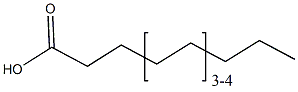
- 8001-31-8
- N/A
- 0
- All (37)
- China (5)
- (37)
- 61788-47-4
- C19H21NO5
- 0
- All (8)
- China (0)
- (8)
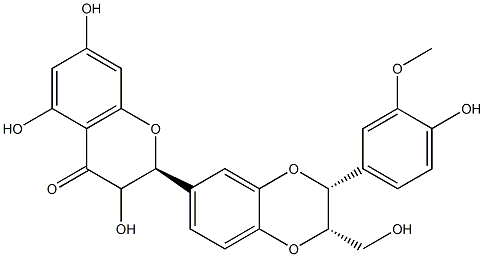
- 84604-20-6
- C25H22O10
- 482.43618
- All (10)
- China (0)
- (10)
Related Products More >

- 29908-03-0
- CNY Request For Quotation
- CNY Request For Quotation
- CNY Request For Quotation
- CNY Request For Quotation
- CNY Request For Quotation
- CNY Request For Quotation
- 7446-20-0
- Request For Quotation
- 7446-19-7
- USD 10.0000
- 25kg


Next, separate the fat. Put the milk in an airtight container. Let it sit at room temperature 12–24 hours or refrigerate 6–8 hours. The fat rises as a creamy layer. Skim that off, put it in a heavy pan, and heat on low. Stir occasionally to melt the fat and evaporate water—about 20–30 minutes, until clear and light golden. Strain through a fine sieve, cool completely.
Store homemade coconut oil in a clean, dry glass jar with a tight lid. Keep it away from sunlight and heat. It lasts 6–12 months. Room temperature is fine, but refrigerate in warm places to keep it solid. It may solidify when cold—just let it warm up to melt. Use a clean spoon to avoid bacteria, which shortens shelf life.
Start by extracting the white meat after cracking the coconut. Grate it finely, then mix with warm water—about a cup for every two cups of grated meat. Let it sit a few minutes, then strain through a cloth to get the milk. The warmth helps release more fat, a little trick I picked up from testing different methods.
Leave the milk in a cool place overnight. The fat rises as a solid layer, which you can scoop out. Heat it gently to melt, then strain again to remove any bits. This simple separation relies on fat’s lower density, a basic principle I find fascinating.
Stored in a sealed jar away from light and heat, it lasts six to eight months. I keep mine in a dark cupboard; it stays fresh, and the solid form makes it easy to use in recipes.
To begin the process, you'll need to extract coconut milk first, as this serves as the foundation for oil production. Start by cracking open the coconut and grating the white flesh using a box grater or food processor. Place the grated coconut in a bowl and cover it with warm water (not hot, about body temperature). Let it soak for 10-15 minutes to soften the fibers. After soaking, place the coconut in a cheesecloth or fine-mesh strainer and squeeze firmly to extract the milk. For richer milk, you can repeat this process with fresh warm water, though each subsequent press will yield a thinner liquid. The first press contains the most oil and nutrients.
Now comes the crucial step of separating the oil from the coconut milk. There are two primary methods: the traditional fermentation method and the heat-based method. For fermentation, let the freshly extracted milk sit at room temperature for 24-48 hours uncovered. During this time, natural separation occurs, creating three distinct layers: a thick cream on top, water in the middle, and curds at the bottom. Carefully scoop off the cream layer and gently heat it in a pan over low heat, stirring constantly. As the water evaporates, the oil will separate and rise to the surface. Strain through a fine cloth to remove any solids.
Alternatively, you can use direct heat. Pour the coconut milk into a saucepan and heat over medium-low heat, stirring frequently to prevent burning. As the water content evaporates (you'll notice the liquid reducing), the oil will begin to separate and accumulate on top. Continue heating until all moisture has evaporated, leaving pure oil behind. Strain immediately to prevent any cooked flavors from developing.
Proper storage is essential for maintaining quality. Homemade coconut oil can last 6-12 months when stored correctly. Keep it in a tightly sealed glass jar, preferably in a cool, dark cabinet. For longer storage, refrigeration is recommended, though the oil may solidify at cooler temperatures. Always use clean, dry utensils when handling the oil to prevent contamination. The oil might change consistency with temperature fluctuations - becoming liquid in warm conditions and solid in cold ones - but this doesn't affect its quality. Avoid exposing it to direct sunlight or moisture, as these can accelerate spoilage. With proper care, your homemade coconut oil will maintain its beneficial properties and freshness for many months.
The separation of oil from coconut milk employs two primary methods. Thermal separation involves gentle heating to evaporate water while allowing triglycerides to rise as a distinct phase, which can be decanted or skimmed. This method leverages the difference in boiling points and densities between water and coconut oil. Alternatively, fermentation utilizes endogenous lipases and gravity separation over 24-48 hours, producing a semi-solid oil layer at the surface. Both methods align with fundamental organic chemistry concepts of immiscible liquid separation and phase behavior.
Storage stability depends on oxidative stability, which is influenced by free fatty acid content and antioxidant presence. Properly processed homemade oil, stored in UV-resistant glass containers under nitrogen flushing if possible, maintains quality for 6-12 months at room temperature. Refrigeration slows oxidation but may promote crystallization, a reversible physical change. Recent research in food chemistry emphasizes the importance of minimal heat exposure during extraction to preserve lauric acid and other medium-chain triglycerides, which are sensitive to thermal degradation. Industrial-scale processes often use vacuum distillation to further enhance purity, though this equipment is impractical for home use. The chemical composition of homemade oil typically shows higher moisture content than commercial refined varieties, necessitating stricter hygiene protocols during production to prevent microbial spoilage.