


 Home
Home
Global PVC markets are drowning in oversupply as Asian factories keep pumping out product despite weak demand. With prices hitting rock bottom and trade wars distorting markets, is this just a temporary slump – or signs of a deeper structural collapse in the plastics industry?
PVC Prices Crash to 5-Year Lows – Is the Plastics Industry Heading for a Full-Blown Crisis?
Related Encyclopedia
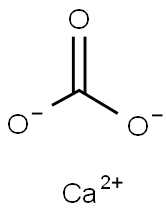
- 1317-65-3
- CCaO3
- 100.09
- All (868)
- China (56)
- (868)
- 792848-15-8
- CCaO3
- 100.08700
- All (868)
- China (56)
- (868)
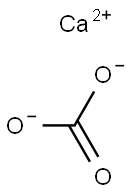
- 471-34-1
- CCaO3
- 100.0869
- All (868)
- China (56)
- (868)

- 22537-15-1
- Cl
- 35.45300
- All (0)
- China (0)
- (0)
- 32745-17-8
- Cl2
- 71.93480
- All (3)
- China (3)
- (3)

- 7782-50-5
- Cl2
- 70.91
- All (3)
- China (3)
- (3)
- 39705-20-9
- Cl2
- 73.93180
- All (3)
- China (3)
- (3)
- 30680-79-6
- Cl2
- 69.93770
- All (3)
- China (3)
- (3)
- 12596-92-8
- Pb2
- 414.40000
- All (24)
- China (4)
- (24)

- 7439-92-1
- Pb
- 207.2
- All (24)
- China (4)
- (24)
Related Products More >

- 63231-66-3
- CNY Request For Quotation
- 632-51-9
- CNY Request For Quotation
- 632-51-9
- CNY Request For Quotation
- 632-51-9
- CNY Request For Quotation
- 96-45-7 Ethylene thiourea
- CNY Request For Quotation
- 9002-88-4
- Request For Quotation
- 143-24-8
- Request For Quotation
- 25322-68-3
- Request For Quotation


That's only a slight exaggeration. With prices at 5-year lows ($625/ton in Asia, $630/ton in the U.S.), the PVC industry is in serious trouble. Here's why:
1. Asia's Overproduction Disaster
Factories keep expanding while demand stagnates
Operating rates slashed as inventories pile up
Freight cost volatility makes exports even less profitable
2. India: The Wildcard
BIS certification delay to December offers temporary relief
But anti-dumping decision looms – could block cheap Asian imports
Monsoon season may spark September demand bounce (or not)
3. Europe's Survival Game
Smaller PVC plants shutting down (can't compete with Asian imports)
Germany's €500B infrastructure plan could help... eventually
Peace in Ukraine? Rebuilding boom might save the market
4. U.S. Losing Ground
Brazil tariffs killed a key export market (43% duty on U.S. PVC)
Housing slump crushing domestic demand
Now directly competing with Asia on price – and losing
The polyvinyl chloride (PVC) market is battling a perfect storm: sluggish demand, tariff wars, and a flood of new Asian capacity. Here are 8 critical factors reshaping the sector: BIS certification delays, Indian monsoon demand, Qatari exports, European consolidation, U.S.-Asia price wars, Brazilian tariffs, German infrastructure spending, and post-Ukraine reconstruction.
Asia’s Oversupply Crisis Deepens
With new Qatari (350k-ton/year) and Chinese plants coming online, PVC inventories are ballooning. Producers are slashing operating rates—some below 70%—to avoid a price collapse. Meanwhile, volatile shipping costs (up 18% YoY on Asia-Europe routes) are squeezing margins.
India: Hope or Hype?
India’s postponed BIS certification deadline (now Dec 2024) offers temporary relief, but traders fear post-certification price hikes. Monsoon-season infrastructure projects and festive stockpiling (+9% demand projected for Q3) could provide a short-term boost. However, the looming anti-dumping ruling (expected October 2025) threatens cheap East Asian imports—a key driver of India’s PVC affordability.
Europe’s Survival Strategy
High energy costs and Asian imports (now 30% of EU supply) are forcing Europe to consolidate. Analysts predict 2-3 plant closures by 2026, with smaller, non-integrated facilities at risk. Germany’s €500B climate infrastructure plan and potential Ukraine reconstruction contracts (if peace talks succeed) could revive demand—but not before 2026.
U.S. vs. Asia: Race to the Bottom
U.S. PVC prices (630/tonFOBHouston∗∗)nownearlymatchAsia’s(∗∗625/ton FOB), triggering cutthroat competition for Latin American markets. Brazil’s 43% anti-dumping duty on U.S. PVC (vs. 8.2% previously) has backfired, pushing importers toward pricier European or Middle Eastern suppliers.
PVC in Daily Life: From Pipes to Electric Cars
Beyond oversupply headlines, PVC’s real-world uses are evolving:
Construction: Pipes for Germany’s infrastructure boom.
Healthcare: Blood bags and tubing (India’s medical sector grows 12% annually).
EVs: PVC-based insulation for wiring in surging electric vehicle production.
What’s Next?
The Qatar facility’s September startup could flood Europe with cheap supply, while India’s anti-dumping decision may redraw global trade maps. One thing’s clear: PVC’s future hinges on who can bleed cash the longest.
However, India could offset some declines—its booming construction and infrastructure sectors may drive demand growth of 6-8% annually. Eight critical factors shaping the market are: (1) China’s export surge flooding markets, (2) high global inventory levels, (3) India’s domestic capacity expansions, (4) delayed U.S. Fed rate cuts stifling investment, (5) substitution by recycled plastics, (6) regional price wars, (7) logistical bottlenecks, and (8) environmental regulations favoring alternatives.
While a full-blown crisis looms if demand doesn’t rebound, India’s growth potential and potential production cuts by major manufacturers could stabilize prices. The industry’s future hinges on balancing supply discipline with emerging-market demand.