


 Home
Home
In the pharmaceuticals industry, we know propylene glycol is used, but exactly how does it function as a solvent for different drugs? Does its usage vary depending on whether it's for oral, topical, or injectable medications? And in cosmetics, what are the specific benefits of propylene glycol for skin and hair products? How does it interact with other ingredients in a formula to enhance product stability? Also, are there any potential side - effects of using propylene glycol in these industries, and how are they mitigated?
Exploring the Uses of Propylene Glycol: What Roles Does It Play in the Pharmaceuticals and Cosmetics Industries?
Related Encyclopedia
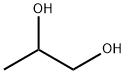
- 57-55-6
- C3H8O2
- 76.09
- All (326)
- China (55)
- (326)
- 26402-31-3
- C21H40O4
- 356.54000
- All (0)
- China (0)
- (0)
- 118624-10-5
- C9H18O7
- 238.23500
- All (0)
- China (0)
- (0)

- 53824-77-4
- C23H44O4
- 384.59300
- All (0)
- China (0)
- (0)
- 112071-94-0
- C9H16O5
- 204.22000
- All (0)
- China (0)
- (0)
- 31565-12-5
- C11H22O3
- 202.29058
- All (0)
- China (0)
- (0)

- 41395-83-9
- C21H40O4
- 356.54000
- All (0)
- China (0)
- (0)
- 25791-96-2
- HO(C3H6O)nCH[CH2(OC3H6)nOH]2
- 0
- All (4)
- China (2)
- (4)
- 64217-62-5
- C21H26N6O7S2
- 538.60000
- All (1)
- China (1)
- (1)

- 105-62-4
- C39H72O4
- 604.99
- All (1)
- China (0)
- (1)
Related Products More >

- CNY Request For Quotation
- CNY Request For Quotation
- CNY Request For Quotation
- 110-98-5
- CNY Request For Quotation
- 110-98-5
- CNY Request For Quotation
- 25322-69-4
- Request For Quotation
- 25322-69-4
- Request For Quotation
- 24800-44-0
- CNY 10.0000
- 25kg


For oral medications, propylene glycol can help create a stable, easy-to-swallow liquid form. It's also used in topical medications like creams and lotions, where it helps other ingredients blend smoothly and stay mixed together. And for injectable medications, it acts as a solvent and stabilizer, ensuring that the drug remains dissolved and potent until it's injected into the body.
In the world of cosmetics, propylene glycol is a real star. It's a humectant, which means it attracts and retains moisture. This makes it great for skin and hair products, where it keeps skin hydrated and soft, and hair smooth and shiny. It also boosts the effectiveness of other ingredients by helping them penetrate deeper into the skin. And because it can mix with both water and oil, it acts as a great emulsifier, keeping formulas stable and preventing them from separating.
Now, like any ingredient, propylene glycol has its potential side effects. Some people may experience skin irritation or allergic reactions. It's important for manufacturers to carefully test their products to make sure they're safe for most users. And for those with sensitive skin, it's always a good idea to check the ingredient list before buying a new product.
To mitigate these risks, companies often use propylene glycol in small amounts and combine it with other ingredients that can soothe and protect the skin. They also conduct rigorous safety testing to ensure that their products are safe for most users. And for those with concerns, there are always alternatives available that can provide similar benefits without propylene glycol. So, while it's a valuable ingredient, it's important to use it responsibly and consider everyone's unique needs.
When it comes to topical medications, propylene glycol does a couple of cool things. It helps the drug penetrate the skin more effectively. Think of it like a little helper that clears the way for the medicine to get to where it needs to go. And it also acts as a humectant, which means it helps keep the skin hydrated. This is great for things like ointments and creams.
Now, injectable medications are a bit more tricky. Propylene glycol has to meet really strict purity standards here. In injectables, it's used to dissolve drugs that might not dissolve well in water, but it has to be done carefully. The amount used in injectables is very precisely controlled because you're putting it directly into the bloodstream.
Moving on to cosmetics. For skin products, propylene glycol is amazing. It helps the product feel smooth and spread evenly on the skin. It also helps other ingredients, like vitamins and antioxidants, penetrate the skin better. This means that the benefits of those ingredients can be fully realized. In hair products, it can help keep the hair moisturized. It's especially useful in things like shampoos and conditioners where it can prevent the hair from drying out.
As for how it interacts with other ingredients in a formula to enhance product stability, propylene glycol has a unique chemical structure. It can form hydrogen bonds with other molecules in the formula. This helps keep everything mixed together and prevents the product from separating. It's like the glue that holds the formula together.
Now, the big question: are there any potential side - effects? Well, some people might be sensitive to propylene glycol. In the cosmetics industry, it can sometimes cause skin irritation in people with very sensitive skin. In the pharmaceuticals industry, if the wrong amount is used in injectables, it could potentially cause problems. But overall, when used correctly, the benefits far outweigh the risks. To mitigate the side - effects, in cosmetics, companies do a lot of testing on different skin types. And in the pharmaceuticals industry, strict quality control measures are in place to ensure the right amount is used in each formulation. So, while there are potential side - effects, the industries have ways to deal with them.
When it comes to different types of medications, its usage does vary. For oral medications, propylene glycol can help in the formulation of syrups or suspensions. It makes the drug more palatable and easier to swallow. In topical medications, it helps the active ingredients spread evenly over the skin. And for injectable medications, propylene glycol is often used because it's compatible with the body's fluids to some extent and can help maintain the drug's stability during injection.
In cosmetics, propylene glycol has several benefits for skin and hair products. For the skin, it's a humectant, which means it attracts moisture from the air and helps keep the skin hydrated. It also helps other ingredients penetrate the skin more effectively. In hair products, it can make the hair shaft smoother and add shine.
It interacts with other ingredients in a formula to enhance stability. It can prevent some ingredients from separating or degrading. For example, it can act as a stabilizer for certain oils or active compounds, keeping the product's texture and effectiveness intact over time.
However, there are potential side - effects. Some people may be sensitive or allergic to propylene glycol, which can cause skin irritation or allergic reactions. To mitigate this, manufacturers often do patch tests on a small group of people before launching a product. Also, they carefully control the concentration of propylene glycol in the formula. In general, when used in appropriate amounts, the benefits usually outweigh the risks, and it remains a valuable ingredient in both industries.